
Key Takeaways
- An LMS is more than a course repository. It can support onboarding, upskilling, assessments, compliance, collaboration, and personalized learning.
- Most LMS myths come from outdated assumptions. Modern platforms can be scalable, easier to manage, mobile friendly, interactive, and adaptable to different industries.
- The right LMS depends on your goals. Organizations should evaluate features, learner needs, integrations, security, scalability, and expected outcomes rather than choosing a platform based on price alone.

With the rise of hybrid and blended learning, Learning Management Systems (LMS) have become essential tools for organizations, universities, and training providers. An LMS can support employee training, onboarding, compliance, assessments, and ongoing skill development from a centralized platform.
A study by Cryptex found that 41.7% of companies saved huge training costs by implementing an LMS while improving learner engagement, tracking compliance, and streamlining content delivery.
Despite wider adoption, misconceptions about LMS features, usability, and value continue across industries. Some decision-makers still assume that an LMS is expensive, difficult to manage, only stores courses, or replaces instructors.
Understanding these myths can help organizations make better LMS decisions and use digital learning to improve onboarding, upskilling, engagement, and performance tracking.
10 LMS Myths That Could Limit Your Training Success
Many organizations and educational institutions adopt learning management systems to support training, teaching, student learning, and academic management.
A corporate LMS helps organizations deliver training, manage learning content, assess employees, and track development, while a school LMS provides a structured way to deliver learning content, manage assignments, conduct assessments, and track student progress. However, outdated assumptions about these systems can prevent institutions from using them effectively.
Here are the most common LMS myths and the facts behind them.
Myth 1: Digital Learning Platforms Are Too Costly
Fact: A learning management software can be a scalable investment rather than a fixed high cost. Modern platforms offer different pricing and feature options, allowing organizations to choose an LMS based on their number of learners, training requirements, and growth plans.
The potential savings also extend beyond the software itself. A learning management system can reduce repetitive classroom training, administrative work, printed materials, and manual tracking.
Myth 2: LMS Implementation Is Complicated and Slow
Fact: Modern cloud based LMS platforms are designed to simplify implementation and administration. Organizations can centralize courses, enroll learners, automate routine tasks, and monitor progress without maintaining extensive on site infrastructure.
The growing LMS market also reflects increasing demand for accessible digital learning technology.
Read more: Top 7 LMS Implementation Problems
Myth 3: Employees Won’t Engage With the Platform
Fact: Employee engagement depends heavily on how learning is designed, not simply on whether an LMS software is used. Interactive assessments, short learning modules, gamification, mobile access, progress tracking, and relevant content can make training easier to consume and more useful.
Myth 4: Only IT Experts Can Manage an LMS
Fact: A learning management system does not need to be managed entirely by an IT team. Modern platforms typically provide intuitive administration tools that allow HR teams, trainers, L&D managers, and instructors to upload content, create assessments, enroll learners, and review reports.
IT may support integrations, security, and technical requirements, but everyday learning management can be handled by the teams responsible for training.
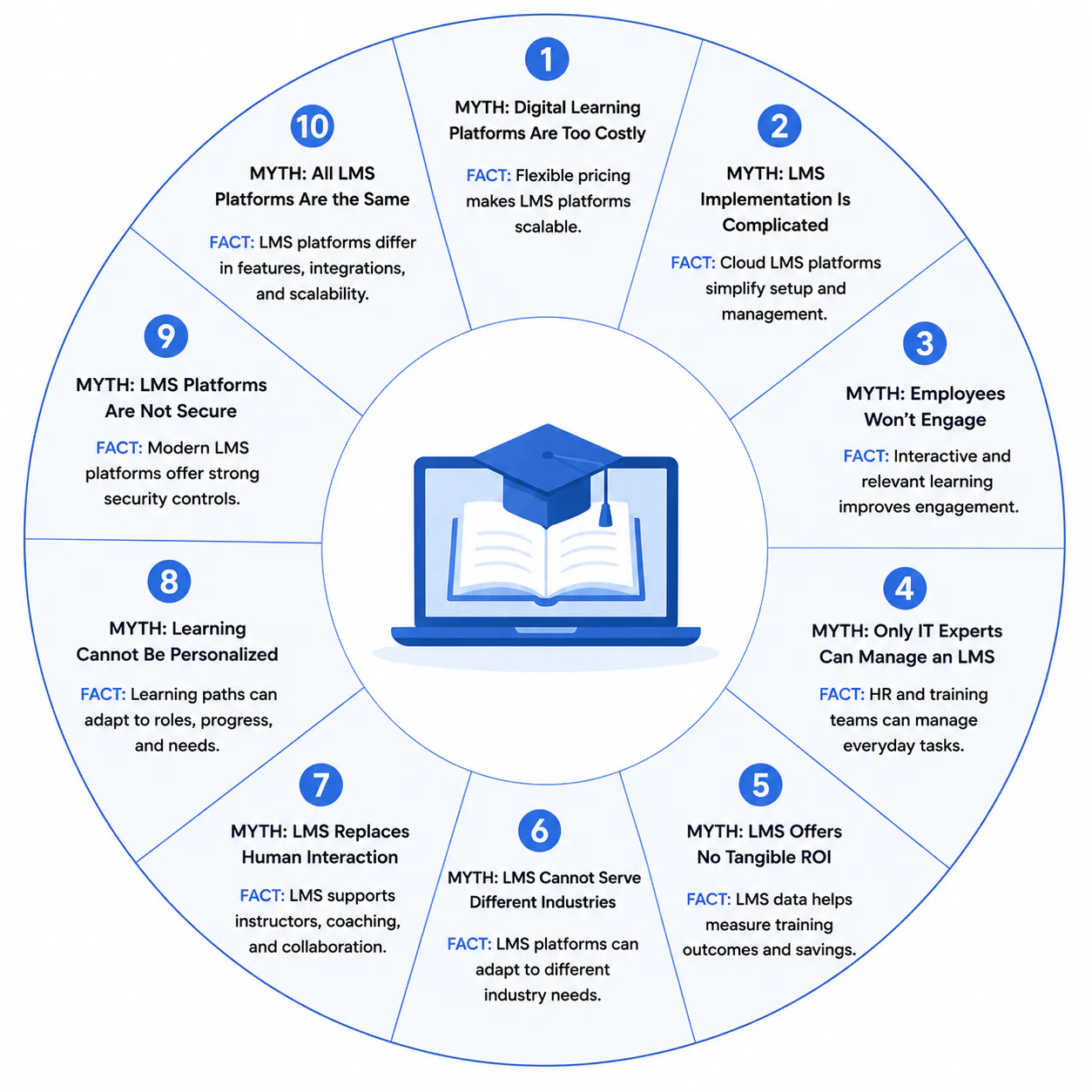
Myth 5: LMS Offers No Tangible ROI
Fact: The value of an LMS can be measured through training and business outcomes. Organizations can track completion rates, assessment performance, certification status, learner progress, and training participation.
An LMS can also reduce manual administration and make it easier to identify knowledge gaps.
Read more: The ROI of Learning and Development in Corporate Training
Myth 6: LMS Cannot Serve Industry Specific Needs
Fact: Modern LMS software can support different industries, learner groups, and training requirements. Organizations can structure learning around roles, departments, locations, compliance requirements, certifications, and skill development goals.
A corporate training program may focus on onboarding and compliance, while a university may need course management and assessments. A healthcare organization may prioritize certification and regulatory training. The platform needs to be configured around the learning model rather than forcing every organization into the same structure.
Myth 7: LMS Replaces Human Interaction
Fact: An LMS can support human led learning rather than replace it. Instructors can use digital courses alongside workshops, live classes, coaching, webinars, discussions, and collaborative activities.
Social learning features can also allow employees or students to ask questions, exchange knowledge, and learn from their peers. The technology provides the infrastructure, while instructors and trainers continue to provide context, guidance, and interaction.
Myth 8: Learning Cannot Be Personalized
Fact: Learning management systems can personalize learning based on learner progress, role, performance, and training requirements. Instead of giving every learner exactly the same path, organizations can assign different courses, assessments, or learning resources based on individual needs.
AI and learning analytics can further support this approach by identifying knowledge gaps and recommending relevant learning content.
Myth 9: LMS Platforms Are Not Secure
Fact: Security depends on the LMS provider, configuration, integrations, and organizational practices. Reputable platforms can provide measures such as encryption, authentication controls, access permissions, backups, and security monitoring.
Organizations should still evaluate data protection, user access, hosting, compliance requirements, and integration security before selecting an LMS. Security should be treated as part of the buying decision rather than assumed to be guaranteed by the platform.
Myth 10: All Learning Management Systems Are the Same
Fact: LMS platforms can differ significantly in their features, usability, integrations, reporting, AI capabilities, customization, scalability, and learner experience.
One organization may need advanced compliance tracking, while another may prioritize course creation, assessments, payments, or cohort management. The right LMS should therefore be evaluated against the organization's learning goals, learner requirements, and long term growth rather than selected solely by price or feature count.
Conclusion
An LMS is more than a digital place to store training content. When implemented around actual learner and business needs, it can simplify training, improve engagement, support personalized learning, and make progress easier to measure. Understanding these myths helps organizations evaluate LMS platforms based on what they can actually deliver rather than outdated assumptions.
The right LMS should fit your learning goals, workforce, content, and growth plans. With the right platform and consistent management, digital learning can become a practical part of how organizations build skills and support long term performance.

