
Key Takeaways
- AI, analytics, and automation are reshaping LMS platforms by personalizing learning, tracking performance, and reducing administrative work.
- Mobile, microlearning, AR, and VR are expanding how learners access and experience education, supporting flexible and interactive learning environments.
- Modern LMS platforms connect learning, assessment, credentials, collaboration, and performance tracking within a single digital learning environment.
LMS technology in 2026 is shifting toward AI-powered personalization, immersive learning, digital credentials, connected platforms, microlearning, analytics, social learning, and automation. An LMS for education helps schools and universities deliver and manage learning, while a corporate LMS supports employee training and development, and training providers use LMS platforms to deliver structured programs to learners and organizations.
Remote education accelerated rapidly, and both sectors now use LMS platforms to close skill gaps created by automation, curriculum changes, and new workplace technologies. According to Grand View Research, the global learning management system market reached $24.05 billion in 2024 and will grow to $70.83 billion by 2030.
In this guide, you will learn the top trends shaping LMS technology in 2026, from AI-native platforms and immersive learning to skills taxonomies, analytics, and much more.
Top 10 LMS Trends In 2026 To Look Out For
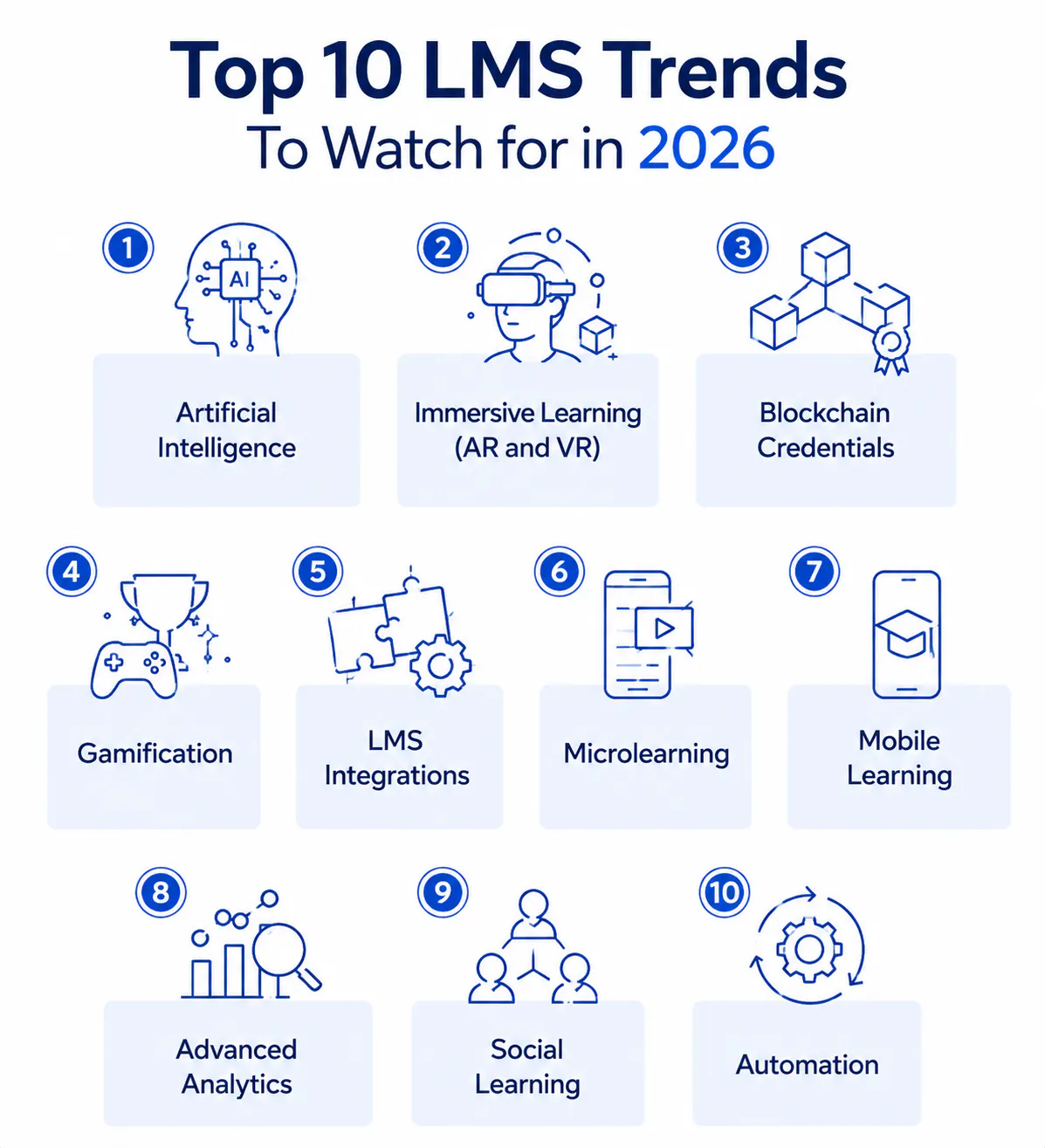
The learning management software landscape is evolving through AI, immersive learning, skills-based education, analytics, and automation. The 10 key LMS trends shaping learning technology in 2026 are:
- Artificial Intelligence
- Immersive Learning (AR and VR)
- Blockchain Credentials
- Gamification
- LMS Integrations
- Microlearning
- Mobile Learning
- Advanced Analytics
- Social Learning
- Automation
1. Artificial Intelligence
AI-powered LMS platforms personalize learning, automate assessments, analyze learner behavior, and generate performance insights. Artificial intelligence is becoming part of course delivery, learner support, assessment, and administration.
- Adaptive Learning Paths: AI analyzes learner progress, assessment results, interaction data, and content completion to adjust learning paths. Advanced learners can move through familiar material faster, while learners with knowledge gaps can receive additional learning resources.
- Real-Time Guidance: AI-powered LMS systems can provide explanations, hints, recommendations, and feedback during learning activities.
- Predictive Insights: AI analyzes learner activity to identify patterns associated with disengagement, low performance, or incomplete courses.
- Dynamic Content Delivery: AI can recommend learning resources based on learner activity, performance, skills, and course requirements.
- Automated Assessments: AI can generate questions, evaluate responses, and provide feedback based on defined learning objectives.
Read more: AI Powered LMS Platform: How AI Enhances Learning Experiences?
2. Immersive Learning (AR and VR)
Augmented reality (AR) and virtual reality (VR) add simulated environments, interactive objects, and scenario-based practice to digital learning.
- Simulated Environments: VR can recreate technical, medical, engineering, manufacturing, and safety scenarios without requiring learners to perform initial practice in a physical environment.
- Augmented Guidance: AR can display instructions, labels, and visual information over physical environments.
- Interactive 3D Learning: 3D models can represent scientific, technical, medical, and engineering concepts that are difficult to understand through static text.
- Scenario-Based Training: Learners can practice decision-making and procedures through controlled simulations.
- Practical Skill Development: Immersive learning connects digital instruction with applied practice.
3. Digital Credentials And Blockchain
Digital credentials provide verifiable records of completed courses, acquired skills, certifications, and micro-credentials. Blockchain is one technology that can support credential verification through tamper-evident records.
- Verifiable Certificates: Digital credentials provide evidence of course completion and certification.
- Portable Records: Learners can store and share credentials across employers, institutions, and professional platforms.
- Automated Verification: Digital credential systems allow organizations to verify qualifications without relying entirely on manual document checks.
- Skills-Based Records: Credentials can represent individual competencies rather than only complete academic programs.
- Micro-Credentials: Short courses and individual skill achievements can be recorded separately and combined into broader learning pathways.
Read more: Future of eLearning
4. Gamification
Gamification adds points, badges, challenges, progress indicators, and other game-based elements to learning activities. LMS platforms use these features to support participation and course engagement.
- Achievements And Badges: Learners receive recognition for completing courses, assessments, or learning milestones.
- Leaderboards: Rankings introduce competitive elements to cohort and team-based learning.
- Learning Challenges: Scenario-based activities turn course concepts into structured challenges.
- Progress Tracking: Completion bars, milestones, and achievement systems make learning progress visible.
- Collaborative Activities: Gamified projects and group challenges combine individual learning with peer participation.
5. LMS Integrations
LMS integrations connect learning platforms with systems used for identity management, communication, human resources, content delivery, payments, and assessment. Connected systems reduce the need to manage learner information across isolated platforms.
Common LMS integrations include:
- HRIS: Employee roles, departments, and organizational information can connect with training assignments.
- Single Sign-On (SSO): Learners can access the LMS through existing organizational identity systems.
- Video Conferencing: Live classes can connect with platforms used for virtual meetings and instruction.
- Payment Systems: Course fees and online payments can connect with learning enrollment.
- Content Systems: External libraries and learning resources can connect with course delivery.
- APIs: Application programming interfaces allow LMS platforms to exchange data with other software.
- LTI, SCORM, And xAPI: Learning technology standards support interoperability, content delivery, and learning activity data.
6. Microlearning
Microlearning delivers short learning units focused on a specific concept, task, or skill. The format supports learners who require focused learning activities within academic or professional schedules.
- Short Modules: A microlearning unit focuses on one concept rather than an entire course.
- Flexible Access: Learners can complete individual activities between work, classes, or other responsibilities.
- Stackable Credentials: Multiple short learning units can contribute to a broader credential or certification.
- Rapid Updates: Instructors can update individual learning units without restructuring an entire course.
- Continuous Learning: Short learning activities support ongoing professional development and skills development.
Read more: How Microlearning Is Changing the Way We Learn in 2026?
7. Mobile Learning
Mobile learning allows learners to access courses, assessments, notifications, and learning resources through smartphones and tablets. Mobile access extends LMS delivery beyond desktop computers and fixed classroom environments.
- Responsive Interfaces: LMS content adapts to different screen sizes and device types.
- Offline Access: Downloadable content allows learners to continue selected learning activities without continuous internet access.
- Notifications: Mobile alerts can notify learners about courses, assessments, deadlines, and feedback.
- Accessibility: Mobile interfaces can support features such as text resizing, voice input, and assistive technologies.
- Flexible Learning: Mobile access supports students and professionals who learn across different locations and schedules.
Read more: Top 5 Types of Learning Management Systems
8. Advanced Learning Analytics
Learning analytics convert learning management software activity data into information about learner engagement, completion, performance, skills, and course effectiveness. Administrators and instructors can use these data to identify learning patterns and support decisions.
- Instructor Dashboards: Reports can display completion rates, assessment performance, engagement, and learner activity.
- Behavior Analysis: LMS data can identify content interactions, assessment attempts, inactive periods, and areas of difficulty.
- Predictive Insights: Statistical and AI-based models can identify patterns associated with learner performance.
- Curriculum Optimization: Learning data can reveal which lessons, assessments, or resources require improvement.
- Training ROI: Organizations can compare training participation, completion, performance, and business outcomes.
Read more: 7 key LMS metrics you should track but are missing
9. Social Learning
Social learning uses discussion, collaboration, peer feedback, and knowledge sharing to extend learning beyond individual course activities. Learning management software can integrate community features directly into structured learning environments.
- Discussion Forums: Learners can ask questions, discuss course topics, and share experiences.
- Peer Feedback: Students and employees can review work and provide structured feedback.
- Collaborative Projects: Group assignments connect learning objectives with communication and problem-solving.
- Learning Communities: Cohorts can continue knowledge sharing outside individual lessons.
- Knowledge Sharing: Learners can contribute examples, experiences, questions, and solutions related to course topics.
10. Learning Automation
LMS automation reduces repetitive administrative work across enrollment, assessment, scheduling, notifications, certification, and learning workflows. Automation allows institutions and organizations to apply predefined rules to recurring learning activities.
- Automatic Enrollment: Learners can be assigned courses based on role, department, cohort, program, or training requirements.
- Scheduled Content Release: Lessons and assessments can become available according to predefined schedules.
- Automated Assessment: Objective assessments can be graded automatically and linked to learner results.
- Notifications: Automated reminders can support deadlines, incomplete courses, assessments, and certifications.
- Workflow Management: Repetitive learning administration can be handled through predefined rules and triggers.
Automation connects enrollment, content delivery, assessment, communication, certification, and administration within one LMS workflow.
What Are the Key LMS Priorities In 2026?
The main LMS priorities in 2026 are personalization, skills development, interoperability, learner analytics, accessibility, automation, and flexible content delivery.
AI connects learner data with personalized learning. Analytics connect activity data with performance decisions. Integrations connect LMS platforms with other enterprise and education systems. Microlearning and mobile learning support flexible access, while digital credentials connect learning achievements with skills and professional development.
How Should Organizations Evaluate An LMS In 2026?
Organizations should evaluate an LMS based on course management, assessment, learner management, analytics, integrations, accessibility, automation, security, scalability, and support for the learning model. Corporate training, K–12 education, higher education, and professional training can require different LMS capabilities.
Important evaluation criteria include:
- Course Management: Content creation, file management, video delivery, and structured learning paths.
- Assessment: Quizzes, assignments, grading, feedback, and performance tracking.
- Learner Management: Cohorts, groups, roles, enrollment, and permissions.
- Analytics: Learner performance, engagement, completion, and skills data.
- Integrations: HRIS, SSO, communication tools, payment systems, APIs, and learning standards.
- Mobile Access: Responsive learning across smartphones, tablets, and computers.
- Automation: Enrollment, notifications, assessments, scheduling, and certification workflows.
- Scalability: Capacity to support changing numbers of learners, courses, instructors, and programs.
Read more: 10 Essential Steps for Selecting an LMS for Your Business
What Does Quyl Offer?
Quyl LMS combines course creation, assessments, live learning, cohort management, analytics, mobile access, and fee management within one learning platform. These capabilities support educational institutions, training providers, and organizations managing structured learning programs.
- Flexible Course Creation: Create courses using videos, files, links, and other learning materials.
- Quizzes And Assessments: Create tests and assignments to evaluate learner understanding.
- Live Classes And Video Sessions: Deliver real-time classes and training through virtual learning sessions.
- Cohort And Group Management: Organize learners into groups and manage cohort-based learning.
- Mobile-Ready Learning: Access courses and learning activities across different devices.
- Analytics And Performance Tracking: Monitor learner progress, course activity, and performance data.
- Fee Management And Invoicing: Manage course payments, invoices, and related financial activities.
Conclusion
The major LMS trends in 2026 connect artificial intelligence, immersive learning, digital credentials, gamification, integrations, microlearning, mobile learning, analytics, social learning, and automation. These technologies are expanding LMS platforms from course repositories into connected learning environments that manage content, skills, assessment, learner data, and administrative workflows.
The strongest LMS strategy combines personalized learning, measurable outcomes, interoperable technology, flexible access, skills development, and automated administration. Organizations and educational institutions can use these capabilities to build learning environments that respond to changing curriculum requirements, workforce skills, learner behavior, and digital education models.

