
Key Takeaways
- The main difference between LMS and traditional learning is how learning is delivered. An LMS provides digital, flexible, and trackable learning through an online platform, while traditional learning depends on physical classrooms, fixed schedules, and face to face teaching.
- LMS supports digital tools such as automated assessments, progress tracking, and multimedia content, while traditional learning relies more on direct teaching and manual assessment.
- Both methods support learning in different ways. LMS offers flexibility and digital access, while traditional learning provides structured classroom interaction and direct teacher support.

A Learning Management System (LMS) and traditional learning differ mainly in how learning is delivered, accessed, managed, and measured.
Traditional learning depends on physical classrooms, scheduled teaching, and face-to-face interaction, while an LMS provides digital, flexible, and trackable learning through an online platform. UNESCO describes an LMS as a software platform that supports learning content, course management, communication, assessment, and learner progress tracking. Traditional instruction is generally structured around face-to-face, teacher-led teaching.
In this blog, you will get to know the key differences between LMS and traditional learning methods, including how they compare in terms of learning environment, accessibility, content delivery, assessment, learner interaction, progress tracking, and scalability.
What Is the Difference Between LMS and Traditional Learning Methods?
The main difference between an LMS software and traditional learning methods is that traditional learning depends on physical classrooms, scheduled teaching, and face to face interaction, while an LMS provides digital, flexible, and trackable learning through an online platform.
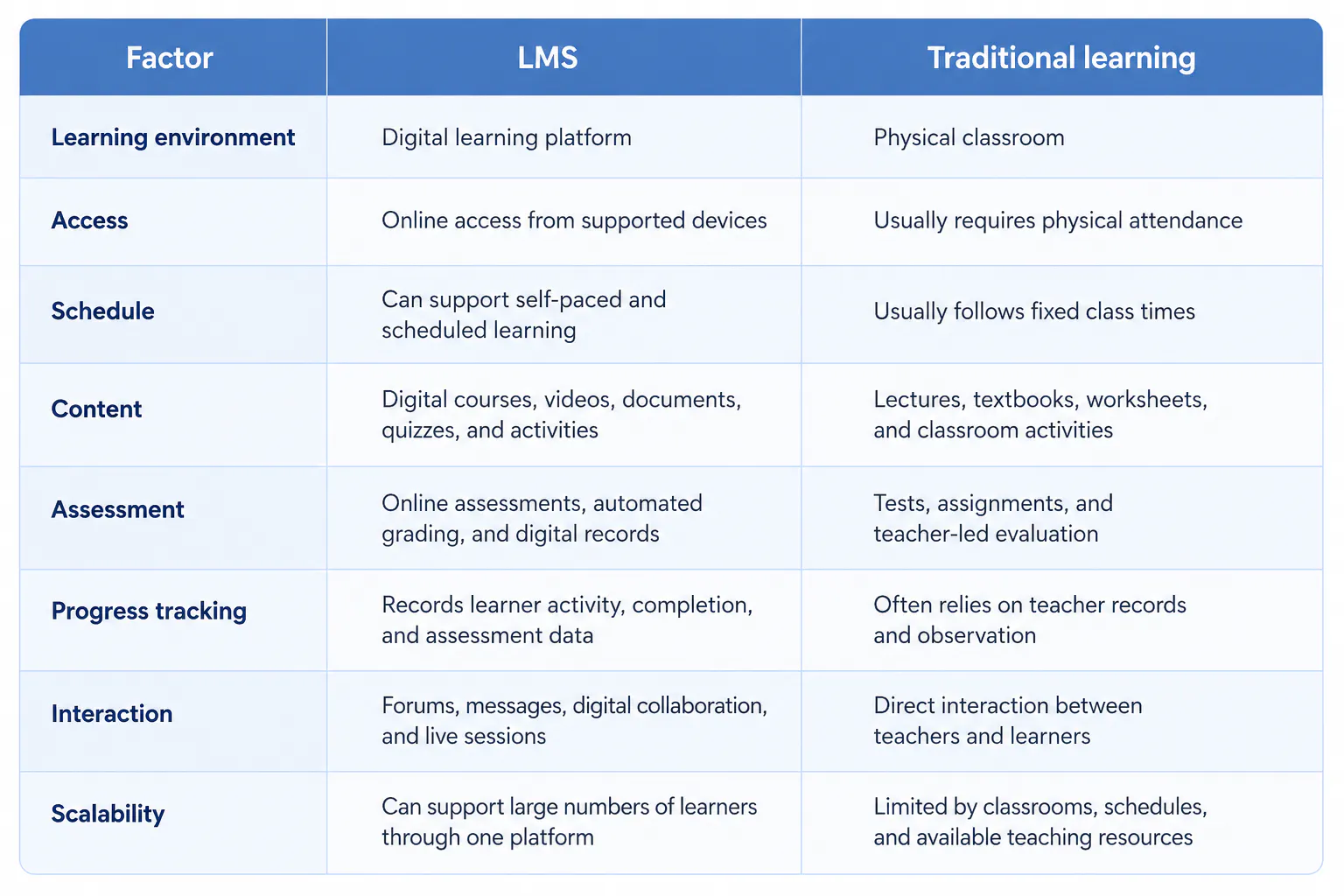
1. Learning environment
An LMS platform provides a digital environment where learners can access courses, learning materials, assessments, and activities through an online platform. Learning can take place remotely or alongside classroom instruction.
Traditional learning takes place in a physical classroom. Teachers deliver lessons directly, while learners participate through classroom discussions, activities, and face-to-face instruction.
2. Accessibility and flexibility
An LMS software allows learners to access digital learning materials from different locations and devices, depending on the platform and available connectivity. This supports online, remote, and self-paced learning.
Traditional learning generally requires learners to attend classes at a specific location and time. This creates a more fixed learning schedule.
Read more: Why Traditional Teaching Methods No Longer Engage Students?
3. Content delivery
A learning management system can bring courses, documents, videos, quizzes, assignments, and other digital resources together in one learning environment. Teachers can organize content into courses and modules and update digital resources when required.
Traditional learning commonly uses lectures, textbooks, written assignments, and classroom activities. These methods support direct teaching but depend more heavily on physical learning materials and classroom delivery.
4. Assessment and feedback
An online learning platform can support quizzes, assignments, automated grading, and digital assessment records. It can also store assessment results alongside other learner data, helping teachers review performance over time.
Traditional learning uses methods such as written tests, assignments, examinations, and classroom participation. Teachers provide direct feedback and evaluate work that requires individual judgment.
Read more: 8 Ways an LMS Increases Student Engagement
5. Interaction and collaboration
An LMS platform can support learner interaction through discussion forums, messaging, collaborative activities, and live online sessions. Online learning can also support synchronous and asynchronous interaction between learners and instructors.
Traditional learning provides direct interaction between teachers and learners in the same physical environment. Face-to-face communication can support relationships, peer interaction, and collaboration. OECD research highlights the continuing importance of in-person interaction for teacher and learner relationships and peer cooperation.
Read more: 10 Modern Learning Methods Transforming K-12 Education
6. Progress tracking
One of the main differences between an LMS and traditional learning is how learner activity is recorded.
A school learning management software can record course completion, assessment results, learning activity, and other learner data. Learning analytics can then be used to understand learner progress and identify areas where additional support may be required.
Traditional learning can also track attendance, assessments, and academic performance, but much of this information may depend on teacher records, observations, and separate administrative processes.
Read more: What Is LMS Analytics?
7. Scalability
An LMS can deliver the same course to multiple classes, groups, departments, or locations through one digital platform. This allows learning providers to increase the number of learners without requiring a corresponding increase in physical classroom space.
Traditional learning is more closely tied to available classrooms, teaching schedules, and instructors. Increasing learner numbers can therefore require additional physical resources.
LMS vs Traditional Learning: Which One Should You Use?
The choice depends on the learning requirements, learners, subject, teaching model, and available resources.
A learning management system is useful when learning requires flexible access, digital content, online assessment, learner progress tracking, or delivery across multiple groups and locations. Traditional learning remains important where direct teacher interaction, physical activities, classroom discussion, and structured face-to-face instruction are central to the learning experience.
The two approaches can also be combined. UNESCO recommends that digital learning platforms complement rather than replace in-person education and teachers.
Conclusion
LMS and traditional learning use different approaches to deliver and manage education. An LMS provides digital course delivery, flexible access, online assessment, learner data, and progress tracking. Traditional learning provides structured classroom instruction, direct teacher interaction, and face-to-face collaboration.
The right approach depends on the learning objectives and delivery requirements. In many cases, combining digital learning with face-to-face teaching can provide both technology-supported learning and direct human interaction.

