
Key Takeaways
- A Headless LMS separates the backend from the frontend, allowing organizations to manage learning centrally while delivering customized experiences across websites, apps, and portals.
- API-based architecture connects learning with the wider digital ecosystem, including HR systems, CRMs, analytics platforms, and business applications.
- Headless learning is best suited to organizations needing flexibility and scalability, particularly for embedded learning, multiple audiences, branded portals, and customized learner experiences.
A Headless LMS is a decoupled learning architecture that separates the learning management backend from the learner-facing frontend. This allows organizations to manage content, learner data, assessments, and reporting centrally while delivering learning through websites, mobile applications, employee portals, customer platforms, or other digital interfaces.
Traditional learning management platforms generally combine the management layer with a predefined learner interface. This works well for standardized training, but organizations with multiple audiences, digital products, or integration requirements may need greater control over how learning is delivered.
In this blog, you will get to know what is a headless LMS, its advantages, and key factors to consider when adopting one.
What Is A Headless LMS?
A Headless LMS is a learning platform in which the backend and frontend operate independently.
The backend acts as the central management layer for learning content, users, assessments, permissions, certifications, and reporting. The frontend is the environment learners interact with, such as a website, mobile application, employee portal, or customer-facing platform.
APIs connect these layers and allow learning information and functions to move between the central system and external applications.
This architecture gives organizations greater control over the learner experience while keeping learning content and administrative data centrally managed.
Key characteristics include:
- Decoupled architecture: The management layer and presentation layer operate independently.
- API-based connectivity: APIs allow learning data and functions to connect with external systems.
- Custom learner experiences: Organizations can design interfaces around different audiences and workflows.
- Multi-channel delivery: Learning can be delivered through websites, applications, portals, and digital products.
- Centralized learning management: Content, learner records, assessments, and reporting remain managed from a central environment.
How Does a Headless Learning System Work?
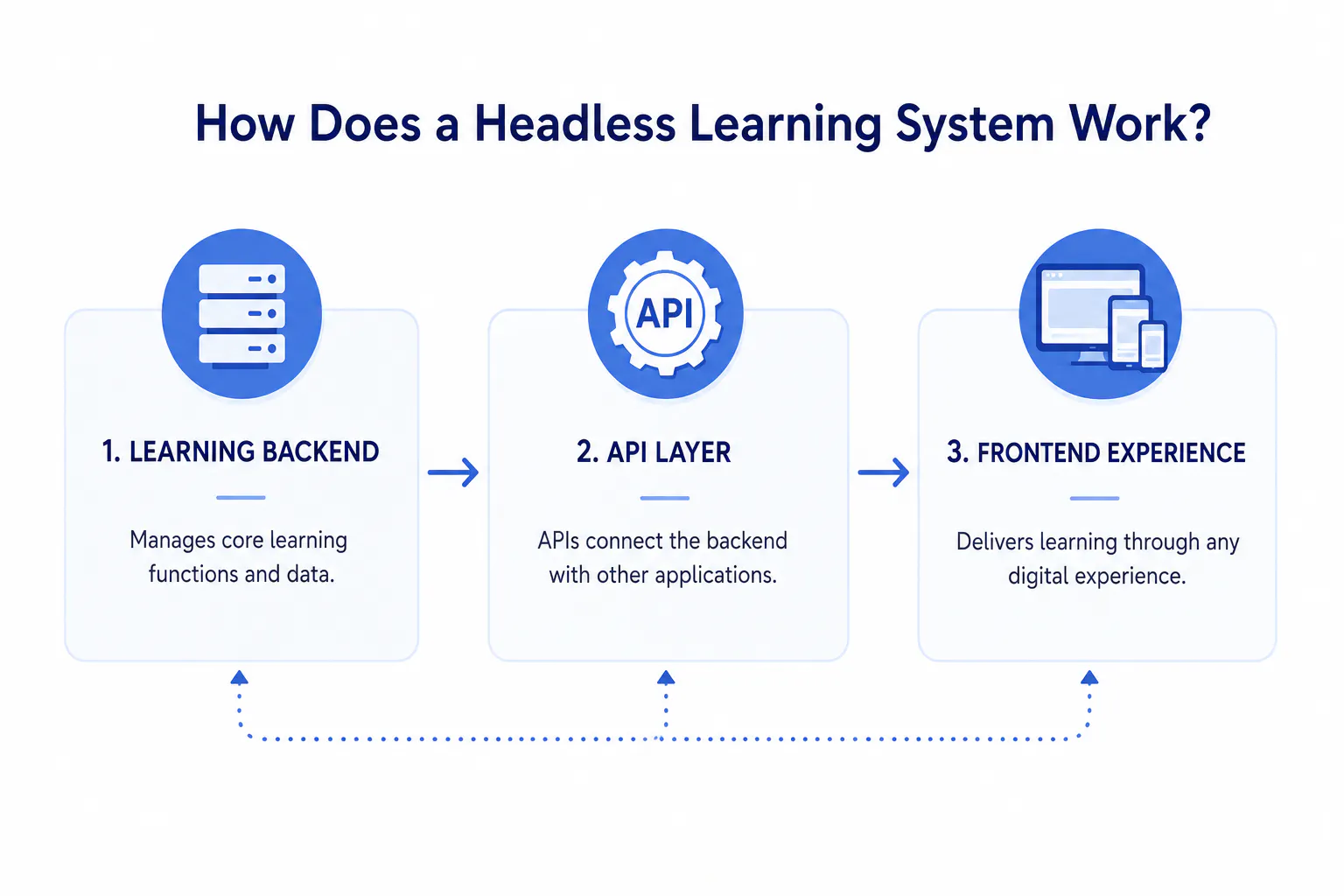
A Headless LMS generally consists of three connected components: the learning backend, API layer, and frontend experience.
- Learning backend: The backend manages the core learning functions, including content, users, assessments, learning paths, certifications, permissions, and performance data.
- API layer: APIs provide communication between the learning backend and external applications. They allow supported content, learner information, and learning functions to be accessed by connected systems.
- Frontend experience: The frontend determines how learners interact with training. It can be a branded website, mobile application, employee portal, customer platform, or another digital interface.
What Are the Limitations Of A Traditional LMS?
Traditional learning platforms remain effective for many organizations, particularly where standardized training and quick deployment are priorities. However, tightly connected architecture can create limitations when greater flexibility is required.
- Limited frontend control: Interface customization depends heavily on the platform's capabilities.
- Integration restrictions: Connecting external applications may require additional development or middleware.
- Less delivery flexibility: Learning is often centered around the platform's own interface.
- Customization constraints: Different audiences may have limited options for creating distinct learning environments.
- Platform dependency: Major interface or workflow changes can depend on vendor updates and available configuration options.
Read more: 10 Key Factors to Consider When Selecting an LMS
Why Are Organizations Using Headless LMS Architecture?
Organizations use Headless LMS architecture when learning needs to become part of a wider digital ecosystem rather than remain within a single training portal.
Custom Learning Environments
Organizations can create branded learning experiences for employees, customers, partners, or other audiences without changing the underlying learning management layer.
API-Powered Integrations
APIs can connect learning with HR systems, CRM platforms, content management systems, identity providers, analytics tools, and internal applications.
Contextual Learning Delivery
Training can be embedded into websites, applications, or digital products. For example, a software company can provide product education within its application instead of sending users to a separate training portal.
Multi-Audience Delivery
The same centralized learning infrastructure can support different frontend experiences for employees, customers, partners, distributors, or other learner groups.
Flexible Digital Architecture
Frontend experiences can evolve independently from the core learning environment. Organizations can introduce new interfaces, applications, or delivery channels without replacing the underlying learning management capabilities.
What Can a Headless Learning System Integrate With?
A Headless LMS can connect learning data and functionality with the wider technology environment through APIs and other integration methods.
Common connections include:
- HR systems: Synchronize employee information and training requirements.
- CRM platforms: Support customer and partner education.
- Identity systems: Manage authentication and access.
- Content platforms: Connect learning resources with existing content environments.
- Analytics systems: Combine learning activity with wider performance data.
- Websites and mobile apps: Deliver learning through customized digital experiences.
- Business applications: Embed training into existing workflows and products.
The purpose of these integrations is to make learning part of the organization's existing digital infrastructure rather than treating training as an isolated activity.
Read more: Types of Learning Management Systems
What Are the Challenges Of Adopting A Headless Learning System?
A decoupled architecture creates greater flexibility, but it also introduces additional technical and operational requirements.
Technical Expertise
Custom frontend development and API integration require technical knowledge. Organizations may need internal developers or an experienced implementation partner.
Security And Data Governance
Learning data can move between several connected systems. Authentication, authorization, encryption, access controls, and data governance therefore need to be considered across the entire learning ecosystem.
Ongoing Maintenance
Independent frontend and backend components require documentation, testing, monitoring, and coordination when systems change.
Higher Initial Development Requirements
Custom interfaces, integrations, and architecture planning can require more initial resources than deploying a standard learning platform interface.
Headless LMS Vs Traditional LMS
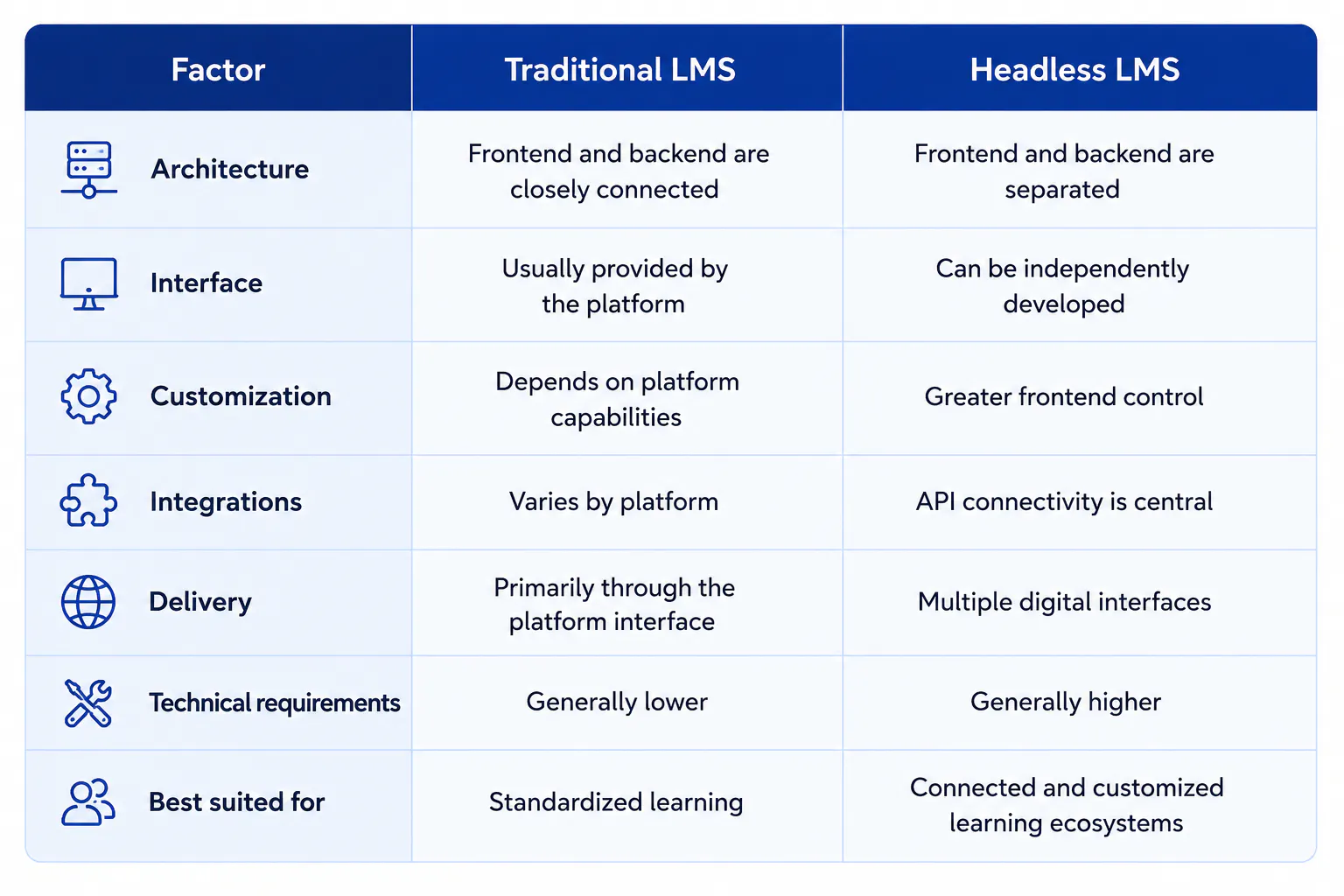
The primary difference is architectural. A traditional platform is often more practical when simplicity and speed are the primary requirements. A Headless LMS becomes more valuable when customization, integrations, embedded learning, or multi-channel delivery are important.
Read more: Headless LMS vs Traditional LMS: Key Differences Explained
Is a Headless LMS Right For Your Organization?
A Headless LMS is a strong fit when an organization needs custom learner experiences, multiple delivery channels, embedded learning, or extensive integration with existing technology.
A traditional learning platform may be more appropriate when the organization prioritizes rapid deployment, standardized training, lower technical requirements, and minimal customization.
The decision should be based on the organization's learning model, technical resources, integration requirements, audience structure, and desired level of frontend control.
Read more: How Corporate LMS Technology Supports Workforce Upskilling?
When Should You Choose a Headless Learning Platform?
Consider a Headless LMS if your organization:
- Operates multiple branded learning portals.
- Serves employees, customers, partners, or multiple learner groups.
- Needs different interfaces for different audiences.
- Embeds training inside products, websites, or applications.
- Requires integrations with HR, CRM, identity, or analytics systems.
- Wants to expand learning across multiple digital channels.
- Needs greater control over the learner-facing experience.
When Is a Traditional LMS The Better Fit?
A traditional learning platform can be the better choice when an organization:
- Needs rapid deployment.
- Has limited development resources.
- Delivers standardized training.
- Requires only a small number of integrations.
- Has minimal frontend customization requirements.
- Wants lower technical maintenance.
Conclusion
A Headless LMS separates the learning management backend from the learner-facing frontend, allowing organizations to centralize learning content and data while delivering customized experiences across different digital environments.
Its core value comes from the relationship between decoupled architecture, API connectivity, centralized learning management, and flexible delivery.
For organizations with standardized training requirements, a traditional LMS can provide a simpler implementation. For organizations that need embedded learning, customized portals, multiple learner experiences, or deeper system integrations, a Headless LMS provides greater architectural flexibility.
The right choice depends on where learning needs to be delivered, which systems need to connect with learning data, and how much control the organization requires over the learner experience.

