
TL;DR
- The development of LMS began with correspondence learning and early teaching machines before computer-based and networked learning systems emerged.
- EKKO, released in 1991, is identified in the provided historical source as the first fully featured LMS, followed by the growth of web-based LMS platforms in the 1990s and 2000s.
- Modern LMS platforms combine course management, assessments, analytics, mobile learning, AI, and personalized learning capabilities.

Learning Management Systems (LMS) evolved from correspondence education, teaching machines, computer-based instruction, and networked learning. Early systems focused on delivering instructional material and supporting self-paced learning. Modern LMS platforms manage courses, assessments, learner data, analytics, mobile learning, AI, and personalized learning.
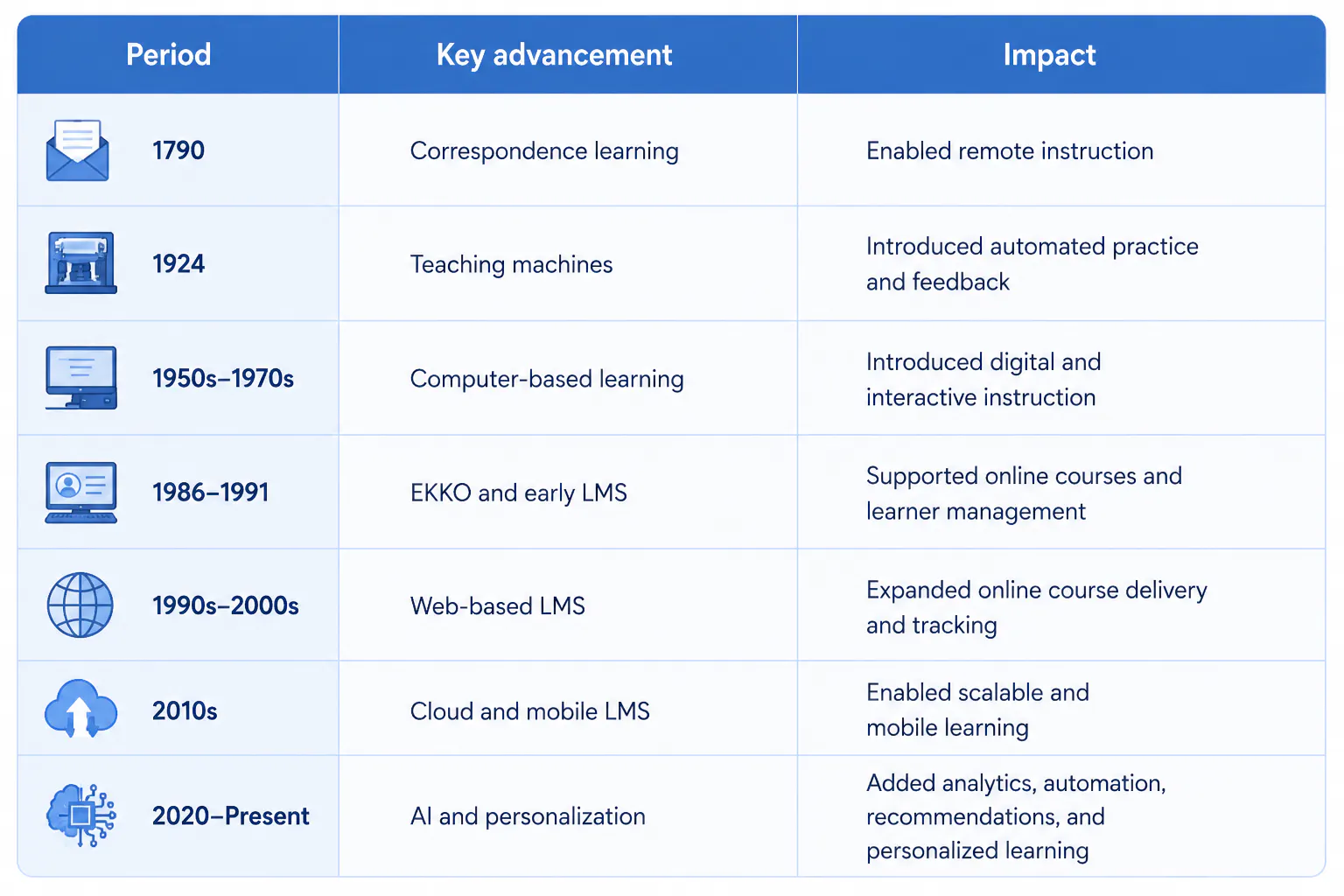
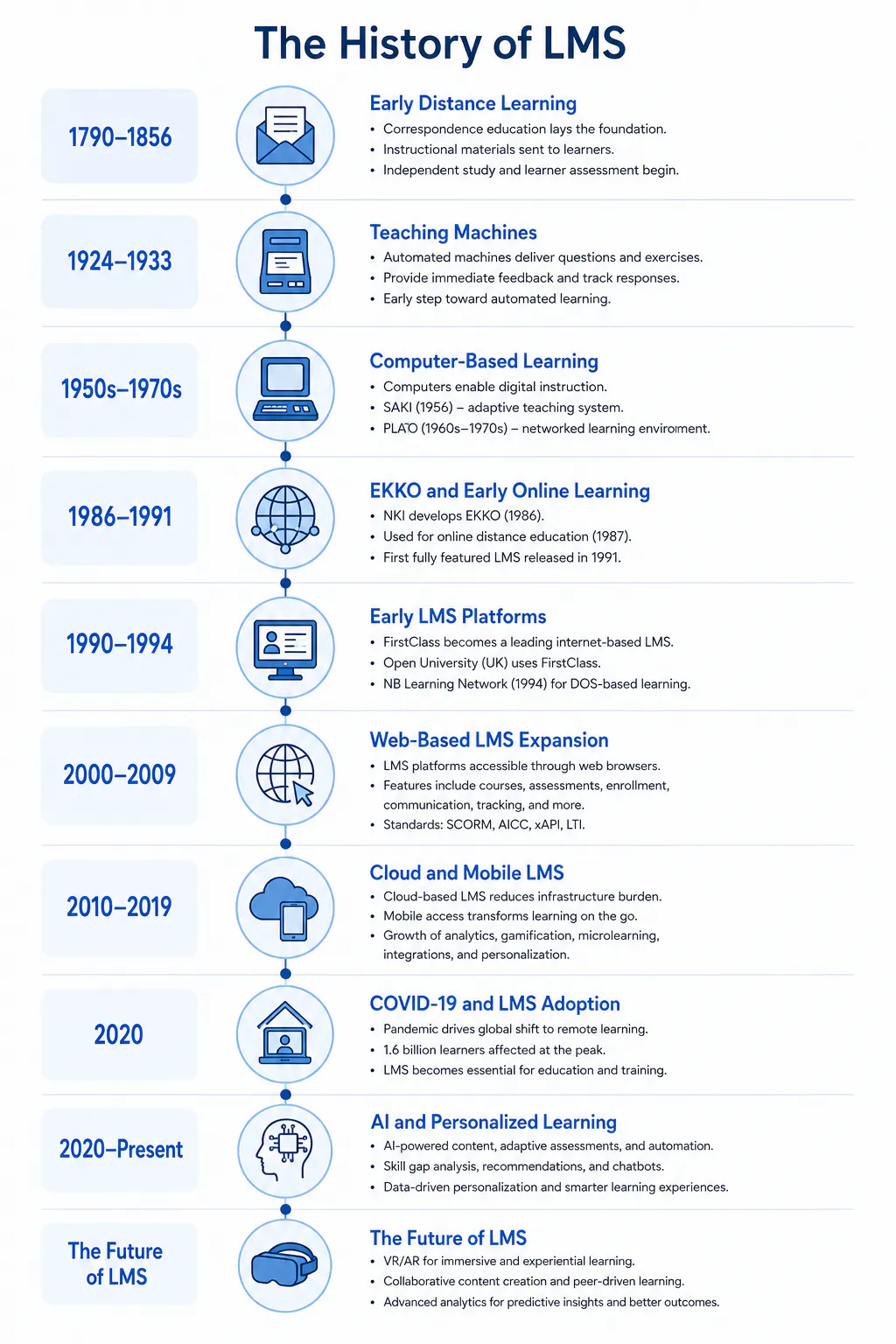
The history of LMS can be divided into key stages, from early distance education to computer-based learning, web-based LMS platforms, cloud learning, and AI-powered personalization.
In this article, you will get to know the history of LMS, highlighting its evolution from early course management systems to today’s advanced digital platforms that emphasize personalization, analytics, and interactive learning experiences.
History of Learning Management Systems (LMS)
LMS development occurred across several stages. Correspondence education established remote learning. Teaching machines introduced automated practice. Computer-based systems introduced digital instruction. Networked systems connected learners with learning resources. Internet-based LMS platforms later added course management, assessment, tracking, and analytics.
To learn more about what is an LMS, read our complete guide.
1790–1856: Early Distance Learning
The foundations of modern LMS platform began with distance education. Learners could receive instructional material without attending a physical classroom.
- 1790: Caleb Phillips advertised correspondence teaching through the Boston Gazette. The teaching model provided instructional material to learners remotely.
- 1840: Isaac Pitman introduced a correspondence shorthand course in England. Students received learning material, completed exercises, and returned their work for review.
- 1843: The success of Pitman's course contributed to the formation of the Phonographic Correspondence Society.
- 1856: Charles Toussaint and Gustav Langenscheidt established an early distance-learning institution for language education.
Correspondence education established remote instruction, independent study, and learner assessment as important elements of distance learning.
1924–1933: Teaching Machines
Teaching machines introduced automated exercises and feedback before computer-based learning became available.
- 1924: Sidney L. Pressey developed a teaching machine that presented questions and exercises to learners.
- 1933: M.E. Zerte developed a problem cylinder based on Pressey's work. The system could compare problems and solutions.
Teaching machines were not LMS platforms. The technology introduced automated learning activities and assessment, which later became important components of computer-based learning.
1950s–1970s: Computer-Based Learning
The development of computers created new methods for delivering digital instruction.
- 1956: Robin McKinnon Wood and Gordon Pask developed SAKI, an adaptive teaching system designed for corporate training.
- 1960s: The PLATO system developed at the University of Illinois as a computer-based learning system.
- 1970s: PLATO expanded as a networked learning environment. Learners could access instructional content and communicate through connected computer systems.
Computer-based learning moved education beyond printed material and mechanical teaching devices. Learners could interact with digital instructional content and receive automated responses.
Read more: 10 Learning Management System (LMS) Trends to Watch in 2026
1986–1991: EKKO and Early Online Learning
Networked computers created new possibilities for online distance education.
- 1986: Norway's NKI Distance Education Network developed EKKO.
- 1987: NKI began using EKKO for online distance education. The system supported learning material, assignments, communication, and learner interaction.
- 1991: The provided historical source identifies EKKO as the first fully featured LMS released in 1991.
EKKO marked an important development in online learning because the system combined learning material with course activities and communication.
1990–1994: Early LMS Platforms
The 1990s established LMS platforms as dedicated systems for online learning.
- 1990s: FirstClass became one of the early internet-based LMS platforms. The UK's Open University used FirstClass during the 1990s and 2000s to support online learning.
- 1994: The NB Learning Network introduced a similar system for DOS-based teaching and business learners.
Early LMS platforms increasingly combined course delivery with learner management, communication, assessment, and progress tracking.
Read more: Future of eLearning
2000–2009: Web-Based LMS Expansion
Internet adoption expanded LMS use across education and corporate training.
2000s: Web-based LMS software allowed teachers, trainers, and learners to access courses through web browsers.
LMS capabilities expanded to include:
- Course creation and management
- Digital content delivery
- Online assessments
- Learner enrollment
- Discussion forums
- Progress tracking
- Synchronous learning
- Asynchronous learning
- Learning analytics
SCORM: The standard supported interoperability between compatible learning content and LMS platforms.
Other learning technology standards included AICC, xAPI, and LTI.
The LMS solution developed from a digital course delivery system into a platform for managing multiple parts of the learning process.
Read more: 10 Learning Management System Myths You Should Stop Believing
2010–2019: Cloud And Mobile LMS
Cloud computing changed LMS deployment.
Cloud-based LMS: Vendors hosted the LMS infrastructure and provided access through the internet.
Organizations could use LMS platforms without managing all server infrastructure internally.
Mobile devices also changed how learners accessed courses.
Mobile LMS: Smartphones and tablets provided another channel for accessing learning content, assessments, and learner progress.
During the 2010s, LMS platforms increasingly included:
- Cloud-based delivery
- Mobile access
- Learning analytics
- Gamification
- Microlearning
- Automated assessments
- System integrations
- Personalized learning features
Learning analytics became an important LMS function. Platforms could record course completion, assessment performance, attendance, participation, and learner activity.
Read more: Cloud LMS vs On-Premise LMS
2020: COVID-19 And LMS Adoption
The COVID-19 pandemic significantly increased reliance on online learning.
2020: School closures disrupted physical education across countries and increased the need for remote learning systems.
UNESCO reported that school closures affected approximately 1.6 billion learners worldwide at the peak of the pandemic.
Schools, universities, and organizations used LMS platforms to deliver courses, distribute learning material, conduct assessments, communicate with learners, and monitor learning activity.
The pandemic increased the importance of digital learning infrastructure for remote and blended education.
2020–Present: AI And Personalized Learning
Modern LMS platforms combine traditional learning management functions with artificial intelligence, learner data, and automation.
- AI-powered content generation: AI can help create or adapt learning material according to defined requirements.
- Personalized learning paths: Learner progress, skills, and learning requirements can inform course sequences and learning recommendations.
- Adaptive assessments: Assessment activities can adjust according to learner performance where the LMS supports adaptive functionality.
- Skill gap analysis: Learning data can identify areas that require additional training.
- Automated grading: Supported assessment types can be evaluated automatically, providing faster results.
- AI tutors and chatbots: AI-based assistants can provide automated responses and learner support.
- Learning recommendations: LMS platforms can recommend courses and learning resources using learner data.
- Learning analytics: LMS platforms can measure completion, participation, assessment performance, and learner activity.
- Mobile learning: Learners can access learning activities through smartphones and tablets.
- System integrations: LMS platforms can connect learning data and workflows with education, HR, business, and productivity systems.
AI has expanded the role of LMS beyond course administration and content delivery. Modern platforms can use learner data to support personalization, automation, and learning recommendations.
The Future of LMS
The next phase of LMS promises immersive, learner-driven experiences:
- Virtual and Augmented Reality (VR/AR): Create realistic simulations for skill practice and experiential learning.
- Collaborative Content Creation: Learners and instructors generate and share content, fostering peer-driven learning.
- Advanced Analytics: Predictive insights help optimize learning paths, identify skill gaps, and improve outcomes.
According to the 2022 PwC US Metaverse Survey, more than 50% of organizations have integrated VR into their learning strategies, signaling the growing impact of immersive technologies.
Conclusion
The history of Learning Management Systems began with distance education and automated instruction. Correspondence courses established remote learning. Teaching machines introduced automated practice. Computer-based systems introduced digital instruction. Networked systems connected learners with digital learning resources.
EKKO became an important milestone in online LMS development. NKI developed EKKO in 1986, used the system for online distance education from 1987, and the provided historical source identifies 1991 as the release of EKKO as a fully featured LMS.
The 1990s and 2000s brought web-based LMS platforms and learning standards. The 2010s expanded cloud and mobile learning. The COVID-19 pandemic increased reliance on digital learning platforms for remote education.
Modern LMS platforms combine course management, content delivery, assessment, learner tracking, analytics, mobile learning, AI, and personalization. LMS technology has developed from basic digital instruction into a broader system for managing, delivering, and measuring learning.

