
TL;DR
- Google Classroom is a classroom management tool, while a full LMS supports complete learning management, including courses, assessments, analytics, and reporting.
- An LMS provides advanced features like student progress tracking, personalized learning paths, cohort management, and institution-wide administration.
- Schools should choose based on their needs — Google Classroom works for basic classroom activities, while an LMS is better for structured, scalable digital learning.
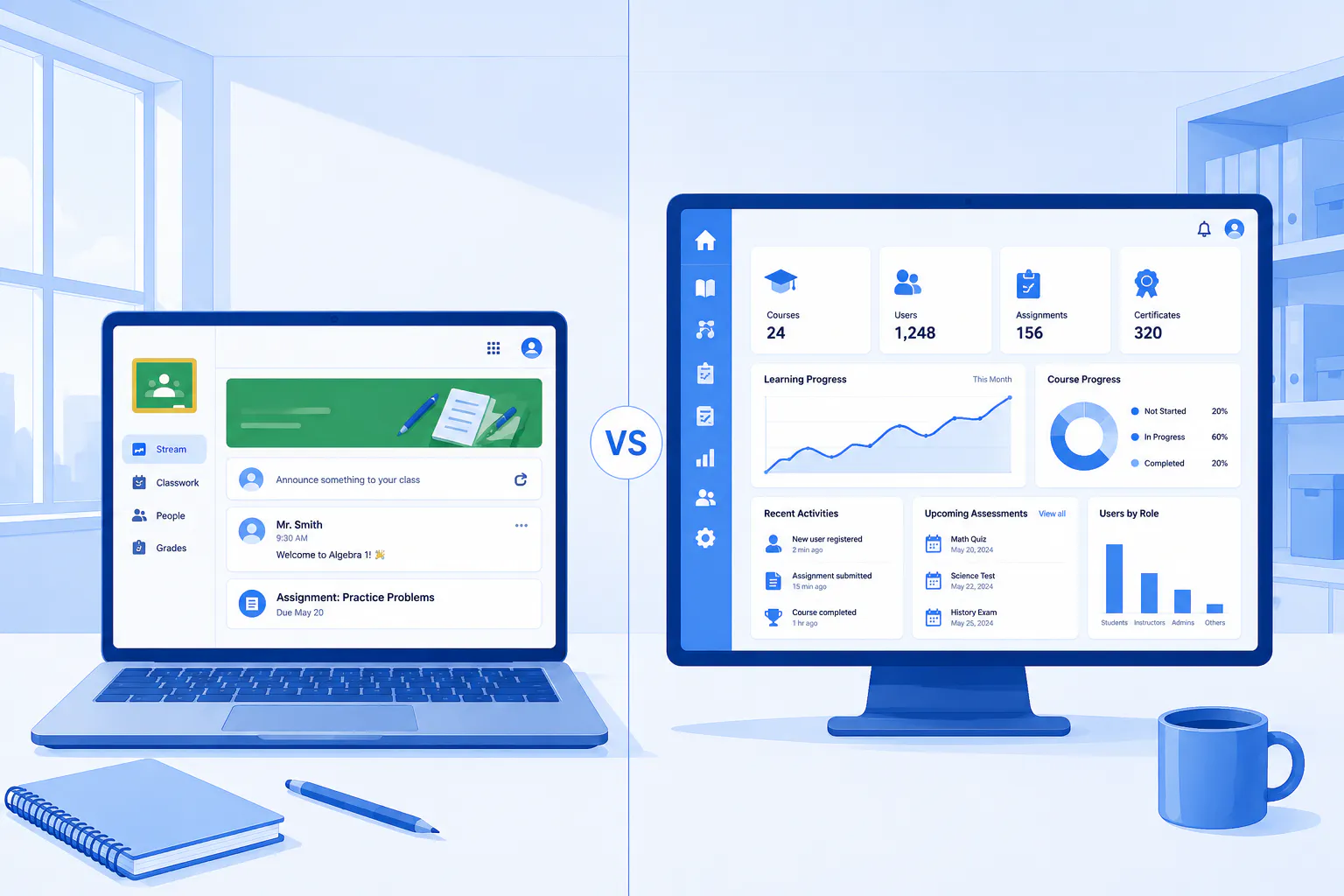
The education community continues to debate one question: Is Google Classroom an LMS? As schools continue their digital transformation, many educators find themselves comparing Google Classroom with a full learning management software for schools to determine which platform can best support teaching, learning, and administration.
While Google Classroom makes it easy to distribute assignments and communicate with students, a Learning Management System is built to manage the entire learning journey. From structured course delivery and assessments to analytics, reporting, and student progress tracking, an LMS provides schools with a much broader set of capabilities.
In this article, we'll compare Google Classroom and an LMS feature by feature, helping you understand their differences, strengths, and which solution is better suited to your school's long term learning goals.
Is Google Classroom a True LMS?
Yes, Google Classroom can function as a basic Learning Management System (LMS), helping teachers distribute assignments, share learning materials, communicate with students, and organize classroom activities.
However, it is more accurately described as a lightweight classroom management platform rather than a full-scale LMS, as it does not offer the broader learning, assessment, analytics, and administrative capabilities found in comprehensive LMS platforms.
Features such as advanced course building, detailed learning analytics, comprehensive reporting, structured learning paths, cohort management, and institution-wide administration are either limited or unavailable.
Google Classroom works well for individual teachers and smaller classrooms, particularly for schools already using Google Workspace. However, schools that require curriculum management, student performance tracking, assessment workflows, and school wide reporting typically benefit more from a purpose built Learning Management System.
Read more: How to Choose the Best LMS for Your School?
What Is Google Classroom?
Google Classroom is a cloud based classroom management platform developed by Google. It helps teachers create classes, distribute assignments, share learning resources, communicate with students, and manage everyday classroom activities through Google Workspace.
Advantages
- Simple and easy to set up.
- Free for schools using Google Workspace for Education.
- Seamless integration with Google Docs, Drive, Meet, and Forms.
- Quick assignment creation and submission.
- User friendly interface for teachers and students.
Disadvantages
- Limited course structuring capabilities.
- Basic reporting and student analytics.
- No advanced learning pathways.
- Limited assessment and grading features.
- Not designed for institution wide learning management.
What Is a Learning Management System (LMS)?
A Learning Management System (LMS) is a comprehensive digital platform designed to manage, deliver, track, and report on learning across an entire educational institution. Beyond classroom management, an LMS supports structured course delivery, assessments, analytics, reporting, learner progress, and administrative workflows.
Advantages
- Structured course and curriculum management.
- Advanced assessments with automated grading.
- Detailed student performance tracking and analytics.
- Comprehensive reporting for teachers and administrators.
- Supports personalised learning paths and cohort management.
- Scales easily across schools, colleges, and training institutions.
- Integrates with a wide range of educational tools and platforms.
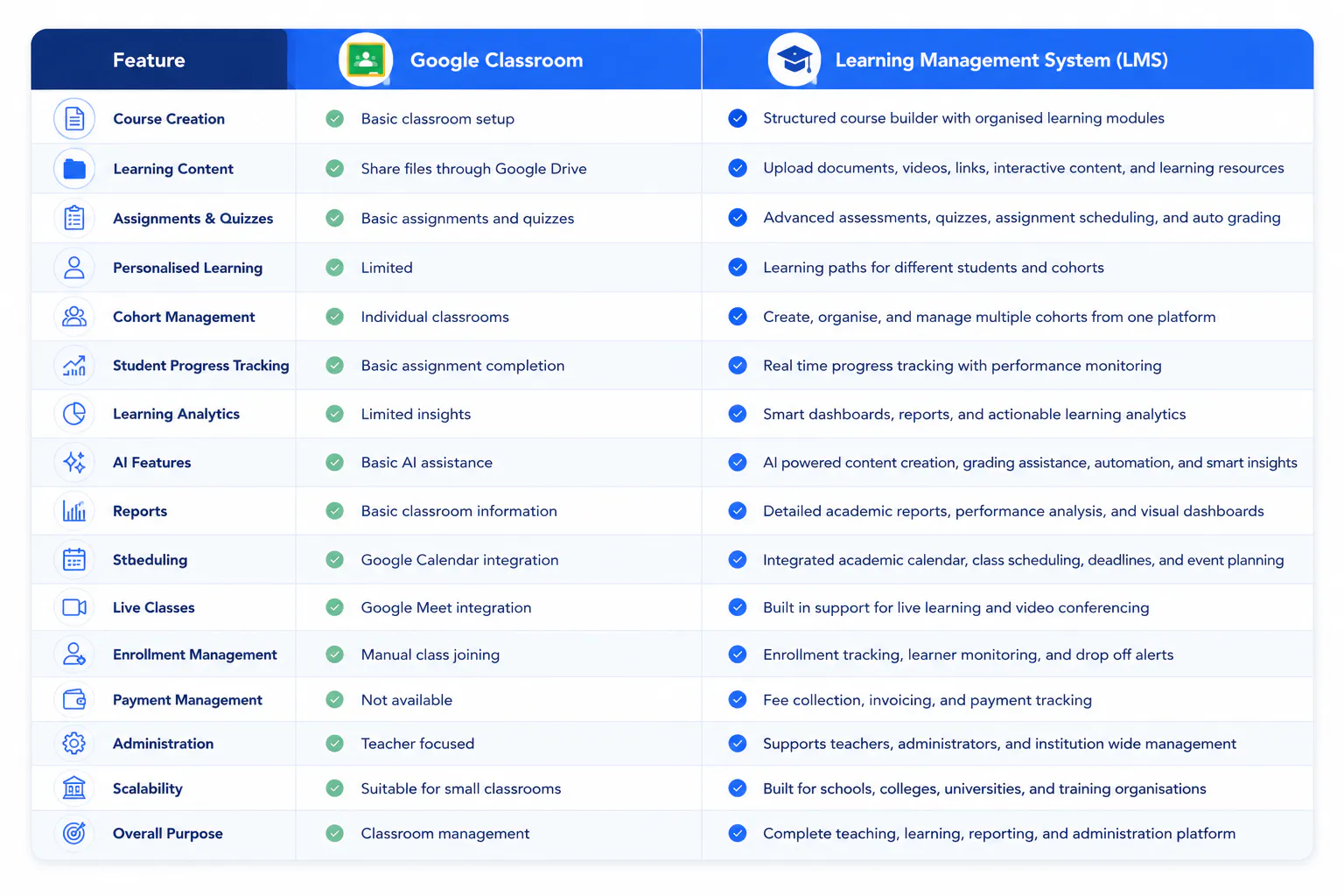
Google Classroom vs LMS: Feature Comparison
While both platforms support digital learning, a dedicated Learning Management System offers significantly more functionality for schools and educational institutions. Here's how they compare.
Conclusion
Google Classroom and Learning Management Systems serve different purposes. While Google Classroom helps teachers manage assignments, communication, and daily classroom activities, an LMS provides a complete platform for managing teaching, learning, and administration.
For schools looking to track student progress, deliver structured courses, analyze performance, and scale digital learning, a dedicated LMS offers greater flexibility and long-term value.

