
Key Takeaways
- Align stakeholder priorities by showing how the new LMS addresses the needs of leadership, IT, HR, L&D, managers, and employees.
- Prove the value through ROI data, demonstrations, pilot results, and measurable improvements.
- Position the LMS as a long-term workforce development platform that supports training, skills development, employee growth, and business goals.

Getting stakeholders to approve a new corporate LMS requires more than demonstrating a list of features. A new LMS can affect training budgets, IT infrastructure, employee experience, administration, compliance, reporting, and workforce development, so each stakeholder will evaluate the investment from a different perspective.
Leadership wants to understand the financial and strategic value. IT teams need confidence in security, integrations, and reliability. HR and L&D teams look at training effectiveness and administration, while managers and employees need a learning experience that is easy to use and relevant to their roles.
The key to stakeholder buy-in is to connect the new LMS with existing business problems, stakeholder priorities, measurable outcomes, and long-term workforce goals. In this guide you will get to know how organizations can build a stronger case for adopting a new LMS and gain support before implementation begins.
Understand Stakeholder Priorities And Pain Points
The first step is to understand who influences the learning platform decision and what each stakeholder expects from the new platform.
A CFO may be concerned about the total investment and potential return, while an IT leader may focus on data security and integrations. HR may need better employee development capabilities, and L&D teams may want more efficient course creation, assessments, and reporting. Managers typically need visibility into employee progress, while employees want relevant training that is easy to access.
Before presenting an LMS, document the main concerns of each stakeholder group.
- Leadership: ROI, cost, scalability, and workforce performance
- IT: Security, integrations, data management, and reliability
- HR: Employee development, onboarding, compliance, and retention
- L&D teams: Course management, assessments, learning paths, and reporting
- Managers: Team progress, skills development, and training effectiveness
- Employees: Accessibility, relevant content, flexibility, and ease of use
Identify Why The Organization Needs A New Learning Management System
Stakeholders are unlikely to support a new LMS simply because another platform has more features. There needs to be a clear reason for changing the existing learning environment.
Start by examining the problems with the current learning system or training process. Common issues include outdated technology, manual administration, limited reporting, fragmented training content, poor mobile access, weak integrations, difficult learner management, or limited support for skills development.
The important part is connecting each problem to its business impact.
For example, if administrators spend significant time manually enrolling employees and preparing reports, the issue is not simply that the learning platform lacks automation. The larger problem is wasted administrative time and limited operational efficiency.
If managers cannot see employee training progress, the problem extends beyond reporting. It can make it harder to identify knowledge gaps and determine whether training is supporting workforce needs.
A strong proposal therefore begins with the problems the organization needs to solve, rather than the features the vendor wants to sell.
Read more: How to Select the Best LMS for Your Organization
Explain What The New LMS Will Improve
Once the problems are clear, explain how the new LMS will improve the current learning environment.
A modern learning management system can centralize training content, automate administrative processes, create structured learning paths, deliver assessments, provide employee analytics, support mobile learning, and connect with other business systems.
However, these capabilities should always be connected to practical outcomes.
For example, automated enrollment can reduce repetitive administrative work. Structured learning paths can give employees clearer development journeys. Better reporting can help managers identify training gaps. Integrated assessments can provide more useful evidence of knowledge and skill development.
Build A Strong Business Case For The New LMS
A business case gives leadership a structured reason to approve the investment.
The proposal should explain what is wrong with the current approach, what the organization needs from a new LMS, how the proposed platform addresses those requirements, and what measurable improvements can be expected.
Consider areas such as:
- Training administration costs
- Employee onboarding time
- Course completion and engagement
- Compliance training management
- Employee skill development
- Reporting and administrative workload
- Training scalability
- Existing software and integration costs
- Employee productivity
The business case should also distinguish between immediate improvements and long-term value. A new learning management system may reduce administrative work immediately, while benefits such as stronger workforce capabilities and better skills visibility may develop over a longer period.
Demonstrate The ROI Of LMS Investment
Return on investment is often one of the most important factors in gaining executive approval.
Rather than comparing LMS subscription prices alone, calculate the broader cost of the organization's existing training environment. Include administrative effort, separate training tools, manual reporting, onboarding costs, content management, support, and other recurring expenses.
Then compare these costs with the expected investment and improvements from the new learning management system.
For example, if an organization currently spends considerable staff time managing employee enrollment and reporting manually, automation could reduce that workload. If onboarding takes several weeks because training is fragmented, structured learning paths could help employees reach required knowledge and skills more efficiently.
ROI should not be limited to direct financial savings. Reduced administrative effort, faster onboarding, improved compliance, stronger employee development, and better training visibility can also contribute to the overall value of an LMS.
Read more: How to Use a Corporate LMS for Effective Employee Onboarding?
Address IT, Security And Integration Concerns
IT stakeholders often have some of the strongest concerns about introducing a new LMS because the platform may connect with existing business systems and handle employee data.
The proposal should clearly address security, authentication, access controls, data management, integrations, APIs, reliability, and implementation requirements.
Explain how the learning management system, will fit into the organization's existing technology environment. Consider integrations with HR systems, communication platforms, CRM systems, identity management tools, or other applications used by employees.
Data migration also needs to be considered if the organization is replacing an existing LMS. Course content, learner records, assessments, certifications, and user information may need to be transferred and validated.
Addressing these requirements early can reduce uncertainty and give IT teams greater confidence in the proposed platform.
Demonstrate The LMS To Each Stakeholder Group
A generic LMS demonstration rarely gives every stakeholder the information they need.
Instead, tailor the demonstration around each group's responsibilities.
Leadership should see dashboards, reporting, scalability, and business insights. IT teams should be shown integrations, security controls, user management, and technical capabilities. HR and L&D teams can evaluate course creation, learning paths, assessments, and reporting.
Managers should see how they can monitor employee development, while employees should experience the actual process of finding courses, completing learning activities, taking assessments, and tracking progress.
Use A Pilot Program To Prove The Value
A pilot can provide evidence before the organization commits to a full rollout.
Instead of immediately moving every employee and training program to the new platform, select a representative department, course, or employee group. Use real training content and realistic workflows during the pilot.
Measure the areas that matter most to the original business case. These might include administrative effort, employee adoption, course completion, assessment performance, reporting quality, user satisfaction, and integration performance.
The pilot should have clear success criteria established before it begins. This allows stakeholders to evaluate whether the LMS actually delivers the improvements promised during the proposal stage.
Show The Employee Experience
Employee adoption can determine whether an LMS succeeds after implementation.
Employees should be able to find relevant training without unnecessary steps, access courses across devices, complete assessments, understand their progress, and continue learning as their roles develop.
A new LMS should also make training more relevant to individual employees. Learning paths can organize training according to job roles, skills, departments, compliance requirements, or career development goals.
When employees can see how learning connects to their work and development, the LMS becomes more useful than a system that simply stores training courses.
Show How The LMS Helps HR And L&D Teams
The value of a new LMS should also be demonstrated from the administrator's perspective.
HR and L&D teams often manage large amounts of training activity, including employee enrollment, course content, assessments, compliance programs, reporting, and learning schedules.
A suitable LMS can centralize these activities and reduce repetitive manual work. Automated workflows can help manage enrollment and notifications, while reporting can provide visibility into employee progress and training performance.
For L&D teams, the ability to organize learning paths, assessments, cohorts, skills, and content within one environment can also make training programs easier to manage as the organization grows.
Read more: Top LMS Management Challenges and How to Overcome Them
Connect The LMS With Workforce Development
A new LMS should support more than today's training requirements. It should contribute to the organization's broader workforce strategy.
Organizations increasingly need to develop skills continuously as technologies, job responsibilities, and business requirements change. An LMS can support this through structured learning paths, skills development, assessments, personalized recommendations, and learning analytics.
For example, an organization introducing new AI tools may need to train employees at different skill levels. Instead of assigning identical training to everyone, learning paths can provide foundational content for some employees and more advanced training for others.
Create A Clear LMS Evaluation Framework
Before making the final recommendation, evaluate the LMS against the requirements that matter most to the organization.
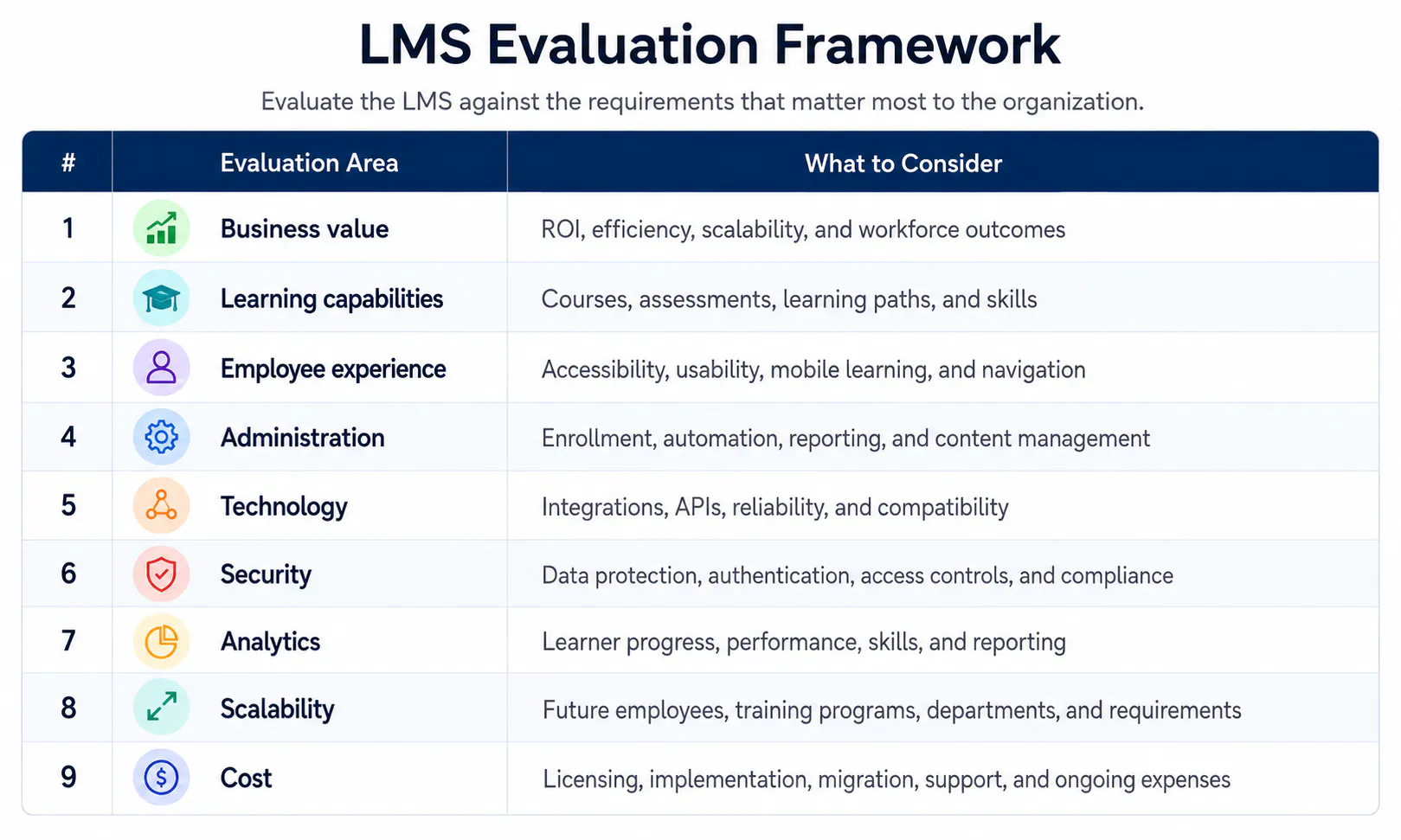
Use Data To Strengthen The Decision
Stakeholder discussions become stronger when they are supported by evidence.
Review current training data to identify problems such as low completion, poor assessment performance, high administrative effort, limited engagement, or gaps in employee skills.
Then establish the metrics that will be used to evaluate the new LMS.
Useful measures can include:
- Employee adoption
- Course completion
- Assessment performance
- Time to competency
- Onboarding time
- Administrative hours
- Compliance completion
- Skills development
- Learner satisfaction
The specific metrics should depend on the reason for adopting the new LMS. Measuring everything can create unnecessary complexity; measuring the outcomes connected to the business case provides more useful evidence.
Read more: 9 Common LMS Mistakes to Avoid for Better Training Results
Best Practices For Getting Stakeholder Buy-In
The most effective LMS proposals focus on the decision rather than the product presentation.
- Start with the business problem: Explain why the existing learning environment is no longer sufficient.
- Connect value to stakeholders: Show how the LMS addresses the priorities of leadership, IT, HR, L&D, managers, and employees.
- Use evidence: Support the proposal with current training data, costs, employee feedback, and pilot results.
- Demonstrate real workflows: Show stakeholders how the platform handles tasks they actually perform.
- Address risk early: Cover security, integrations, implementation, data, and adoption before they become objections.
- Define success: Agree on measurable outcomes before the LMS is implemented.
- Think beyond implementation: Evaluate how the platform can support future workforce skills and continuous learning.
Conclusion
Getting stakeholder buy-in for a new LMS is ultimately about demonstrating value, reducing uncertainty, and connecting the platform to organizational goals. Stakeholders need to understand why the current learning environment needs to change, how the proposed LMS addresses existing problems, and what measurable improvements the organization can expect.
A strong proposal brings together the concerns of leadership, IT, HR, L&D, managers, and employees rather than treating LMS adoption as an isolated technology decision. Business value, security, employee experience, administration, reporting, scalability, and workforce development all contribute to the final decision.
The most effective organizations do not ask stakeholders to approve an LMS simply because it has better features. They show how the new platform can improve the way the organization trains, develops, measures, and supports its workforce.

