
Key Takeaways
- Cohort-based learning combines a shared schedule, instructor guidance, peer interaction, and structured progress.
- Unlike self-paced learning, cohort programs prioritize accountability and collaboration over individual flexibility.
- An LMS with cohort management, assessments, learning paths, communication, and analytics can help organizations deliver and manage cohort-based programs at scale.

Cohort-based learning, or CBL, brings learners together in structured groups, moving through courses as a team. It blends live instructor sessions with peer collaboration and interactive discussions, creating a more engaging learning experience. Today, gaining skills or knowledge isn’t limited to traditional classrooms or MOOCs. The focus is on learning environments that help you stay engaged, retain more information, and actually finish what you start.
According to Josh Bersin, learners typically remember 28% of what they learned after two days when studying alone. When they use the material, answer questions, and interact with others, retention can reach 69%. According to Learnopoly, self-paced courses often see completion rates as low as 3%, while cohort-based programs regularly exceed 90%.
In this blog, you’ll learn what cohort-based learning is, how it works, its benefits and limitations, how it compares with self-paced learning, and how an LMS can support cohort-based programs.
What Is Cohort-Based Learning?
Cohort-based learning is an educational model in which a defined group of learners progresses through a course or program together according to a structured schedule. Participants typically share a start date, learning milestones, assignments, live sessions, and completion timeline.
Unlike independent online courses, cohort learning emphasizes interaction between learners and instructors. Participants can ask questions, discuss concepts, complete collaborative activities, provide peer feedback, and apply what they learn throughout the program.
A typical cohort-based course combines three core elements:
- Instructor-led learning: Live or scheduled sessions allow instructors to explain concepts, answer questions, and provide feedback.
- Peer interaction: Discussions, group activities, peer reviews, and collaborative projects help learners learn from one another.
- Structured progression: Shared deadlines and milestones create accountability and keep participants moving through the course.
How Does Cohort-Based Learning Work?
Cohort-based learning follows a shared learning journey where participants move through content, activities, assessments, and discussions within a defined timeframe.
- Learners join a defined cohort: Participants enroll in the same course or program and begin around the same time.
- The program follows a schedule: Modules, assignments, assessments, and live sessions are organized around specific dates.
- Instructors guide learning: Teachers, trainers, or subject-matter experts provide instruction, answer questions, and offer feedback.
- Learners interact with peers: Discussions, group projects, peer reviews, and collaborative activities encourage knowledge sharing.
- Learners apply what they learn: Assignments and practical activities help participants connect concepts with real-world situations.
- Progress is monitored: Educators can track participation, assignment completion, assessment results, and overall learner progress.
- The cohort reaches shared milestones: Learners progress through the program together and typically complete it within the same defined period.
Read more: Cohort-Based Learning Tips
What Are The Core Elements Of Cohort-Based Learning?
An effective cohort-based program depends on several connected components that keep learners engaged and progressing.
Structured Learning Paths
Learners follow an organized sequence of modules, lessons, assignments, and assessments.
Live Instructor Interaction
Live classes, workshops, office hours, and Q&A sessions provide opportunities for learners to interact directly with instructors and receive immediate clarification.
Peer Collaboration
Discussion forums, group assignments, peer reviews, and collaborative projects create opportunities for participants to share knowledge and solve problems together.
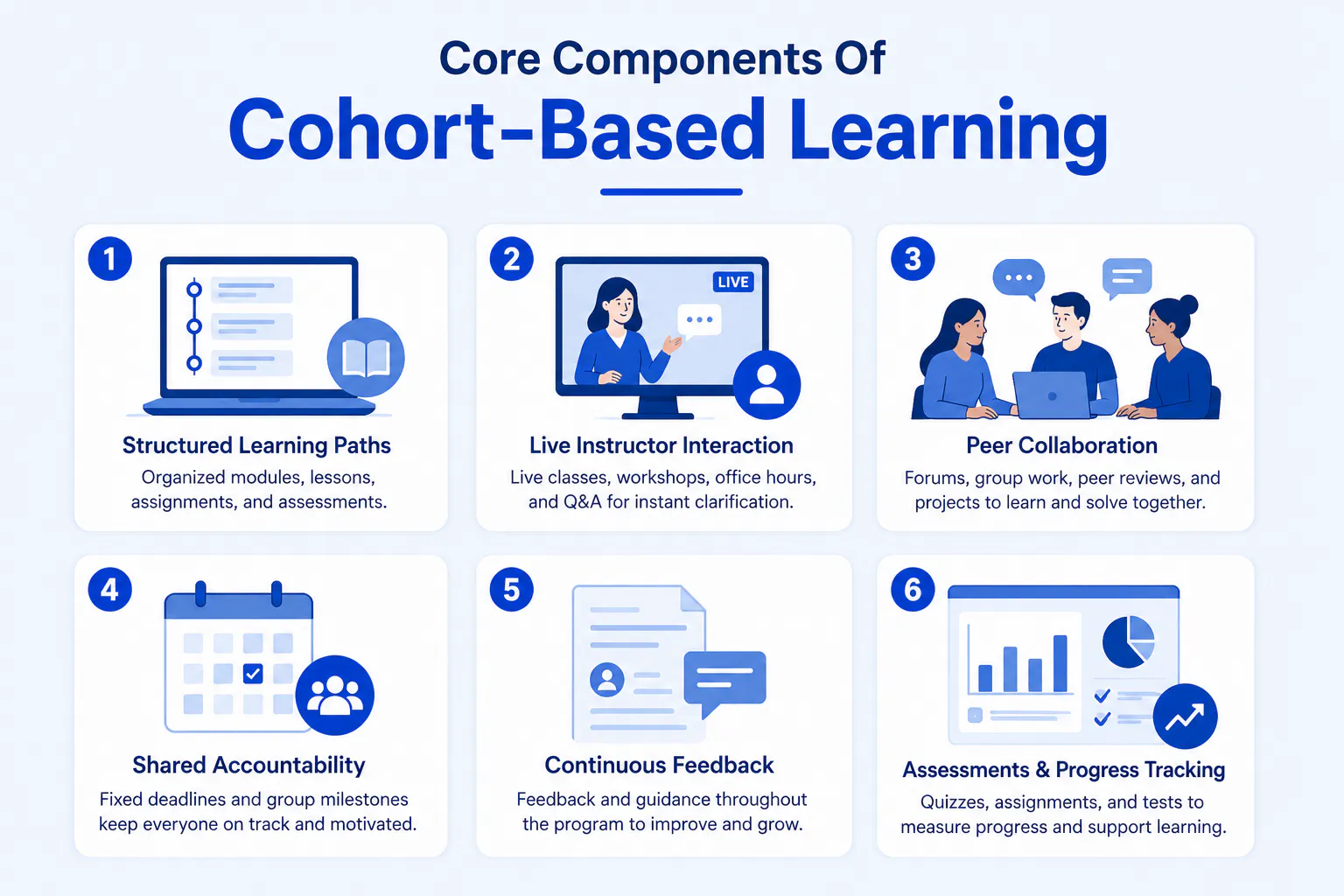
Shared Accountability
Fixed deadlines and group milestones encourage learners to maintain consistent progress. Seeing peers participate can also reinforce motivation.
Continuous Feedback
Instructors can review assignments, answer questions, identify learning gaps, and provide feedback throughout the program instead of only at the end.
Assessments And Progress Tracking
Quizzes, assignments, tests, and other assessments help educators evaluate learner understanding and identify areas that require additional support.
Read more: 5 Strategic Best Practices for Cohort-Based Learning Management
What Are the Benefits Of Cohort-Based Learning?
Cohort-based learning combines structured progression with interaction and accountability. These characteristics can benefit both learners and educators.
Benefits For Learners
- Greater accountability: Shared deadlines and group milestones encourage learners to maintain consistent progress.
- More interaction: Learners can discuss concepts, ask questions, and exchange ideas with instructors and peers.
- Better knowledge application: Practical activities and collaborative projects allow learners to apply concepts instead of only consuming content.
- Immediate feedback: Instructor and peer feedback can help learners identify mistakes and improve their understanding.
- Learning community: Participants build connections with others who have similar educational or professional goals.
- Structured progression: A defined schedule provides clear expectations and reduces uncertainty about what to complete next.
Benefits For Educators
- Better visibility into learner progress: Educators can monitor participation, assignments, assessments, and completion.
- More meaningful interaction: Live classes and discussions create opportunities to understand learner needs.
- Faster identification of learning gaps: Regular assessments and activities reveal areas where additional instruction may be required.
- Consistent course delivery: A shared schedule makes it easier to deliver the same curriculum across a defined group.
- Continuous feedback: Educators can collect feedback during the program and improve future cohorts.
- Stronger learning communities: Structured interaction encourages collaboration beyond individual course materials.
What Are the Disadvantages Of Cohort-Based Learning?
Cohort-based education offers structure and interaction, but it is not suitable for every learner or program.
- Less flexibility: Fixed sessions and deadlines can be difficult for learners with unpredictable schedules.
- Different learning speeds: Learners may understand concepts at different rates even when following the same curriculum.
- Higher instructor involvement: Live sessions, feedback, and learner support require consistent educator participation.
- Coordination requirements: Managing schedules, groups, assignments, and communications becomes more demanding as cohort size increases.
- Dependence on participation: The quality of peer learning can decline when learners do not actively participate.
- Missed sessions can affect progress: Learners who miss important live activities may find it harder to keep up with the cohort.
For these reasons, organizations should consider learner availability, course complexity, instructor capacity, and collaboration requirements before adopting a cohort-based model.
Read more: 10 Modern Learning Methods
When Is Cohort-Based Learning Most Effective?
Cohort-based learning works particularly well when a program requires structured progression, instructor guidance, practical application, and interaction between participants.
Common use cases include:
- Corporate training: Employee onboarding, leadership development, professional skills, and compliance programs.
- Higher education: Online degree programs, professional courses, continuing education, and specialized programs.
- Schools: Group-based academic programs, project-based learning, and structured online courses.
- Professional certification: Programs where learners need to complete modules, assignments, and assessments within defined timelines.
- Bootcamps: Technical, business, design, and career-focused programs that require intensive instruction and practical work.
- Training providers: Structured programs that combine digital content with instructor-led sessions and learner communities.
What Are the Best Practices For Cohort-Based Learning?
Effective cohort programs require more than placing learners into the same online course. The learning experience needs clear structure, interaction, support, and continuous monitoring.
Define Clear Learning Objectives
Set measurable learning outcomes before the program begins. Learners should understand what skills or knowledge they are expected to develop by the end of the course.
Create A Structured Schedule
Organize modules, live sessions, assignments, assessments, and milestones into a predictable schedule. Clear timelines help learners understand what they need to complete and when.
Design For Collaboration
Include discussions, group activities, peer reviews, and collaborative projects where they support the learning objectives. Interaction should contribute to learning rather than exist simply for engagement.
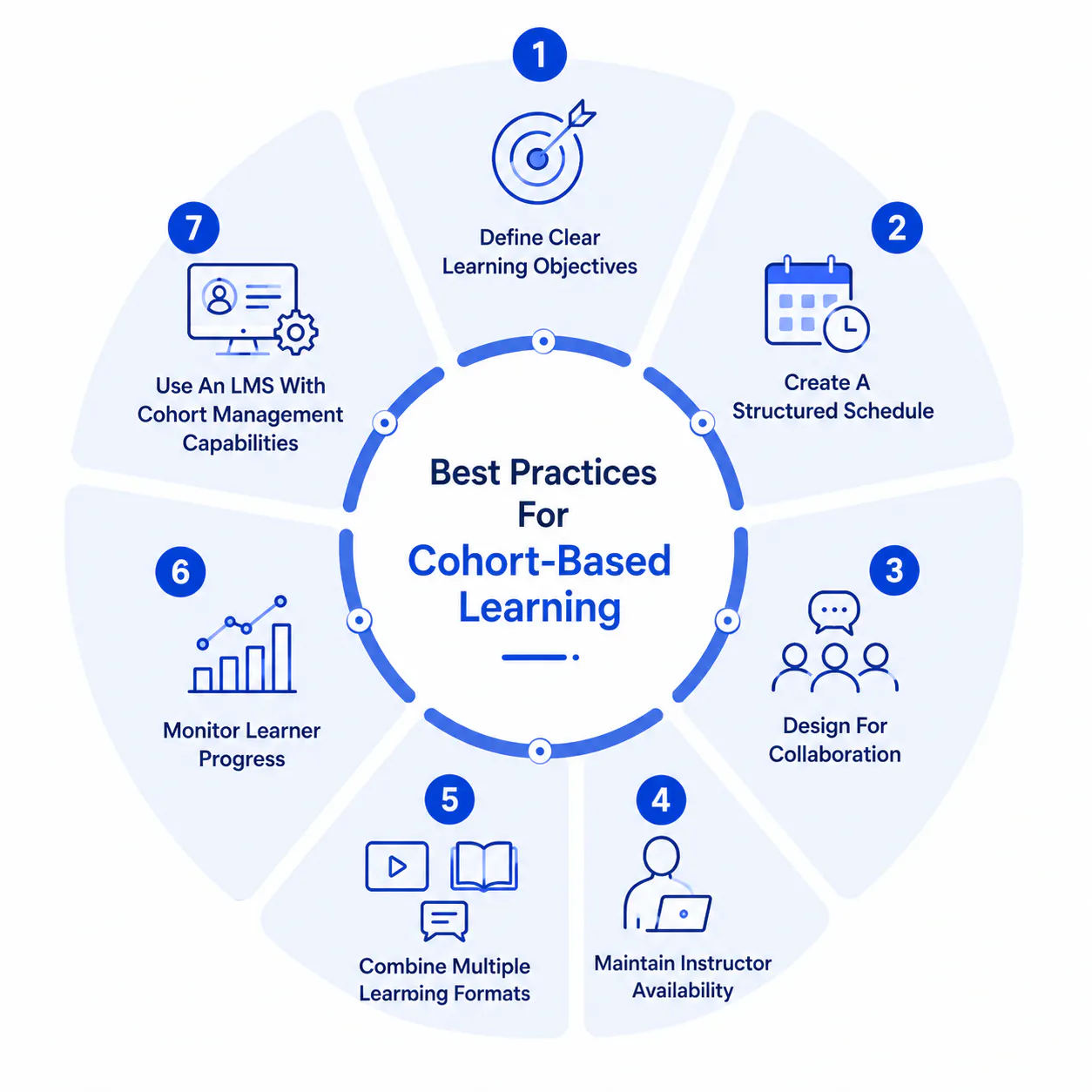
Maintain Instructor Availability
Provide learners with regular opportunities to ask questions and receive feedback. Consistent instructor involvement can prevent learners from falling behind.
Combine Multiple Learning Formats
Use live classes alongside recorded lessons, reading materials, assessments, practical activities, and discussion-based learning. A blended approach can accommodate different learning requirements.
Monitor Learner Progress
Track participation, assignment completion, assessment performance, and course progress. Learning analytics can help educators identify learners who may need additional support.
Use An LMS With Cohort Management Capabilities
A learning management system can centralize cohort enrollment, learning paths, course content, assessments, schedules, communication, and progress tracking.
How Does An LMS Support Cohort-Based Learning?
A learning management software provides the infrastructure needed to manage cohort-based programs at scale. A corporate LMS can organize employee training cohorts, learning materials, assessments, and progress, while a school learning management software can help educators manage student groups, course content, assignments, assessments, and academic progress.
Instead of managing these activities through separate systems, organizations and educational institutions can bring them together within one platform.
Key LMS capabilities for cohort learning include:
- Cohort management to organize learners into defined groups.
- Automated enrollment to assign learners to the appropriate program or cohort.
- Learning paths to organize courses and activities into a structured sequence.
- Course scheduling to coordinate modules, sessions, and deadlines.
- Assessments to evaluate learner understanding throughout the program.
- Progress tracking to monitor individual and cohort-level performance.
- Reporting and analytics to evaluate completion, participation, and learning outcomes.
For schools, universities, training providers, and corporate learning teams, these capabilities make it easier to deliver structured, collaborative, and measurable online learning programs.
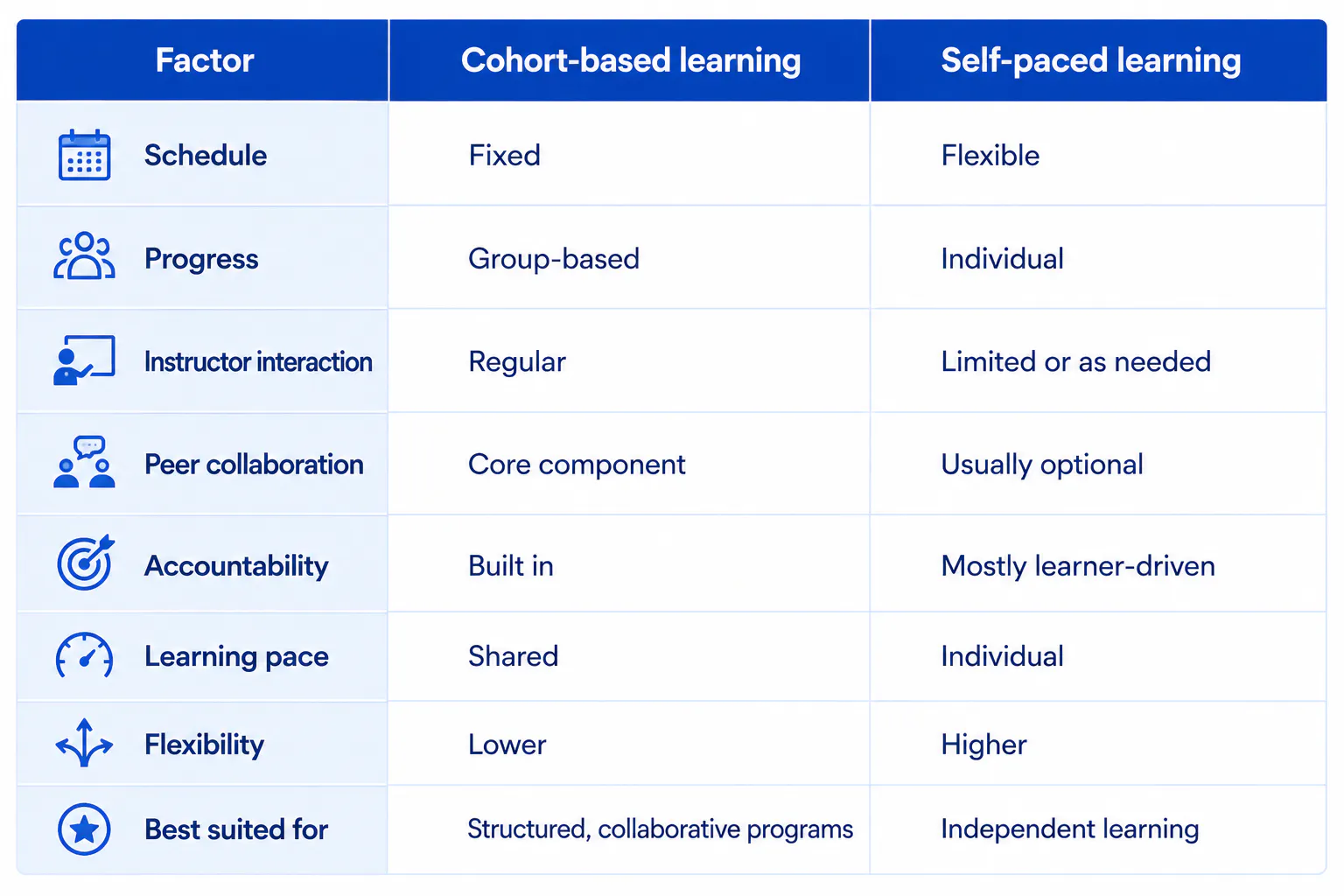
What Is The Difference Between Cohort-Based Learning And Self-Paced Learning?
The main difference is structure and interaction. Cohort-based learning moves learners through a shared schedule with instructors and peers, while self-paced learning lets individuals access course materials and progress independently. Both models support online education, but they suit different learning preferences and program goals.
Read more: Cohort-Based Learning vs Self-Paced Learning
Conclusion
Cohort-based learning creates a structured environment where learners progress together, interact with instructors and peers, and apply knowledge throughout a defined program. Its combination of accountability, collaboration, instructor support, and structured learning makes it suitable for education, professional development, corporate training, and certification programs.
While the model offers less flexibility than self-paced learning, it can provide a stronger sense of structure and community for learners who benefit from shared goals and regular interaction. With the right learning design and an LMS that supports cohort management, organizations can deliver consistent learning experiences while tracking progress and outcomes across each cohort.

