
Key takeaways
- Microsoft Teams supports communication, while an LMS manages the entire learning journey. Teams excels at virtual classes, collaboration, and messaging, whereas an LMS provides structured course delivery, assessments, grading, and learning analytics.
- Schools need more than collaboration to manage education effectively. A dedicated LMS streamlines enrollment, course organization, student progress tracking, reporting, and administrative workflows that Teams alone cannot fully support.
- The best digital learning experience comes from using both together. Integrating Microsoft Teams with a Learning Management System combines seamless communication with comprehensive academic management, creating a more organized and scalable learning environment.
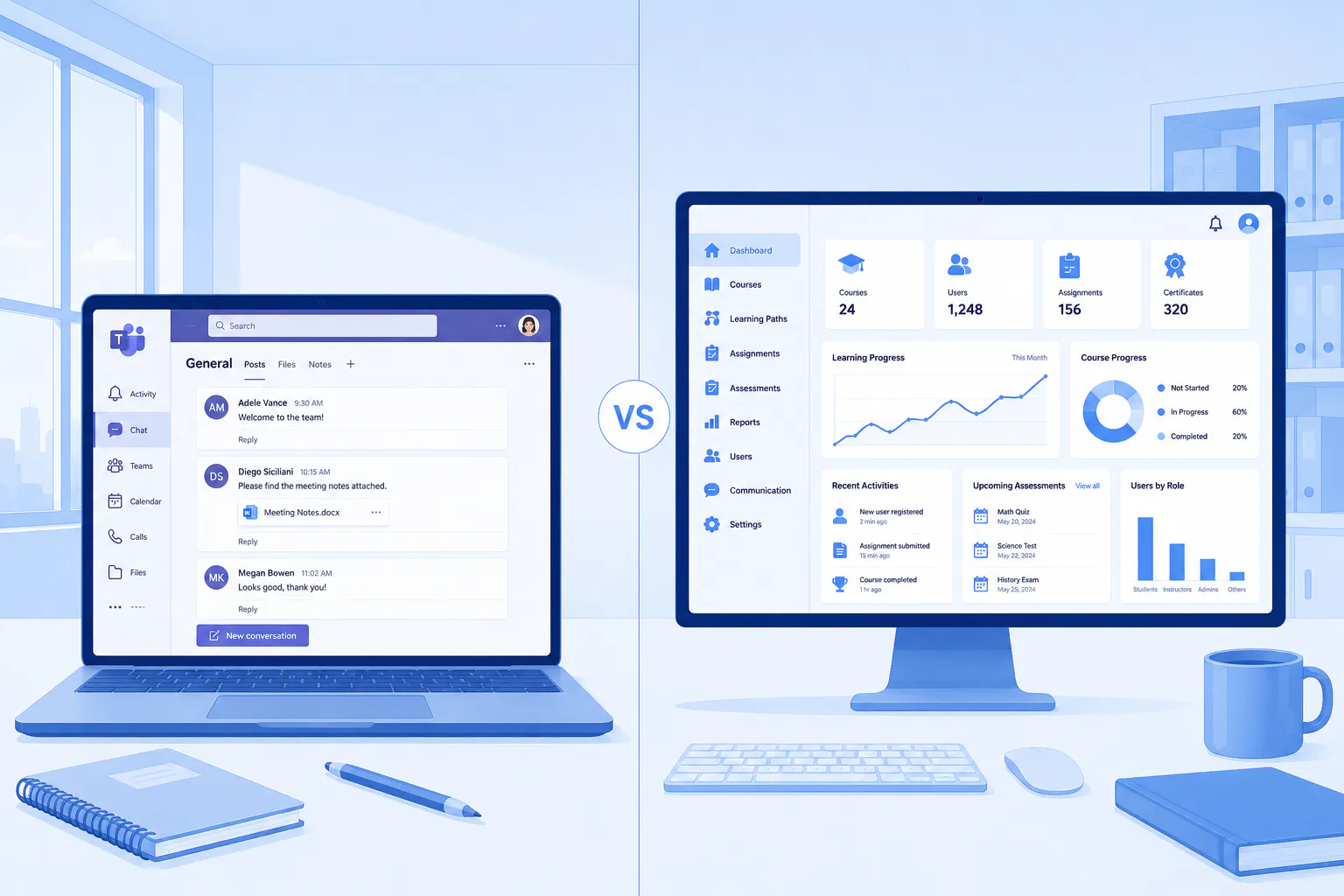
Schools have increasingly adopted Microsoft Teams to support online learning, virtual classrooms, and day to day communication. With video meetings, file sharing, assignments, and collaboration tools all available in one platform, it's understandable why many educators ask the same question: Can Microsoft Teams replace a Learning Management System?
The short answer is not entirely.
While Microsoft Teams is an excellent platform for communication and collaboration, it wasn't built to manage the complete learning journey. Course delivery, student enrollment, assessments, grading, learning analytics, and long term academic management require capabilities that extend beyond virtual classrooms and messaging.
In this blog, we'll compare Microsoft Teams and a Learning Management System, explain where each platform excels, and help you decide whether Teams alone is enough or if your school would benefit from a dedicated LMS.
What Is the Difference Between Microsoft Teams and a Learning Management System?
Microsoft Teams and a Learning Management System are often used together in schools, but they serve very different purposes. Although both support digital learning, they were built to solve different challenges.
Microsoft Teams was developed as a communication and collaboration platform. It acts as a central hub where teachers and students can hold live classes, chat, share files, make announcements, and collaborate on projects. Its primary purpose is to keep people connected and make communication easier.
A school learning management software, however, was designed to manage the entire teaching and learning process. It helps schools create structured courses, enroll students, organize cohorts, deliver lessons, conduct assessments, automate grading, monitor progress, generate reports, and analyse learning outcomes throughout the academic journey.
Where Microsoft Teams Falls Short as a Learning Management System?
Microsoft Teams is an excellent platform for communication, collaboration, and virtual learning. However, managing an entire learning ecosystem requires capabilities that go beyond meetings, chats, and file sharing. As schools expand their digital learning initiatives, they often need greater structure, consistency, and visibility than a collaboration platform alone can provide.
Structured course management
Teams allow teachers to share learning materials and assignments, but organizing an entire curriculum can quickly become difficult as courses, subjects, and student groups grow. A dedicated learning management software is built to manage structured learning paths, organize courses into modules, enroll students, and deliver lessons in a consistent format across classrooms.
Consistent assessments and grading
Assignments are only one part of student evaluation. Schools also need standardized grading, assessment rubrics, quizzes, automated marking, and centralized gradebooks that help maintain consistency across different teachers and departments. A dedicated LMS simplifies assessment management while providing a single location for academic records throughout the learning journey.
Student progress and learning analytics
Understanding how students are performing requires more than knowing whether they attended a class. School leaders and educators need visibility into course completion, assignment submissions, assessment results, learner engagement, and overall academic progress. An LMS software brings this information together through dashboards and reports, making it easier to identify students who may need additional support.
Managing learning at scale
As institutions grow, so does the complexity of managing courses, teachers, student groups, academic calendars, and enrollments. A purpose built LMS helps automate many of these administrative processes through cohort management, enrollment tracking, scheduling, grading, and centralized reporting, reducing the workload for teachers and administrators.
Long term academic management
Microsoft Teams focuses on helping people communicate and collaborate in the moment. A learning management software is designed to support the entire academic lifecycle, from enrollment and course delivery to assessments, grading, reporting, and long term student records.
Microsoft Teams and a Learning Management System Work Better Together
Rather than viewing Microsoft Teams and a Learning Management System as competing platforms, schools should see them as complementary technologies. Microsoft Teams provides an excellent environment for communication, collaboration, and live classes, while an LMS manages the academic side of learning through structured courses, assessments, grading, student progress tracking, and reporting.
Using both together allows schools to create a connected digital learning environment where collaboration remains simple while teaching, learning, and academic management stay organized, measurable, and scalable.

