
Key Takeaways
- Cohort-based learning works best with structure and flexibility, allowing learners to follow shared milestones while receiving support based on individual needs.
- Active participation is essential for cohort success, with peer collaboration, instructor guidance, and timely feedback keeping learners engaged and progressing.
- Effective cohort management depends on visibility and efficiency, using learner data, progress tracking, and automation to identify gaps and reduce administrative work.

Cohort-based learning management works best when structured learning paths, peer interaction, instructor support, progress tracking, and automation address challenges such as uneven pacing, low participation, limited personalization, and administrative workload.
Universities, online academies, and corporate training programs use cohort-based learning to organize learners around shared timelines, guided instruction, collaborative activities, and peer accountability. However, managing these programs can create challenges around learner participation, individual support, scheduling, and instructor workload.
In this article you will get to know the key challenges of cohort-based learning management, how to solve them, and the best practices for keeping cohort programs structured, engaging, and effective.
5 Challenges of Cohort-Based Learning Management and How to Solve Them
1. Uneven Learning Pace and Personalization
Cohort-based programs follow a shared schedule, but learners do not always have the same prior knowledge, skill level, learning speed, or support requirements. Some participants may complete activities quickly, while others need additional time or guidance.
Why it matters: A fixed pace can leave advanced learners underchallenged while learners who need more support fall behind.
How to solve it: Build flexibility into the shared learning path. Provide supplementary resources, optional enrichment activities, additional practice, and targeted instructor support without changing the core schedule for the entire cohort.
Best practice: Use progress tracking and competency-based activities to identify where individual learners need additional support or challenge.
2. Low Active Participation
A learner can attend a session or log into a platform without actively participating. In online cohorts, some learners may dominate discussions while others remain passive.
Why it matters: Cohort-based learning depends on interaction. Limited participation reduces peer learning, weakens accountability, and makes it harder for instructors to understand whether learners are actually engaging with the material.
How to solve it: Design participation into the learning experience rather than relying on voluntary discussion. Use small-group activities, peer reviews, collaborative assignments, discussion prompts, and practical problem-solving exercises.
Best practice: Give every activity a clear purpose and participation requirement. Smaller groups can also make it easier for quieter learners to contribute.
3. Limited Individual Adaptation
A shared curriculum creates consistency, but it can also make personalized learning more difficult. Learners may have different professional goals, experience levels, and areas of weakness.
Why it matters: When every participant receives exactly the same content and activities, some learners may receive material that is too basic, too advanced, or unrelated to their immediate needs.
How to solve it: Maintain a common core curriculum while introducing flexible learning resources. Instructors can assign additional exercises, supporting materials, or advanced activities based on learner performance.
Best practice: Use learning paths, assessments, progress data, and instructor feedback to identify where learners need different levels of support.
4. Limited Progress Visibility
Managing a cohort requires more than knowing whether learners completed a course. Instructors need visibility into attendance, assignments, assessments, participation, completion, and individual progress.
Why it matters: Without timely learning data, struggling or disengaged learners can remain unnoticed until they fall significantly behind.
How to solve it: Centralize learner data and monitor progress throughout the program. Use dashboards and reports to identify incomplete activities, assessment gaps, declining participation, and learners who may need intervention.
Best practice: Use learning analytics for early intervention, rather than waiting until the end of the program to evaluate learner performance.
5. Operational Strain at Scale
Managing one cohort can be straightforward. Managing multiple groups introduces additional work around enrollment, scheduling, communication, content delivery, assessments, feedback, and reporting.
Why it matters: Manual administration increases instructor workload and makes consistent program delivery harder as the number of learners grows.
How to solve it: Standardize repeatable processes and automate routine administrative tasks wherever possible. Enrollment, notifications, progress updates, assessment workflows, and reporting can be managed through a centralized learning platform.
Best practice: Use cohort management, automation, scheduling, and centralized reporting to reduce administrative work while maintaining learner support.
How Can You Improve Cohort-Based Learning Management?
Effective cohort management requires more than a shared schedule. The strongest programs combine structure, flexibility, collaboration, instructor support, learner analytics, and automation to keep participants progressing.
Build Learning Paths Around Measurable Outcomes
Connect learning objectives with activities, assessments, and practical tasks so learners know what they are expected to achieve. Clear competency-based milestones also help instructors identify learning gaps throughout the program.
Balance Shared Structure With Individual Flexibility
Keep common deadlines and cohort milestones while allowing additional resources, practice activities, or support for learners who need more time or challenge.
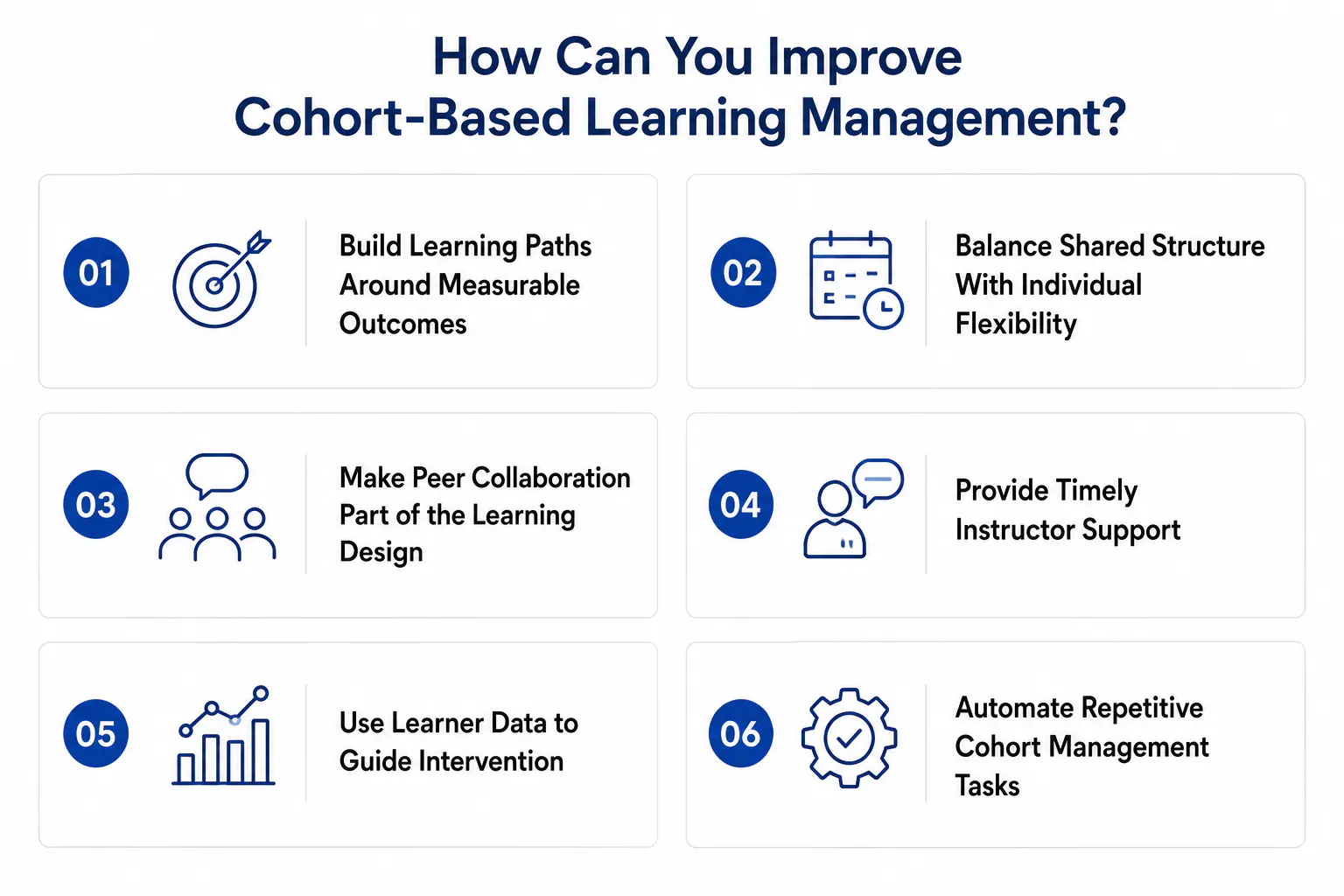
Make Peer Collaboration Part of the Learning Design
Use group projects, case discussions, peer reviews, and collaborative problem-solving to make interaction purposeful. Structured peer learning can strengthen knowledge application while giving participants opportunities to share different perspectives.
Provide Timely Instructor Support
Regular feedback helps prevent small learning gaps from becoming larger problems. Live sessions, office hours, assignment feedback, and targeted interventions give instructors opportunities to support learners before they fall behind.
Use Learner Data to Guide Intervention
Monitor attendance, assessment performance, assignment completion, participation, and overall progress throughout the program. Learning analytics can help instructors identify disengaged learners and intervene before performance declines further.
Automate Repetitive Cohort Management Tasks
Automate routine processes such as enrollment, notifications, scheduling, assessments, progress updates, and reporting. Reducing manual administration gives instructors more time to focus on teaching, feedback, and learner engagement.
Conclusion
Effective cohort-based learning management should create a structured yet flexible learning environment where learners stay engaged, receive timely support, and progress toward measurable outcomes. Addressing challenges such as uneven pacing, low participation, limited personalization, progress visibility, and administrative workload requires purposeful course design and the right learning technology.
By combining structured learning paths, meaningful peer interaction, instructor guidance, learner analytics, and automation, organizations can improve both the learner experience and the efficiency of program delivery.

