
Key Takeaways
- Cohort-based learning provides shared structure, accountability, peer interaction, and instructor guidance, while self-paced learning prioritizes flexibility and learner autonomy.
- Cohort programs are particularly effective for collaborative, practical, and skills-based learning, while self-paced programs work well for flexible, scalable, knowledge-focused training.
- Organizations do not have to choose one model exclusively; hybrid learning can combine self-paced content with live instruction, collaboration, and guided practice.

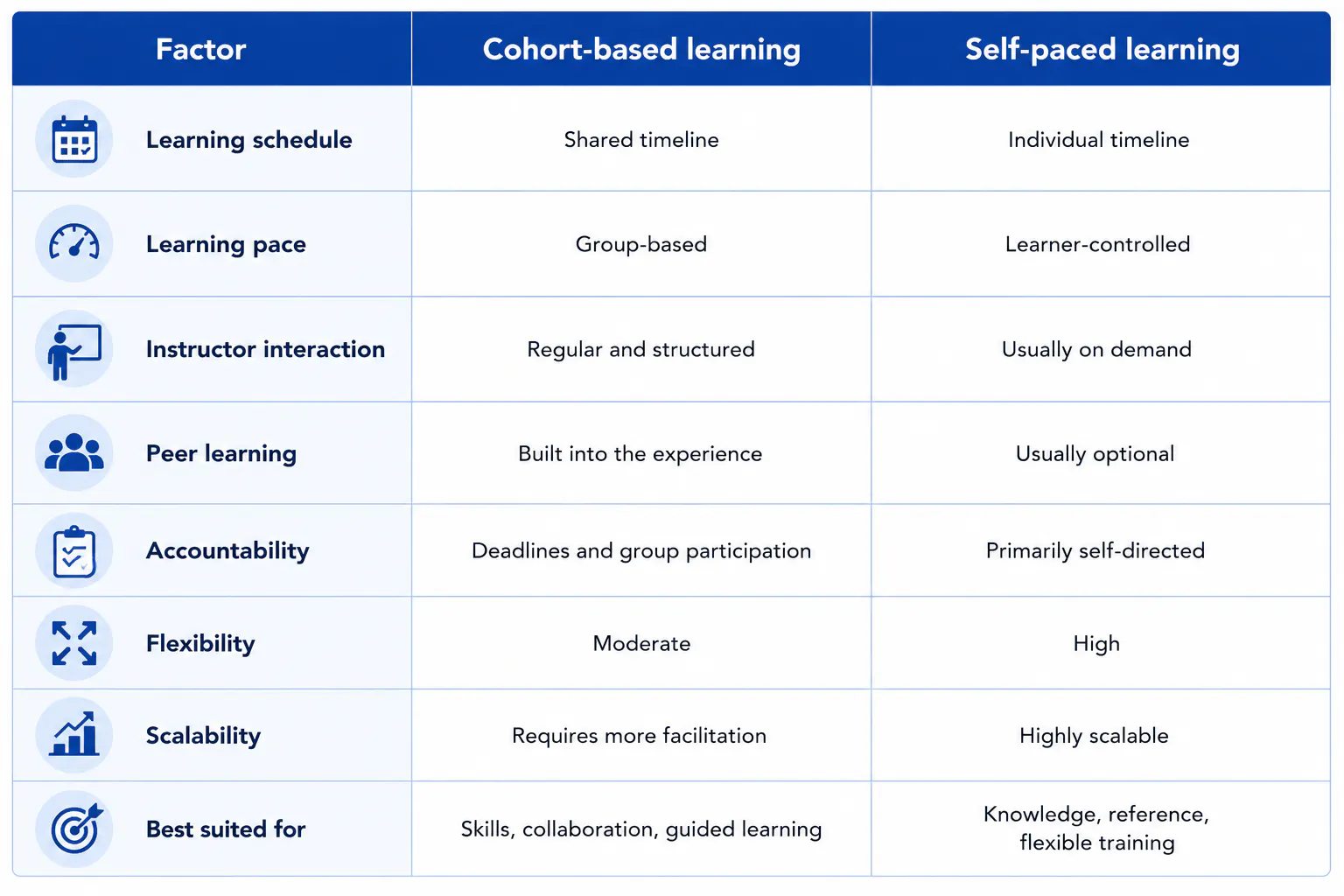
The main difference between cohort-based learning and self-paced learning is how learners progress. Cohort programs follow a shared schedule with peer interaction and instructor guidance, while self-paced learning offers flexibility and learner autonomy.
Cohort-based learning supports accountability, collaboration, and practical skill development, whereas self-paced learning prioritizes flexibility, accessibility, and independent learning.
In this guide you will get to about cohort-based learning and self-paced learning across structure, flexibility, learner engagement, instructor interaction, accountability, scalability, and learning outcomes.
What Is the Difference Between Cohort-Based Learning and Self-Paced Learning?
The main difference is how learning is structured and controlled. Cohort-based learning uses a shared timeline where learners progress through a program together, while self-paced learning gives individuals control over their learning schedule and progression.
What Is Cohort-Based Learning?
Cohort-based learning is an educational model in which a defined group of learners starts and progresses through a program within a shared timeframe. Participants follow a common learning path, attend scheduled sessions, complete activities, and reach key milestones together.
The model combines synchronous instruction, asynchronous learning materials, peer interaction, collaborative activities, assessments, and instructor feedback. Instead of moving through content independently, learners participate in a shared learning environment where interaction and accountability are built into the program.
When Should You Use Cohort-Based Learning?
Cohort-based learning works best when the learning outcome depends on discussion, practice, feedback, collaboration, or behavioral change. It is particularly suitable for:
- Leadership and management development
- Professional certification programs
- Skills-based training
- Executive education
- Team development
- Mentorship and career development
- Project-based learning
- Programs requiring peer collaboration
Advantages of Cohort-Based Learning
- Stronger accountability: Shared deadlines and peer participation encourage consistent progress.
- Active learner engagement: Discussions, workshops, and collaborative activities require participation rather than passive content consumption.
- Instructor feedback: Regular interaction helps instructors identify learning gaps and provide timely guidance.
- Peer learning: Participants exchange experiences, approaches, and perspectives.
- Practical skill development: Projects, simulations, and group activities support knowledge application.
- Learning community: Regular interaction builds stronger connections between participants.
- Progress visibility: Instructors can monitor participation, assessment performance, and learner progress.
Read more: Cohort-Based Training: 5 Tips for Better Learner Engagement
Limitations of Cohort-Based Learning
- Less scheduling flexibility: Learners need to accommodate shared sessions and deadlines.
- Pacing differences: Participants with different levels of prior knowledge may progress at different speeds.
- Higher facilitation requirements: Instructors need to manage discussions, activities, feedback, and learner support.
- Greater coordination: Scheduling sessions and group activities requires additional planning.
- Potential pressure: Learners who fall behind may find it difficult to rejoin the cohort's pace.
What Is Self-Paced Learning?
Self-paced learning allows individuals to control when and how quickly they progress through educational content. Learners can access lessons, videos, readings, assessments, and other digital resources according to their availability and learning needs.
Unlike cohort-based programs, there is usually no requirement for everyone to begin or finish at the same time. Learners can pause, revisit, skip familiar material, or repeat lessons when necessary.
When Should You Use Self-Paced Learning?
Self-paced learning is most effective when flexibility, on-demand access, and independent progression are more important than synchronized participation. Common applications include:
- Employee onboarding
- Compliance training
- Product education
- Software training
- Policy education
- Knowledge-based courses
- Professional development
- Reference and resource libraries
- Large-scale employee training
It is also useful when learners have different schedules, locations, experience levels, or learning requirements.
Read more: 10 Modern Learning Methods
Advantages of Self-Paced Learning
- Greater flexibility: Learners can study around work, academic, or personal commitments.
- Learner autonomy: Participants control their pace and progression.
- On-demand access: Learning resources remain available whenever learners need them.
- High scalability: Large audiences can access the same content without requiring live instruction for every session.
- Consistent content delivery: Every learner receives the same core learning materials.
- Repeatable learning: Participants can revisit difficult concepts whenever necessary.
- Efficient administration: Automated enrollment, assessments, notifications, and completion tracking reduce manual work.
Limitations of Self-Paced Learning
- Lower external accountability: Without shared deadlines, learners must manage their own progress.
- Limited peer interaction: Collaboration is often optional rather than embedded.
- Delayed support: Learners may need to wait for assistance when they encounter difficulties.
- Potential disengagement: Without regular interaction or milestones, some learners may stop progressing.
- Limited practical application: Content-focused programs may provide fewer opportunities for guided practice.
- Greater reliance on self-regulation: Learners need motivation and time-management skills to maintain progress.
Cohort-Based Learning vs Self-Paced Learning: Which Works Better?
Cohort-based learning works better when learners need collaboration, accountability, instructor feedback, and practical application. Self-paced learning is better when flexibility, accessibility, and independent progression are the priority.
For example, a leadership development program may benefit from cohort learning because participants can discuss scenarios, complete group exercises, and receive instructor feedback. A compliance course may be better suited to self-paced delivery because employees can complete standardized content around their schedules.
The better model therefore depends on the learning objective, learner needs, level of interaction, and required flexibility, rather than one format being universally better.
Can You Combine Cohort-Based and Self-Paced Learning?
Yes. A hybrid approach combines the flexibility of self-paced learning with the accountability and interaction of cohort-based instruction.
Learners can complete recorded lessons and digital assessments independently before joining a weekly live workshop. The live session can then focus on discussion, problem-solving, demonstrations, and practical application.
How Can an LMS Support Both Learning Models?
An LMS can provide the infrastructure for both cohort-based and self-paced learning by managing content, learners, assessments, communication, and progress data in one environment.
For cohort programs, useful capabilities include cohort management, scheduled content, learning paths, live session integration, group activities, discussion tools, and progress monitoring.
For self-paced programs, an LMS can support on-demand course access, automated enrollment, assessments, completion tracking, certificates, notifications, and learner analytics.
Using one learning platform for both approaches can also help organizations create different learning experiences for different learner groups without maintaining completely separate systems.
Conclusion
Cohort-based and self-paced learning serve different instructional needs. The better model is the one that matches the learning objective, learner requirements, level of interaction, and available resources.
Programs focused on collaboration, skill development, and guided practice can benefit from the structure of a cohort, while flexible knowledge delivery can often be handled effectively through self-paced learning. For organizations that need both flexibility and engagement, combining the two approaches can create a more adaptable learning experience.

