
Key Takeaways
- AI is making eLearning more personalized, using learner data to adapt content, recommend learning paths, and provide targeted support.
- Learning is becoming more flexible and skills-focused, with microlearning, hybrid learning, cohort-based learning, and micro-credentials supporting continuous development.
- Modern eLearning is becoming more measurable and interactive, combining immersive learning, social experiences, assessments, and analytics to connect learning with real outcomes.
Digital learning growth has accelerated across both higher education and workforce training, driven by technology adoption, flexible learning demand, and mobile-first access to education. According to Grand view research, global e learning services market was valued at USD 299.67 billion in 2024 and is projected to reach USD 842.64 billion by 2030, growing at a CAGR of 18.6% to 19.0%, according to Grand View Research.
The next phase of digital learning is defined by agentic AI systems that automate learning decisions, immersive technologies such as AR and VR that simulate real-world environments, and skills validation frameworks that measure competency with precision.
In this blog you will get to know the most important elearning trends in 2026 that directly shape how institutions and organizations design, deliver, and scale modern learning experiences.
Top eLearning Trends to Look Out For in 2026
eLearning in 2026 is moving beyond basic online courses toward AI-powered personalization, skills-based learning, immersive experiences, flexible delivery, and measurable learning outcomes. LMS platforms are increasingly combining AI, analytics, microlearning, collaboration, and new credentialing models to create more adaptive learning experiences for schools, universities, and organizations.
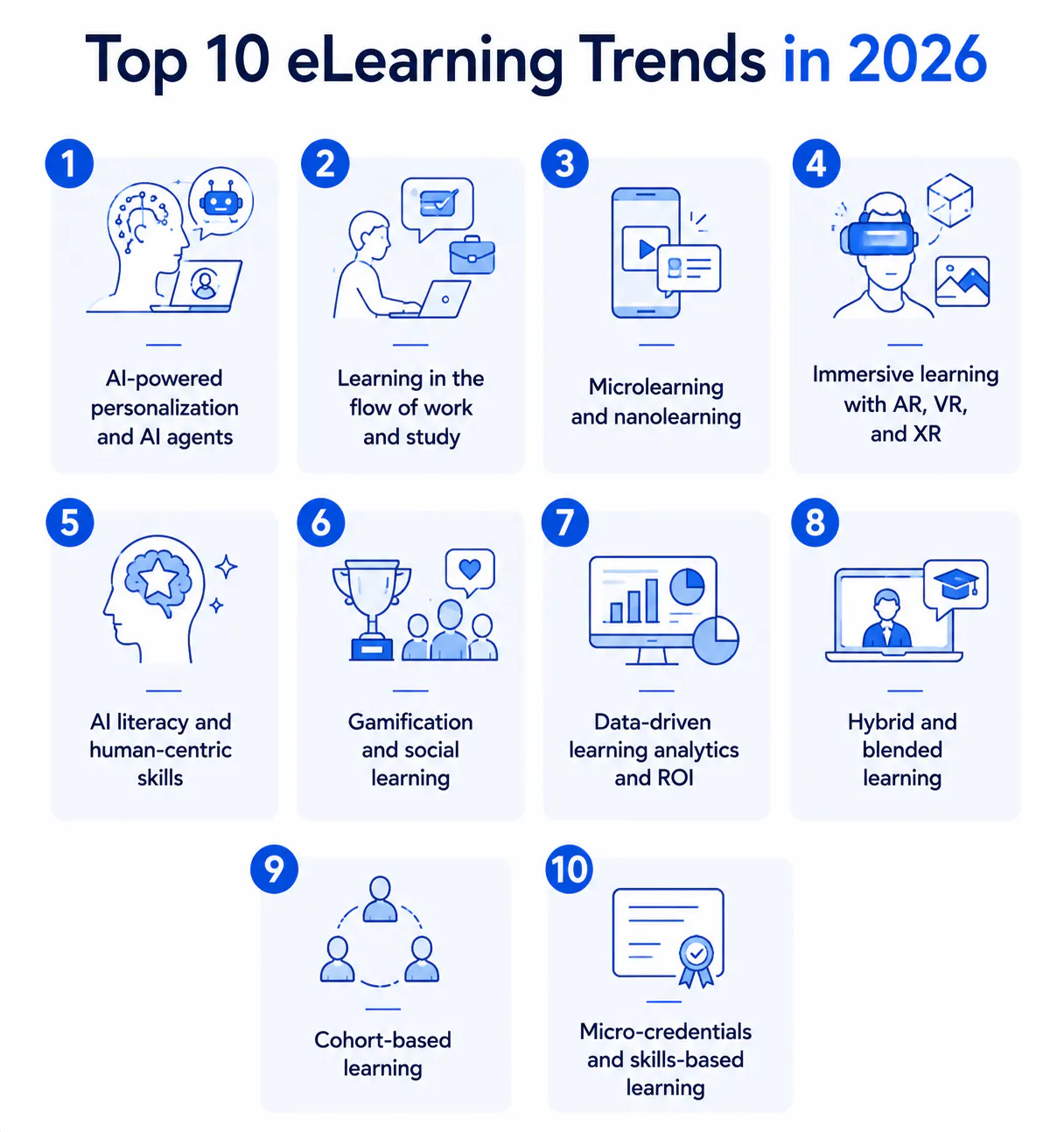
The top 10 eLearning trends in 2026 are:
- AI-powered personalization and AI agents
- Learning in the flow of work and study
- Microlearning and nanolearning
- Immersive learning with AR, VR, and XR
- AI literacy and human-centric skills
- Gamification and social learning
- Data-driven learning analytics and ROI
- Hybrid and blended learning
- Cohort-based learning
- Micro-credentials and skills-based learning
AI Agents and Personalization
AI agents in 2026 analyze behavioral data, generate personalized learning paths, and execute training decisions in real time without manual input.
AI systems have evolved into agentic models that recommend content, adjust difficulty levels, and automate learning journeys. These systems continuously track learner performance and align training with measurable skill gaps and goals.
According to PwC survey, 79% of businesses use AI agents, and 66% report measurable productivity gains. The AI agents market is projected to reach USD 52.62 billion by 2030, confirming large-scale adoption across education and enterprise training.
Recommendation: Start with one practical AI use case, such as personalized content recommendations or an AI tutor, and keep teachers or instructors involved in reviewing learning outcomes.
Learning in the Flow of Work
Learning in the flow of work embeds training directly into digital tools, enabling learners to access task-specific knowledge instantly as they execute.
Content is integrated into platforms such as collaboration tools and enterprise systems, triggered by real-time actions. Learners receive targeted instructions at the exact moment of need, eliminating separate training sessions.
Recommendation: Identify common points where learners get stuck and create short resources that can be accessed directly at those moments.
Microlearning & Nanolearning
Microlearning and nanolearning deliver structured content in 30-second to 10-minute formats, improving completion rates, engagement, and retention.
Microlearning achieves up to 80% completion rates compared to 20% for traditional courses. Content production is 300% faster, and costs are reduced by 50%, while engagement increases by up to 50%.
AI systems deliver context-aware modules and assemble personalized learning paths based on real-time learner data and behavior.
Recommendation: Use microlearning for revision, reinforcement, onboarding, skill practice, and just-in-time support, while keeping longer courses for subjects that require deeper instruction.
Read more: How Microlearning Is Changing the Way We Learn in 2026?
Immersive Tech Adoption (AR/VR)
Immersive technologies use AR and VR to simulate real-world environments, enabling safe and practical skill development.
Extended Reality is applied in healthcare, aviation, and manufacturing to train learners in high-risk scenarios without physical consequences. Learners perform tasks in controlled simulations that replicate real conditions.
Recommendation: Use AR or VR where simulation provides a clear learning advantage. Do not introduce immersive technology simply because it is new.
AI Literacy and Human-Centric Skills
AI literacy training develops the ability to use AI systems effectively while strengthening critical thinking, decision-making, and emotional intelligence.
Programs focus on safe AI usage, ethical understanding, and operational competence. Learners gain the ability to interpret outputs, identify risks, and apply AI tools in structured workflows.
Recommendation: Combine AI training with critical thinking and verification activities instead of teaching AI tools in isolation.
Gamification & Social Learning
Gamification and social learning increase engagement through structured interaction, competition, and collaboration.
Elements such as badges, leaderboards, and group challenges improve participation and completion rates. Social learning environments enable knowledge sharing and peer-driven reinforcement.
Cohort-based learning achieves over 90% completion rates, demonstrating the impact of collaborative learning structures.
Recommendation: Use gamification to reinforce learning objectives and add meaningful peer interaction rather than using points and badges simply to increase activity.
Read more: 10 Learning Management System (LMS) Trends to Watch in 2026
Data-Driven ROI Metrics
Data-driven analytics measure learning effectiveness by linking training activity to performance and business outcomes.
95% of organizations struggle to align learning with business goals, and 69% cannot measure learning impact. Systems such as xAPI and Learning Record Stores track detailed learner interactions across platforms.
These systems connect learning data to KPIs such as productivity, retention, and revenue, transforming training into a measurable business function.
Recommendation: Decide what learning outcome you want to measure before collecting data. Track meaningful indicators such as skill progression, assessment performance, knowledge gaps, or time to competency.
Hybrid Learning & Blended Learning
Hybrid and blended learning combine in-person instruction, live online sessions, and self-paced digital learning.
The focus in 2026 is shifting from simply offering multiple delivery methods to designing them as one connected learning experience. Online content can provide preparation and independent study, while live sessions can focus on discussion, collaboration, demonstrations, and practical application.
This approach is relevant to schools, universities, professional training, and distributed organizations. Current education technology research identifies hybrid learning as part of the broader move toward flexible and technology-supported learning ecosystems.
Recommendation: Decide which learning activities work best online and which require live interaction, then connect both through a single course structure and assessment system.
Cohort-Based Learning Makes a Comeback
Cohort-based learning organizes learners into structured groups that follow fixed timelines, improving engagement, accountability, and completion rates.
Learners progress together through scheduled modules, discussions, and collaborative tasks. This structure reinforces consistency and increases participation through shared responsibility and peer interaction.
Completion rates exceed 90% in cohort-based programs. AI systems support delivery by identifying disengaged learners, assisting instructors with feedback, and maintaining balanced group performance.
Recommendation: Use cohort-based learning when peer interaction and accountability are important. Combine scheduled group activities with self-paced resources to give learners flexibility.
Micro-Credentials: Skills Over Degrees
Micro credentials validate specific competencies through measurable outcomes, replacing degree-based evaluation with skill-focused proof of ability.
Each credential represents a defined skill aligned with real-world tasks and job requirements. This approach connects learning directly to employability and performance.
According to the 2025 Coursera Micro-credentials Impact Report, 96% of organizations recognize micro-credentials as valuable in hiring, and 87% have recruited candidates with at least one credential. These credentials stack into flexible pathways that support continuous skill development.
Recommendation: Map every micro-credential to a clearly defined competency and assessment. A credential should demonstrate what the learner can actually do, not simply confirm that they completed a course.
Conclusion
The eLearning ecosystem in 2026 is defined by intelligent systems, measurable outcomes, and skill-first learning models. AI agents, immersive technologies, and data-driven frameworks are transforming how learning is designed, delivered, and evaluated.
Organizations and institutions that adopt these trends build scalable, efficient, and outcome-focused learning environments that align directly with business and workforce needs. The shift is no longer toward digital learning adoption, but toward optimizing learning for performance, precision, and long-term impact.

