
TL;DR
- Key government initiatives shaping EdTech in India include NEP 2020, Digital India, PM eVIDYA, DIKSHA, SWAYAM, and NDEAR, each supporting different aspects of digital education and technology adoption.
- These policies influence how schools approach digital learning, from infrastructure and online education to teacher development, blended learning, digital resources, and interoperability.
- Understanding these initiatives helps schools make better technology decisions and build digital learning environments that align with India's evolving education goals and requirements.

Government policies shape how schools adopt, regulate, and implement education technology across the country. Government initiatives encourage digital learning, improve technology infrastructure, support teacher development, and establish standards for digital education.
Schools that understand education technology policies can select suitable technology solutions and align digital learning strategies with national education goals. In this blog, we will explore key government initiatives, the impact of policy changes on schools, and ways educational institutions can align technology adoption with evolving education requirements.
Major Government Policies That Impact EdTech in India
India's digital education ecosystem is supported by several government initiatives. Each policy focuses on a different area, from digital infrastructure and online learning to teacher development and technology integration.
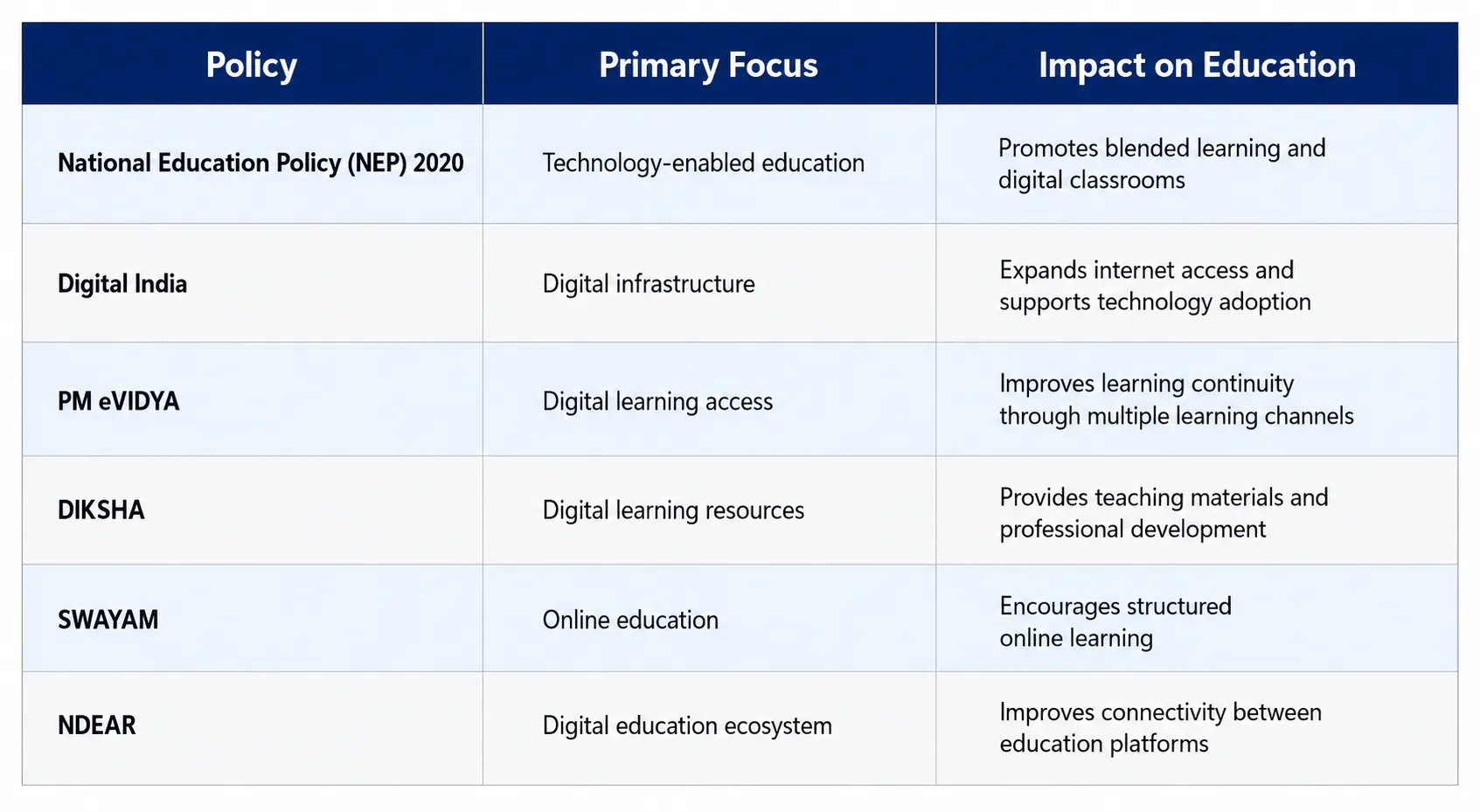
National Education Policy (NEP) 2020
The National Education Policy 2020 encourages schools to integrate technology into everyday teaching and learning. It promotes competency-based education, blended learning, digital literacy, and continuous assessment to improve student learning experiences.
Key highlights
- Promotes conceptual learning over rote memorisation.
- Encourages blended and technology-supported learning.
- Supports digital skill development for teachers and students.
Impact on schools
Schools are encouraged to adopt digital platforms that support interactive lessons, continuous assessments, personalised learning, and better classroom management.
Read more: How NEP 2020 Promotes Critical Thinking and Problem Solving?
Digital India Programme
The Digital India Programme strengthens the country's digital infrastructure and expands access to internet-based services. It creates the foundation that allows schools to adopt modern educational technologies.
Key highlights
- Expands broadband connectivity.
- Promotes digital public services.
- Encourages technology adoption across education.
Impact on schools
Schools gain better access to smart classrooms, online learning platforms, and digital teaching resources through improved digital infrastructure.
PM eVIDYA
PM eVIDYA brings together multiple digital learning initiatives under one programme to improve access to education across the country.
Key highlights
- Supports learning through online platforms, television, and radio.
- Expands access to digital education.
- Promotes uninterrupted learning.
Impact on schools
Schools can continue teaching through multiple digital channels and reach students with different learning needs and levels of internet access.
DIKSHA
DIKSHA is a national digital platform that provides curriculum-aligned learning resources for teachers and students.
Key highlights
- Provides digital textbooks and learning materials.
- Supports teacher professional development.
- Delivers curriculum aligned educational content.
Impact on schools
Teachers can access ready to use learning resources, making lesson planning and digital teaching easier.
Read more: 10 Modern Learning Methods Transforming K-12 Education
SWAYAM
SWAYAM is India's online learning platform that provides structured courses developed by recognised educational institutions.
Key highlights
- Offers government supported online courses.
- Supports structured digital learning.
- Encourages quality online education.
Impact on schools
Although primarily designed for higher education, SWAYAM strengthens the acceptance of digital learning and encourages structured online education across the education sector.
National Digital Education Architecture (NDEAR)
NDEAR provides a common digital framework that allows different education technology systems to work together more efficiently.
Key highlights
- Supports interoperability between education platforms.
- Standardises digital education systems.
- Improves data sharing across institutions.
Impact on schools
Schools can connect multiple digital tools more efficiently, reduce duplicate work, and create a more connected digital learning ecosystem.
How Quyl Helps Schools Align with Government Policies
Quyl supports schools in meeting the goals of India's digital education initiatives through a connected school LMS platform for teaching, learning, assessments, and academic management. Its features help schools adopt technology more effectively while creating a structured digital learning environment.
Supports NEP 2020 Learning Goals
Quyl enables schools to create interactive courses, conduct continuous assessments, organise digital learning resources, and monitor student progress. These features support competency-based and blended learning approaches encouraged by NEP 2020.
Simplifies Digital Teaching
Teachers can create structured courses, upload files, videos, links, and interactive content, while managing quizzes and assignments from one platform. This makes digital lesson planning and classroom delivery more organised.
Improves Student Progress Monitoring
Quyl provides enrollment tracking, progress monitoring, assessment tracking, and smart reports. Teachers and school leaders can monitor learner performance and make informed academic decisions using real time insights.
Supports Teacher Productivity
Quyl reduces administrative work by combining course management, assessments, grading, reporting, and learner tracking within one platform. Teachers spend less time managing systems and more time supporting students.
Creates a Connected Digital Learning Environment
Quyl brings together live classes, learning content, assessments, schedules, reports, and academic administration in one system. Schools can manage digital learning more efficiently without relying on multiple disconnected platforms.
Scales with Institutional Growth
Quyl supports individual classrooms, schools, coaching centres, and training institutions through structured course management, learner management, reporting, and administrative tools, making it suitable as digital learning requirements grow.

