
TL;DR
- Every smart classroom should have these 10 essential tools: Interactive Flat Panel Displays (IFPDs), Learning Management Systems (LMS), student laptops and tablets, AI-powered assessment tools, document cameras, classroom audio systems, interactive digital whiteboards, video conferencing tools, classroom management software, and VR/AR technology.
- Together, these technologies help schools create more engaging, interactive, and data-driven learning experiences while improving teaching efficiency and student outcomes.
- When investing in smart classroom equipment, schools should prioritise integrated, scalable, and easy-to-use solutions that support long-term teaching and learning goals.
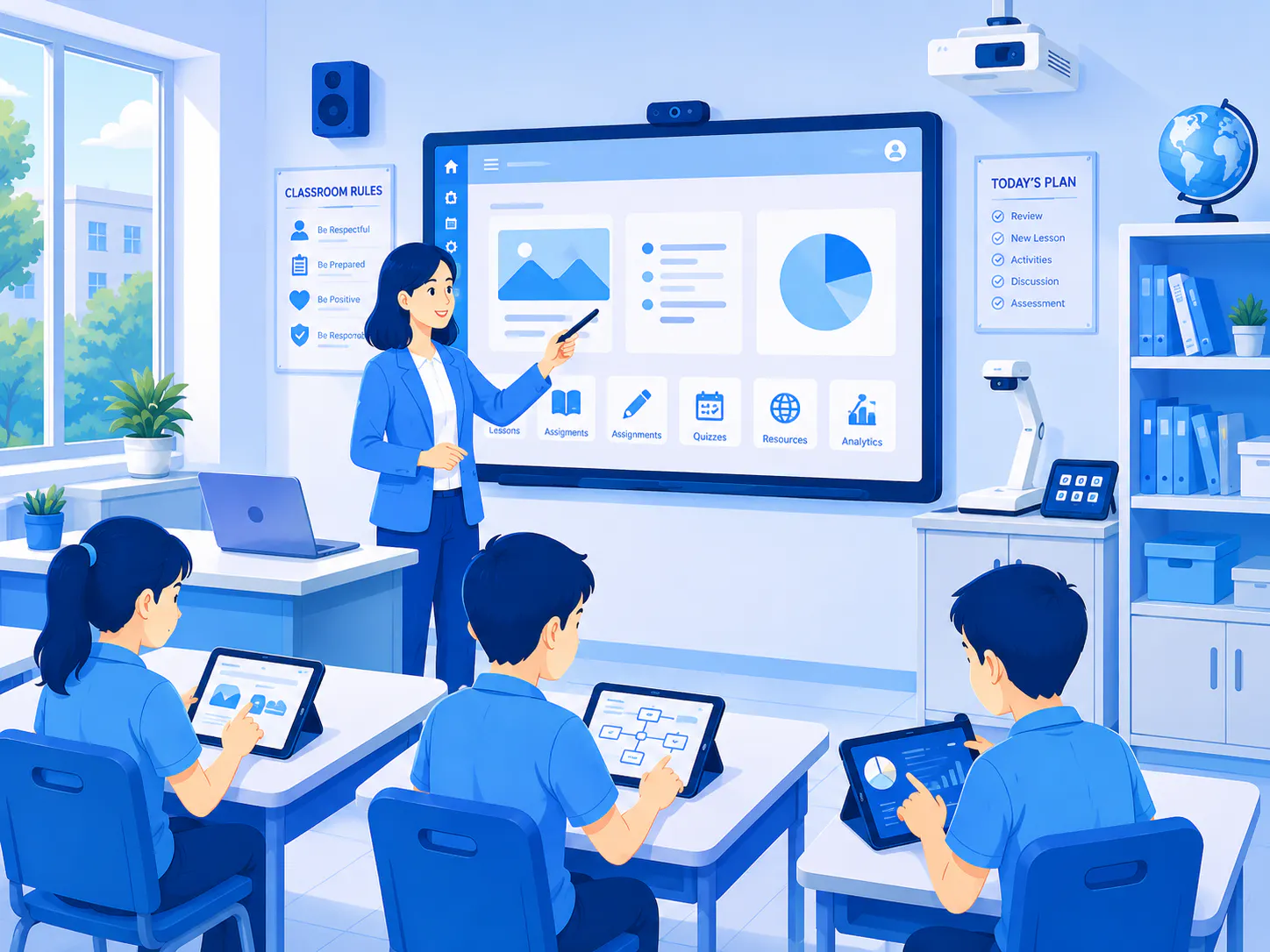
Students are losing attention faster than ever, and traditional classrooms are struggling to keep pace. Long lectures, static whiteboards, and one size fits all teaching methods are no longer enough for learners who are growing up in a digital first world. Schools are now looking beyond textbooks and investing in technology that makes learning more interactive, engaging, and personalised.
Smart classroom equipment is at the centre of this transformation. From interactive displays and AI powered tools to learning management systems and real time analytics, modern classrooms are becoming more connected and data driven. These technologies not only improve student engagement but also help teachers deliver lessons more efficiently and monitor learning outcomes with greater accuracy.
In this blog, we'll look at the top 10 smart classroom equipment every school should consider in 2026, how each one supports better teaching and learning, and what schools should prioritise when building a future ready classroom.
1. Interactive flat panel displays (IFPDs)
Interactive Flat Panel Displays (IFPDs) have become the centrepiece of modern smart classrooms, replacing traditional whiteboards, projectors, and chalk based teaching. Unlike conventional displays, IFPDs allow teachers to write, annotate, play multimedia content, browse the internet, conduct live quizzes, and collaborate with students on a single touch enabled screen. Their ability to combine visual learning, interactive teaching, and digital resources helps create a far more engaging classroom environment.
2. Learning Management System (LMS)
A Learning Management System for schools serves as the foundation of every smart classroom. Instead of managing lessons, assignments, assessments, attendance, and communication across multiple applications, an LMS centralises everything in one platform. Teachers can create courses, distribute learning materials, schedule assessments, communicate with students, monitor academic progress, and analyse classroom performance without switching between different tools.
Modern LMS platforms also integrate AI powered features such as automated grading, quiz generation, learning analytics, and personalised feedback, allowing educators to spend less time on administration and more time supporting student learning.
3. Student laptops and tablets
Providing students with individual laptops or tablets enables learning to continue beyond the classroom. These devices allow learners to access digital textbooks, complete assignments, participate in collaborative projects, conduct research, attend virtual lessons, and engage with interactive educational content. They also support personalised learning by allowing students to progress at their own pace whilst giving teachers greater visibility into student performance and participation.
4. AI powered assessment tools
Assessment no longer needs to be a time consuming manual process. AI powered assessment tools enable teachers to generate quizzes, create question papers, automate grading, provide instant personalised feedback, and identify learning gaps within minutes. Instead of spending hours evaluating assignments, educators can focus on improving instruction whilst using performance analytics to support students who require additional attention.
5. Document cameras
Document cameras make it easier for teachers to demonstrate physical textbooks, worksheets, handwritten solutions, laboratory experiments, maps, artwork, and three dimensional objects to an entire classroom. They also support lesson recording, allowing absent students to revisit classroom demonstrations later. This makes them particularly valuable for science, mathematics, art, and practical learning environments where visual demonstrations improve understanding.
Read more: How NEP 2020 Promotes Critical Thinking and Problem Solving?
6. Classroom audio systems
Clear communication is essential for effective learning, especially in large classrooms. Classroom audio systems combine microphones and strategically placed speakers to ensure every student can hear instructions without difficulty. Teachers can move freely around the classroom while maintaining consistent audio quality, reducing vocal strain and creating a more inclusive learning experience for every learner.
7. Interactive digital whiteboards
Digital whiteboards extend classroom collaboration far beyond traditional writing surfaces. Teachers can create diagrams, annotate presentations, solve mathematical equations, explain scientific concepts, and invite students to participate directly on the display. Many platforms also include drawing tools, geometry instruments, templates, and screen annotation features that make visual learning significantly more engaging and interactive.
8. Video conferencing and live classroom tools
Hybrid learning has made virtual classroom technology an essential part of modern education. Integrated video conferencing tools allow schools to conduct live online classes, share presentations, record lessons, and facilitate discussions between teachers and students regardless of location. These platforms ensure learning continues uninterrupted during remote or blended learning environments.
9. Classroom management software
Managing multiple classes manually can become overwhelming as student numbers grow. Classroom management software simplifies daily operations by helping teachers organise learners, schedule classes, monitor attendance, assign coursework, manage virtual classrooms, and track classroom activities from a single dashboard. This improves operational efficiency whilst allowing teachers to focus more on instruction than administration.
Read more: What is the Difference Between LMS and Traditional Learning Methods?
10. Virtual reality (VR) and augmented reality (AR)
Virtual Reality and Augmented Reality are transforming classroom experiences by allowing students to interact with concepts that are difficult to visualise through textbooks alone. Students can explore historical landmarks, perform virtual science experiments, study human anatomy in three dimensions, or experience immersive field trips without leaving the classroom. These technologies make abstract concepts easier to understand while increasing curiosity, participation, and long term knowledge retention.
Key Factors to Consider Before Investing in Smart Classroom Equipment
Schools should choose smart classroom technology based on long term learning outcomes rather than features alone. Consider these key factors before making an investment:
- Align with teaching goals to ensure the technology supports learning outcomes and classroom needs.
- Choose integrated solutions that work seamlessly with your LMS and existing digital tools.
- Prioritise ease of use so teachers and students can adopt the technology quickly.
- Plan for future growth by investing in scalable solutions that can expand with your institution.
- Evaluate total costs including installation, maintenance, software, and support.
- Ensure reliable technical support to minimise downtime and classroom disruptions.
- Protect student data by choosing platforms with strong security and privacy measures.
- Train teachers effectively so they can confidently use the technology in everyday teaching.

