
Key Takeaways
- Modern learning methods move beyond traditional lectures by encouraging students to participate, collaborate, apply knowledge, and take greater ownership of learning.
- Approaches such as blended, flipped, project-based, personalised, competency-based, and inquiry-based learning support different learning needs and classroom goals.
- Technologies such as LMS platforms, digital content, online assessments, learning analytics, collaboration tools, and VR/AR can support modern teaching and learning methods.
Learning has changed significantly as classrooms move beyond traditional lectures, textbooks, and memorisation. Modern learning methods encourage students to participate actively, apply knowledge to practical situations, collaborate with peers, and use digital tools to support their learning.
From blended and flipped learning to project-based, personalised, competency-based, and collaborative learning, modern approaches give teachers more ways to address different learning needs while creating more flexible and engaging learning experiences.
In this blog, we’ll look at 10 modern learning methods, the technologies that support them, their benefits and challenges, and how schools can implement these approaches effectively.
Why Is Traditional Learning No Longer Enough?
Traditional learning alone may not meet the needs of today’s students because it often:
- Relies heavily on lectures and memorisation.
- Uses the same pace and approach for all students.
- Provides fewer opportunities for practical learning.
- Limits learning to fixed classroom schedules.
- Can delay feedback and progress tracking.
- Gives teachers less real-time insight into student performance.
Read more: Why Traditional Teaching Methods Are Losing Student Attention?
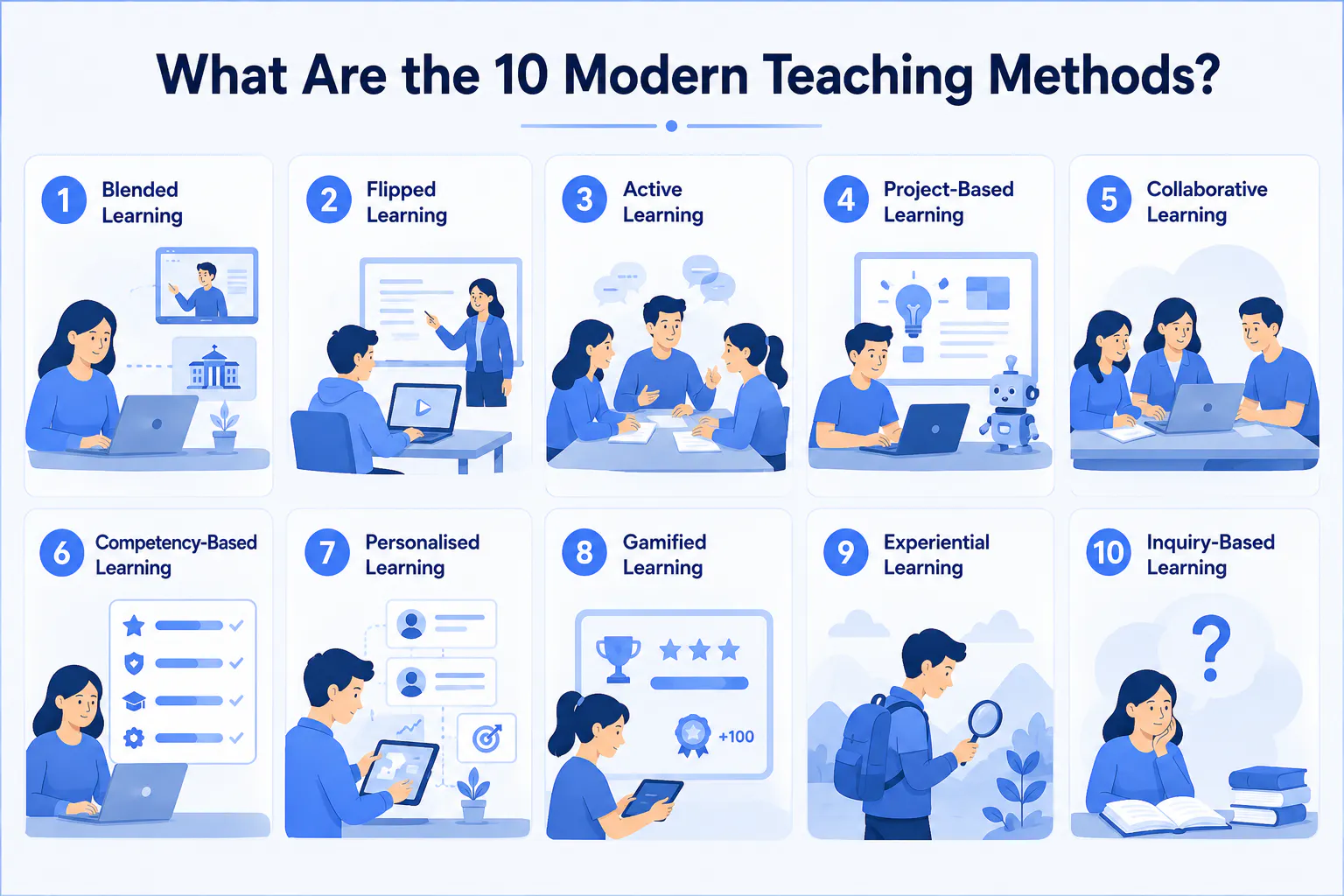
What Are the 10 Modern Teaching Methods?
Modern learning methods shift the focus from simply delivering information to helping students participate, apply knowledge, collaborate, and demonstrate what they understand. Each method uses a different approach to organise teaching and learning. The 10 modern learning methods are:
- Blended Learning
- Flipped Learning
- Active Learning
- Project-Based Learning
- Collaborative Learning
- Competency-Based Learning
- Personalised Learning
- Gamified Learning
- Experiential Learning
- Inquiry-Based Learning
1. Blended Learning
Blended learning combines face-to-face teaching with online learning. Teachers can introduce concepts in the classroom and use digital resources for practice, revision, assessments, or additional learning outside class.
Example: A teacher explains photosynthesis in class and then assigns a video and online quiz for students to complete at home.
Best for: Schools that want to combine traditional classroom teaching with digital learning.
2. Flipped Learning
Flipped learning moves the initial delivery of learning content outside the classroom. Students study videos, readings, or digital lessons before class, while classroom time focuses on discussion, activities, and problem solving.
Example: Students watch a lesson on algebra before coming to class, then spend the classroom session solving equations with teacher guidance.
Best for: Classrooms where teachers want more time for practice, discussion, and individual support.
Read more: 40 AI Prompts That Save Teachers Hours Every Week
3. Active Learning
Active learning involves students directly in the learning process through activities such as discussions, experiments, debates, problem solving, and peer learning. The approach shifts students from simply receiving information to applying and discussing concepts.
Example: Instead of explaining a science experiment, the teacher asks students to predict the result, conduct the experiment, and explain their observations.
Best for: Improving participation, understanding, and critical thinking.
4. Project-Based Learning
Project-based learning uses a practical project as the foundation for learning. Students research a problem, apply subject knowledge, develop an outcome, and present their work.
Example: Students design a sustainable school model using concepts from science, mathematics, environmental studies, and technology.
Best for: Developing practical skills, problem solving, creativity, and collaboration.
5. Collaborative Learning
Collaborative learning allows students to work together to achieve a shared learning objective. Students can discuss ideas, divide responsibilities, solve problems, review work, and develop projects as a group.
Example: A history teacher divides students into groups and asks each group to research different perspectives of the same historical event before presenting their findings.
Best for: Building teamwork, communication, peer learning, and social skills.
Read more: What is Learner Autonomy?
6. Competency-Based Learning
Competency based learning focuses on what students can demonstrate, rather than simply how much content students have completed. Teachers define specific skills or outcomes and assess whether students have achieved them.
Example: Instead of marking a student successful because the student completed a mathematics chapter, the teacher assesses whether the student can correctly interpret graphs and explain the results.
Best for: Skill based education, measurable outcomes, and mastery focused learning.
7. Personalised Learning
Personalised learning adapts learning experiences according to individual student needs, abilities, progress, and learning pace. Teachers can provide different resources, activities, practice levels, and support based on student performance.
Example: Students who struggle with fractions receive additional practice while students who have mastered the topic work on advanced problems.
Best for: Supporting mixed ability classrooms and individual learning needs.
Read more: How Teachers Can Use AI to Identify Learning Gaps and Reduce Dropouts?
8. Gamified Learning
Gamified learning uses elements such as points, challenges, badges, levels, rewards, and progress indicators within educational activities. These elements can make repetitive practice more engaging without turning the entire lesson into a game.
Example: A language teacher creates vocabulary challenges where students earn points for completing quizzes and correctly using new words.
Best for: Increasing motivation, participation, and repeated practice.
9. Experiential Learning
Experiential learning connects academic concepts with direct experience. Students learn through practical activities, experiments, simulations, fieldwork, role play, and reflection.
Example: Business students create a mock business, calculate costs, set prices, and present their business plan to the class.
Best for: Practical learning, real-world application, and deeper understanding.
Read more: 10 Smart Strategies for Teachers to Work Smarter and Save Time
10. Inquiry-Based Learning
Inquiry based learning begins with a question, problem, or situation that encourages students to investigate and develop an answer. Students research information, collect evidence, test ideas, and draw conclusions with teacher guidance.
Example: Instead of explaining what plants need to grow, a teacher asks students which conditions produce the fastest growth and allows students to design an experiment.
Best for: Developing curiosity, independent learning, research skills, and critical thinking.
Read more: What Is a Learning Management System (LMS)?
What Technologies Support Modern Learning Methods?
Modern learning methods rely on technology to deliver content, support interaction, assess learning, and track student progress. The technology does not replace the teacher; it gives teachers additional ways to organise and support learning.
- Learning Management Systems (LMS): An LMS for schools helps in managing courses, learning materials, assignments, assessments, and student progress.
- Digital Content Platforms: Provide e textbooks, videos, simulations, presentations, and interactive learning materials.
- Online Assessment Tools: Support digital quizzes, tests, assignments, automated grading, and instant feedback.
- Virtual Classroom Platforms: Enable live online classes, discussions, presentations, and remote collaboration.
- Collaboration Tools: Allow students and teachers to work together through shared documents, discussions, projects, and communication.
- Learning Analytics: Analyse student activity, assessment results, progress, and engagement to support teaching decisions.
- Mobile Learning Technologies: Allow students to access lessons, resources, and activities through smartphones and tablets.
- VR and AR Technologies: Create immersive simulations and interactive experiences for subjects where practical or visual learning adds value.
Read more: Top 10 Smart Classroom Equipment Every School Needs in 2026
Conclusion
Modern learning methods give schools more ways to match teaching with student needs, learning objectives, and real world skills. Approaches such as blended, flipped, project based, competency based, personalised, and inquiry based learning can make learning more active, flexible, and focused on measurable outcomes.
Technology can strengthen these approaches by giving teachers access to digital content, assessments, learning analytics, collaboration tools, and an LMS. Schools do not need to adopt one method across every subject. They can combine different approaches based on what works best for their students, teachers, curriculum, and learning goals.

