
Key takeaways
- NEP 2020 is India’s National Education Policy introduced in 2020, designed to transform education through holistic development, competency based learning, skill development, and technology integration.
- NEP 2020 moves education beyond rote learning, emphasizing critical thinking, problem solving, practical skills, flexible learning, and holistic student development.
- Technology supports NEP 2020 implementation, with LMS platforms, digital learning, learning analytics, and AI tools helping schools improve teaching, assessment, and student progress tracking.

The National Education Policy 2020 (NEP 2020) introduces a major shift in how schools approach education. Approved by the Government of India on July 29, 2020, NEP 2020 replaces the previous National Policy on Education 1986 and creates a framework focused on holistic development, competency based learning, vocational exposure, and digital education.
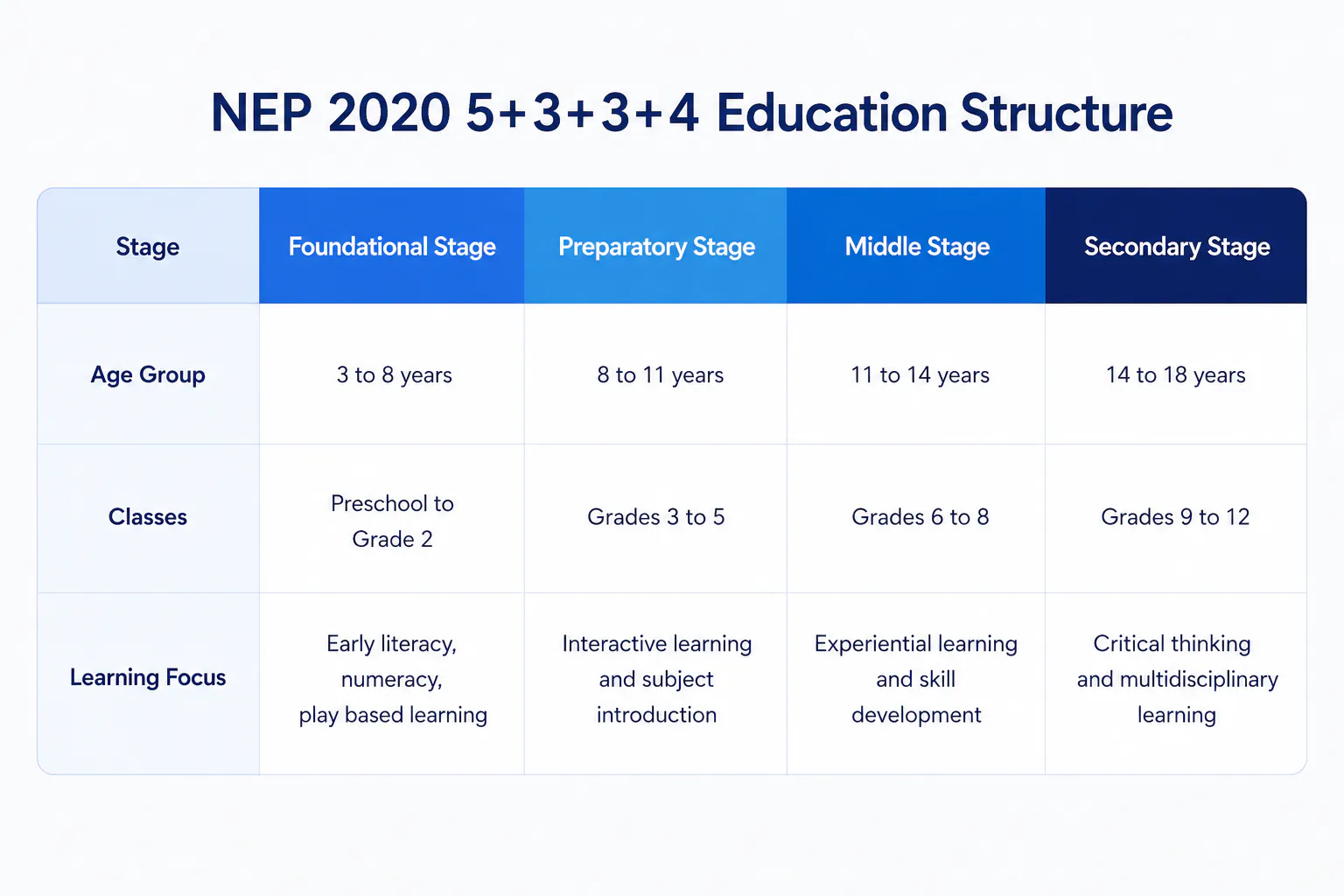
For schools, NEP 2020 impacts every part of academic operations. It changes the school structure through the 5+3+3+4 education model, strengthens foundational literacy and numeracy, introduces skill based learning from Grade 6, improves assessment methods, and increases the importance of technology in education management.
The policy also creates new responsibilities for school administrators and teachers. Institutions must adopt modern teaching approaches, improve student progress tracking, and create learning environments that support individual student needs.
In this guide you will get to know what is NEP 2020, its key features, implementation challenges, assessment reforms, technology requirements, and how schools can use digital learning platforms to support NEP aligned education.
What is NEP 2020?
The National Education Policy 2020 is India’s education reform framework that focuses on improving learning outcomes through flexible curriculum design, competency based education, skill development, and technology integration.
Introduced by the Ministry of Education, NEP 2020 redesigns school education by focusing on how students learn rather than only what students memorize.
The policy covers:
- School education from early childhood to Grade 12
- Teacher development and professional training
- Vocational education and skill development
- Student assessment reforms
- Digital learning infrastructure
- Higher education transformation
NEP 2020 replaces the earlier 10+2 education structure with a development focused model that includes early childhood education and organizes learning stages according to student growth.
The policy aims to create students who can apply knowledge, solve problems, communicate effectively, and develop skills required for future opportunities.
Why was NEP 2020 introduced?
NEP 2020 was introduced to address challenges in India’s education system, including rote learning, limited practical skill development, outdated assessment methods, and unequal access to quality education.
Traditional education systems focused heavily on syllabus completion and examination performance. This created gaps between academic knowledge and real world application.
NEP 2020 addresses these challenges by introducing:
- Concept based learning: Students focus on understanding ideas instead of memorizing information.
- Skill development: Schools introduce practical skills, vocational learning, and technology exposure.
- Flexible education pathways: Students receive greater freedom in choosing subjects and learning methods.
- Inclusive learning systems: Schools create better opportunities for students from different backgrounds.
Read more: How NEP 2020 Promotes Critical Thinking and Problem Solving?
What are the key objectives of NEP 2020?
The main objective of NEP 2020 is to create a student focused education system that develops academic knowledge, practical skills, creativity, and critical thinking abilities.
The major objectives include:
Improve foundational literacy and numeracy
NEP 2020 identifies early learning skills as the foundation of education.
Schools focus on developing:
- Reading ability
- Writing skills
- Basic mathematical understanding
The policy aims for students to achieve foundational literacy and numeracy skills by Grade 3.
Promote holistic education
The policy expands education beyond academic subjects by including:
- Arts
- Sports
- Vocational learning
- Communication skills
- Life skills
Increase flexibility in learning
NEP 2020 allows students to explore different subjects based on their interests, abilities, and career goals.
Strengthen teacher development
Teachers receive greater support through:
- Professional development programs
- Digital teaching training
- Modern teaching methodologies
What is the 5+3+3+4 education structure in NEP 2020?
The 5+3+3+4 structure is the new school education model introduced by NEP 2020. It replaces the previous 10+2 system and divides education into four stages based on student development from ages 3 to 18.
What are the fundamental principles of NEP 2020?
The fundamental principles of NEP 2020 are Access, Equity, Quality, Affordability, and Accountability. These principles guide schools in improving education delivery and student outcomes.
- Access: Ensures every student receives opportunities for quality education through better resources, digital tools, and inclusive learning environments.
- Equity: Supports every learner through personalized learning, inclusive classrooms, and additional academic assistance.
- Quality: Improves education standards through better teacher training, modern curriculum, and improved assessment methods.
- Affordability: Reduces barriers that limit access to education and promotes wider participation.
- Accountability: Helps schools measure performance and improve outcomes through data driven decisions.
Read more: Best ICT Tools for Teaching and Learning
What are the Main Features of NEP 2020?
The main features of NEP 2020 focus on early education, skill development, inclusive learning, assessment improvements, and technology integration.
- Early Childhood Care and Education (ECCE): Brings preschool education into the formal learning system with focus on language, numeracy, cognitive growth, and social skills.
- Foundational Literacy and Numeracy (FLN): Ensures students develop basic reading, writing, and mathematics skills by Grade 3 through structured activities and continuous assessments.
- Mother Tongue and Multilingual Education: Encourages learning through familiar languages using regional resources and bilingual teaching methods.
- Vocational Education: Introduces skill based learning from Grade 6 through practical activities, internships, and career focused programs.
- Inclusive Education: Supports equal learning opportunities through accessible infrastructure, personalized support, and flexible teaching methods.
- Higher Education Reforms: Introduces multidisciplinary learning, flexible degree options, Academic Bank of Credits, and research focused education.
What does NEP 2020 say about teacher training?
NEP 2020 identifies teacher development as a critical factor in improving education quality. The policy focuses on continuous professional development, digital skills, and student focused teaching methods.
Teacher development under NEP 2020 includes:
- Professional development: Teachers are expected to complete continuous training, including 50 hours of professional development annually.
- Digital teaching skills: Educators learn to use technology for content creation, assessments, and student tracking.
- Modern teaching methods: Teachers shift from lecture based instruction toward interactive and practical learning.
- Continuous improvement: Regular training helps teachers adapt to changing education requirements.
Read more: 10 Must-Have Smart Classroom Tools for Modern Schools
How can schools successfully implement NEP 2020?
Schools can implement NEP 2020 successfully by combining teacher development, digital infrastructure, competency based assessments, and structured learning systems.
Schools should focus on:
- Adopting digital learning solutions: Use technology platforms such as LMS platforms for schools for course delivery, assessments, and tracking.
- Strengthening teacher capabilities: Provide regular training on modern teaching practices.
- Improving assessment systems: Track student learning through continuous evaluation.
- Encouraging experiential learning: Introduce projects, practical activities, and skill based programs.
What are the implementation challenges of NEP 2020?
Implementing NEP 2020 requires schools to upgrade teaching methods, digital infrastructure, assessment systems, and teacher capabilities. The biggest challenges include technology adoption, curriculum changes, teacher readiness, and managing a shift toward competency based education.
Schools face several operational challenges while aligning their systems with NEP 2020:
- Digital infrastructure gaps: Schools require reliable internet access, digital devices, and learning platforms to support technology enabled education.
- Teacher training requirements: Educators need continuous training to adopt new teaching methods, digital tools, and competency based assessments.
- Assessment transformation: Schools must move beyond traditional examinations and implement continuous evaluation methods that measure student understanding and skills.
- Curriculum adaptation: Institutions need to include experiential learning, vocational exposure, and multidisciplinary approaches within existing academic frameworks.
Read more: 40 AI Prompts That Save Teachers Hours Every Week
How does NEP 2020 reform assessment in schools?
NEP 2020 changes assessment methods by focusing on competency, understanding, and practical application instead of only testing memory through examinations.
The assessment approach under NEP 2020 includes:
- Competency based evaluation: Students are assessed on their ability to apply concepts, solve problems, and demonstrate skills.
- Continuous assessment: Schools use assignments, activities, projects, and quizzes to track learning progress throughout the academic year.
- Holistic progress reports: Student evaluation includes academic performance, skills, participation, and overall development.
- PARAKH framework: The Performance Assessment, Review, and Analysis of Knowledge for Holistic Development (PARAKH) establishes national assessment standards to improve evaluation quality.
Read more: 6 Government Policies Shaping EdTech in India
What is the role of technology in NEP 2020?
Technology enables schools to deliver digital learning, monitor student progress, conduct assessments, and improve academic decision making through data driven insights.
NEP 2020 encourages schools to integrate:
- Digital learning platforms: Deliver courses, learning materials, and interactive content beyond traditional classrooms.
- Learning management systems: A Learning Management System (LMS) helps schools organize, deliver, and monitor learning activities through a centralized platform.
- Learning analytics: Use student data to identify progress patterns and learning gaps.
- AI powered education tools: Support teachers through automation, personalized learning support, and smarter academic decisions.
How does Quyl support NEP 2020 implementation in schools?
Quyl helps schools align with NEP 2020 by enabling digital learning, competency based assessments, student tracking, and smarter academic management.
- Course creation: Build structured courses with videos, files, and interactive content.
- Assessments: Create quizzes, assignments, and automated evaluations.
- Student tracking: Monitor progress with reports and learning insights.
- Digital learning: Support live classes and blended learning models.
- Cohort management: Organize learners and assign learning paths.
- AI support: Automate tasks and improve academic decisions.
Conclusion
NEP 2020 creates a modern education framework focused on skill development, flexible learning, competency based assessments, and technology enabled teaching.
The policy changes how schools approach curriculum planning, student evaluation, teacher development, and academic management.
Schools that combine effective teaching practices with digital learning systems can create more personalized, measurable, and future ready learning environments for students. NEP 2020 provides the framework, while technology platforms help institutions implement these changes effectively.

