
Key Takeaways
- A Headless LMS separates the front-end from the back-end, enabling organizations to deliver personalized learning experiences across multiple platforms while maintaining centralized content management.
- A Traditional LMS combines the front-end and back-end into a single platform, making it easier to deploy, manage, and deliver structured learning with minimal technical complexity.
- Choosing between a Headless LMS and a Traditional LMS depends on an organization's customization needs, technical resources, integration requirements, and long-term learning strategy.

Since the post-COVID era, digital learning platforms such as Learning Management Systems have become central to both businesses and higher education institutions. Organizations are exploring different LMS architectures to meet evolving learning needs. Traditional LMS platforms combine the front-end presentation and back-end services, offering an all-in-one solution for course delivery and management.
Headless LMS platforms, in contrast, separate the front-end interface from the back-end system, providing flexibility to deliver learning content across multiple channels and tailor the user experience without changing the core system.
In this blog, we compare headless and traditional LMS platforms, highlighting their features and helping organizations understand which approach aligns with their goals.
What is a Headless LMS?
A Headless LMS is a learning management system where the back-end services are separated from the front-end user interface. This decoupling allows organizations to manage content centrally while delivering it through multiple platforms, apps, or custom interfaces.
Key Advantages of Headless Learning Platform:
- Flexible Content Delivery: Learning materials can be distributed across websites, mobile apps, portals, or custom interfaces without changing the core system.
- Customizable Learner Experience: Front-end interfaces can be tailored for different audiences, roles, or branding needs.
- Future-Proof Technology: Changes to the interface or delivery method do not require reconfiguring the back-end system.
- Scalable Across Channels: Ideal for organizations with diverse delivery needs, such as hybrid training programs or multi-platform learning.
- API-Driven Integration: Open APIs allow seamless connection with third-party tools, analytics systems, or enterprise software while keeping the LMS core intact.
Limitations of Headless Learning System:
- Development Resources Required: Custom front-end interfaces often need technical expertise to implement and maintain.
- Higher Initial Setup Time: Unlike all-in-one systems, launching a headless LMS typically takes longer because of front-end customization.
- Dependency on IT Teams: Continuous updates or design changes may rely on developers or internal teams.
Best Use: Ideal for organizations needing highly customized learning experiences across multiple platforms.
What is a Traditional Learning Management System?
A Traditional learning management platform combines both the back-end and front-end in a single platform. It offers a ready-to-use interface with built-in tools for course creation, tracking, reporting, and user management.
Key Advantages of a Traditional Learning Management Platform:
- Ease of Use: The out-of-the-box user interface makes it simple for administrators and learners to adopt.
- Quick Deployment: Minimal customization required, allowing organizations to start training immediately.
- All-in-One Platform: Course creation, reporting, analytics, and learner management are integrated into one system.
- Lower Technical Dependency: Updates and maintenance are handled mostly by the LMS provider, reducing the need for internal IT support.
Limitations of Traditional Learning Management Platform:
- Limited Flexibility: Customizing the user interface or delivering content to multiple platforms can be difficult.
- Branding Constraints: Organizations may have less control over the design and experience compared to headless solutions.
- Scaling Challenges: Expanding to multiple delivery channels or integrating with other enterprise systems may be more complex.
Best Use: Ideal for organizations, schools, and training centers seeking a simple, ready-to-use solution for structured courses and standard learning programs.
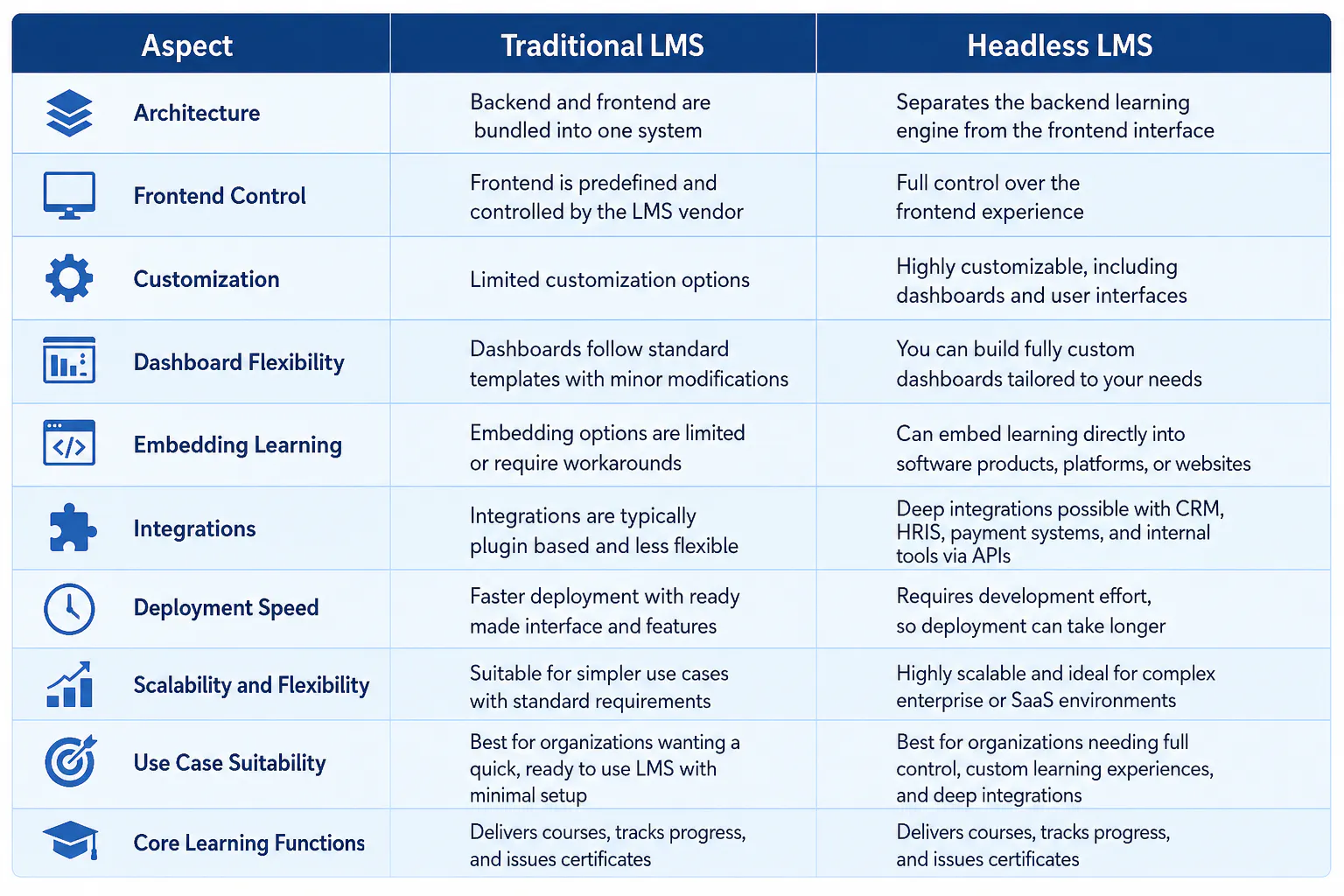
What Is the Difference Between a Traditional LMS and a Headless LMS?
A headless LMS and a traditional LMS differ in how they deliver and manage learning. The main distinction lies in control, customization, and integration: headless LMS separates backend and frontend for flexibility, while traditional LMS combines them for ready-to-use simplicity.
Architecture
- Headless LMS: Separates the backend learning engine from the frontend interface
- Traditional LMS: Backend and frontend are bundled into one system
Frontend Control
- Headless LMS: Full control over the frontend experience
- Traditional LMS: Frontend is predefined and controlled by the LMS vendor
Customization
- Headless LMS: Highly customizable, including dashboards and user interfaces
- Traditional LMS: Limited customization options
Dashboard Flexibility
- Headless LMS: You can build fully custom dashboards tailored to your needs
- Traditional LMS: Dashboards follow standard templates with minor modifications
Embedding Learning
- Headless LMS: Can embed learning directly into software products, platforms, or websites
- Traditional LMS: Embedding options are limited or require workarounds
Integrations
- Headless LMS: Deep integrations possible with CRM, HRIS, payment systems, and internal tools via APIs
- Traditional LMS: Integrations are typically plugin based and less flexible
Deployment Speed
- Headless LMS: Requires development effort, so deployment can take longer
- Traditional LMS: Faster deployment with ready made interface and features
Scalability and Flexibility
- Headless LMS: Highly scalable and ideal for complex enterprise or SaaS environments
- Traditional LMS: Suitable for simpler use cases with standard requirements
Use Case Suitability
- Headless LMS: Best for organizations needing full control, custom learning experiences, and deep integrations
- Traditional LMS: Best for organizations wanting a quick, ready to use LMS with minimal setup
Core Learning Functions
- Headless LMS: Delivers courses, tracks progress, and issues certificates
- Traditional LMS: Delivers courses, tracks progress, and issues certificates
How to Choose Between a Headless LMS and a Traditional LMS?
If you are evaluating learning platforms for your organization, the choice between a headless LMS and a traditional LMS comes down to your goals and resources.
- Headless LMS – Ideal for organizations that need full control over the learning experience, want to embed training into websites or apps, or require deep integrations with existing tools. Best for complex enterprise environments, SaaS platforms, and tech-forward businesses.
- Traditional LMS – Suitable for organizations looking for a quick, ready-to-use solution with minimal setup. Perfect for schools, training centers, or companies that prioritize ease of deployment over advanced customization.
Will a Headless LMS Replace Traditional Platforms?
Headless LMS platforms are not designed to completely replace traditional LMS systems. Instead, they complement them. Many modern platforms are moving toward hybrid architectures that combine structured LMS capabilities with API-driven flexibility. The trend is toward adaptability, allowing organizations to choose the right architecture based on their complexity, growth, and technical capacity.
Conclusion
Headless and traditional LMS platforms serve different needs, and the right choice depends on your organization’s goals, technical capacity, and scalability requirements.
A headless LMS offers flexibility, customization, and multi channel delivery, while a traditional LMS provides simplicity, faster deployment, and ease of use. As learning evolves, many organizations are moving toward hybrid approaches that combine structure with flexibility, ensuring long term adaptability and better learning experiences.

