
Key Takeaways:
- An LMS focuses on learning delivery, including courses, assessments, learner progress, and certifications, while a TMS focuses on training operations such as scheduling, instructors, resources, and attendance.
- The right choice depends on your training requirements. Choose an LMS for digital learning and learner development, or a TMS when managing complex instructor led training and administrative workflows.
- An LMS and TMS can work together to connect learning delivery with training operations, helping organizations improve learner outcomes while reducing administrative effort.

A Learning Management System (LMS) manages the learning experience, while a Training Management System (TMS) manages the operational side of training. Although both systems help organizations deliver effective training, they solve different problems.
An LMS helps teams create and deliver courses, manage assessments, personalize learning paths, and track learner progress. A TMS focuses on scheduling training sessions, managing instructors and resources, tracking attendance, and handling the logistics behind instructor led and blended programs.
Understanding the difference between an LMS and TMS is important when choosing training software. The right system depends on whether your priority is managing learning, managing training operations, or connecting both. In this guide, we break down their differences, benefits, use cases, and when your organization may need one or both.
What’s the Difference Between a Training Management System (TMS) & a Learning Management System (LMS)?
An LMS manages learning, while a TMS manages training operations.
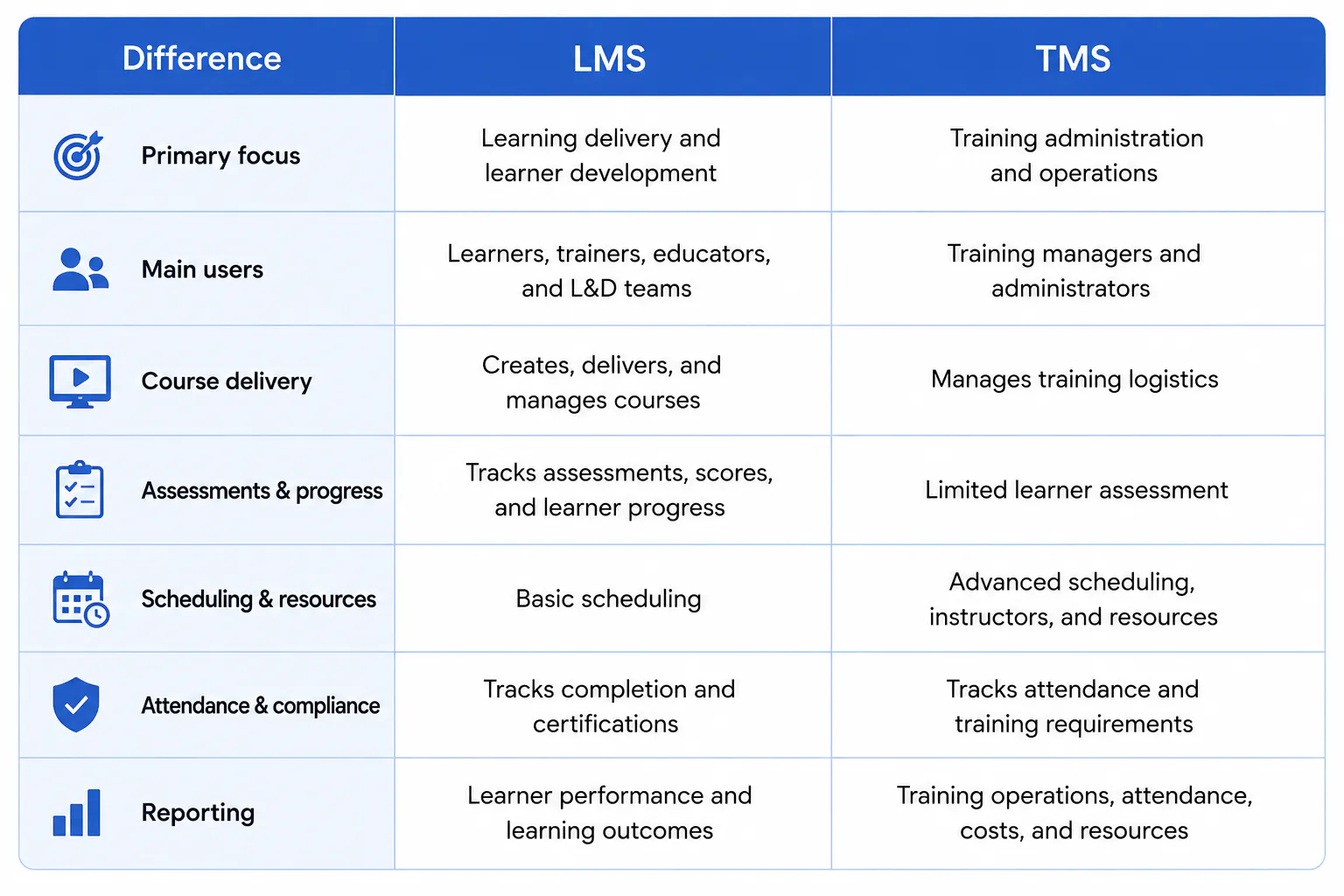
A Learning Management System helps organizations create, deliver, and track learning. It manages course content, assessments, learning paths, learner progress, and training performance from a centralized platform.
A Training Management System focuses more on the administration behind training. It helps teams schedule sessions, assign instructors, manage venues and resources, track attendance, monitor costs, and maintain compliance records.
In simple terms, an LMS answers “What should the learner learn?” while a TMS answers “How should the training be organized and delivered?”
What Is an LMS?
A Learning Management System (LMS) is a digital platform used to create, deliver, manage, and measure learning programs. Organizations, universities, schools, and training providers can use an online learning platform to centralize courses, assessments, learning resources, and learner records.
Modern LMS platforms support more than basic course delivery. They can provide personalized learning paths, interactive assessments, multimedia content, certifications, progress tracking, and learning analytics.
This makes an LMS useful for employee onboarding, compliance training, professional development, academic learning, customer education, and continuous upskilling.
Read more: What Is a Learning Management System (LMS)?
What Are the Main Benefits of an LMS?
The main benefits of an LMS are centralized learning delivery, personalized learning, assessment and evaluation, learner progress tracking, scalable training delivery, and learning analytics
- Centralized learning delivery – Keep courses, videos, documents, assessments, and other learning resources in one accessible platform.
- Personalized learning paths – Assign courses and learning activities based on a learner’s role, skills, progress, or training requirements.
- Assessment and evaluation – Create quizzes, tests, assignments, and other assessments to measure knowledge and learning outcomes.
- Learner progress tracking – Monitor course completion, assessment scores, certifications, and individual learning progress.
- Scalable training delivery – Deliver consistent training to employees, students, or customers across different locations without relying entirely on classroom sessions.
- Learning analytics – Use training data to identify knowledge gaps, monitor engagement, and understand how learning programs are performing.
Read more: 10 Essential Steps for Selecting an LMS for Your Business
What Is a TMS?
A Training Management System (TMS) is a platform designed to manage the administrative and operational side of training. Rather than focusing primarily on course delivery, a TMS helps training teams organize the people, schedules, resources, and processes required to run training programs.
A TMS can support instructor led training, classroom sessions, virtual training, workshops, seminars, and blended programs. Training managers can use it to coordinate instructors, venues, equipment, learner registrations, attendance, costs, and compliance requirements.
For organizations that manage large or frequent training programs, a training management system can reduce manual administration and give training teams greater visibility into day to day operations.
Key Benefits of a TMS
- Training scheduling – Plan sessions, dates, locations, instructors, and learner availability from a centralized system.
- Instructor management – Assign trainers to sessions, manage availability, and maintain instructor information.
- Resource management – Coordinate classrooms, equipment, training materials, and other resources required for each session.
- Enrollment and attendance tracking – Manage registrations and monitor learner attendance across different training sessions.
- Training cost management – Track expenses related to instructors, venues, materials, travel, and other training activities.
- Compliance and certification management – Monitor mandatory training, certification requirements, renewal dates, and completion status.
Read more: LMS vs ERP
LMS vs TMS: Key Differences
While an LMS and TMS can work together, their core responsibilities are different. An LMS is primarily learner focused, whereas a TMS is primarily focused on training administration and operations.
Can An LMS And TMS Work Together?
Yes. An LMS and TMS can complement each other rather than compete. An LMS can manage the learning experience while a TMS handles scheduling and operational workflows.
For example, a company could use a TMS to schedule a classroom training session, assign an instructor, and manage attendance, while the LMS delivers pre-training materials, assessments, and follow-up courses.
How To Choose Between An LMS And TMS?
Start by identifying the main training problem you need to solve. Look at your training format, number of learners, administrative workload, reporting requirements, integrations, and future scalability.
Before choosing a platform, consider:
- Training format: Is most training online, instructor-led, or blended?
- Learner volume: How many employees, students, or trainees will use it?
- Operational complexity: Do you need advanced scheduling and resource management?
- Learning requirements: Do you need assessments, learning paths, and progress tracking?
- Integrations: Does it need to connect with HR, CRM, ERP, or other systems?
- Scalability: Can the platform support your future training requirements?
Final Takeaway
An LMS manages learning, while a TMS manages the operations behind training. The right choice depends on your organization's priorities. For learning delivery, assessments, and learner progress, an LMS is the stronger fit. For scheduling, resources, instructors, and training administration, a TMS is more suitable. Organizations with broader requirements may benefit from using both together.

