
Key Takeaways
- The best LMS providers in Bangalore include Learnyst, Disprz, SeekLMS, NetSkill, Quyl and KREDO Learning.
- These platforms support different learning needs across schools, colleges, coaching institutes, online academies and corporate training teams.
- The comparison covers platform features, use cases, learner management, analytics, technology and available user feedback.

The best LMS providers in Bangalore are Learnyst, Disprz, SeekLMS, NetSkill, Quyl and KREDO learning. These platforms offer learning management solutions for different needs, from academic learning and online course delivery to employee training and corporate learning and development.
With the rise of AI-powered learning, schools, educational institutions and businesses are increasingly looking for digital learning platforms that support structured course delivery, learner engagement, assessments, progress tracking and personalised learning experiences. An LMS helps organisations bring these activities together while making learning easier to manage and monitor.
In this blog, we have analysed six LMS providers in Bangalore based on their platform capabilities, use cases and available user feedback to help you compare their offerings and identify a suitable solution.
The Short Answer: 6 Best LMS Providers in Bangalore
Bengaluru has LMS providers serving different learning requirements, from academic institutions and coaching centres to corporate training and workforce development. The following platforms offer different approaches to course delivery, learner management, performance tracking and training administration.
- Learnyst: Best for coaching institutes, online academies and educators looking to create, deliver and monetise courses through branded learning platforms.
- Disprz: Best for enterprises seeking AI-powered employee training, personalised learning paths, skills development and workforce analytics.
- SeekLMS: Best for businesses and training providers that need structured course delivery, assessments, certifications and learner progress tracking.
- NetSkill: Best for organisations looking to combine learning management, skills development and employee learning analytics.
- Quyl: Best for schools, colleges, coaching institutes and education providers that need course management, assessments, attendance tracking, fee management and academic performance insights.
- KREDO Learning: Best for educational and training organisations seeking digital learning experiences supported by course content, assessments and learner engagement tools.
How We Analysed these LMS platforms for Bengaluru?
Bengaluru has LMS providers serving different markets, including schools, colleges, coaching institutes, online education businesses and corporate training teams. We considered the practical requirements of these organisations rather than comparing platforms through feature counts alone. Our evaluation focused on five areas:
1. Bengaluru Market Presence: We considered providers with a presence in Bengaluru, including companies headquartered or operating in the city, and their relevance to its education and corporate learning market.
2. Industry and Use-Case Relevance: We assessed the specific audiences each platform serves, from academic institutions and coaching businesses to enterprise L&D and workforce training teams.
3. Core Learning Capabilities: We examined how platforms support course creation and delivery, learner management, assessments, assignments, certifications and different learning formats.
4. Learning Analytics and Performance Tracking: We looked at the ability to monitor learner progress, course completion, assessment performance, skill development and training outcomes.
5. Technology and Platform Flexibility: We considered capabilities such as AI-assisted learning, integrations, API access, customisation, mobile accessibility and scalability.
Best LMS Platforms in Bengaluru: Comparison
Bengaluru has several LMS providers serving educational institutions, training businesses and corporate teams. The following comparison highlights six platforms, their key features, the problems they address and their intended users.

Review and research note: We reviewed the providers' official websites and publicly available user feedback on 27 November 2026. Feature availability, pricing, integrations and trial access may vary by plan.
Note: These platforms serve different learning requirements. Some focus on academic learning and course delivery, while others specialise in corporate training and workforce development. Compare them based on your organisation's learning objectives and implementation needs.
1. Learnyst: LMS for Online Course Businesses and Coaching Institutes

Learnyst is a Bengaluru-based learning management platform designed for coaching institutes, educators and online academies. It combines course creation, live classes, assessments, content protection and course-commerce tools to help education businesses deliver and monetise online learning programmes.
Why We Picked Learnyst
Learnyst has a verified Bengaluru address and a strong focus on online education businesses. Against our evaluation criteria, its course delivery, assessment tools, branded learning environments and marketing capabilities make it relevant to coaching institutes and educators looking to operate their own digital learning businesses.
Key Features
- Course Creation and Delivery: Create courses, live classes, batches and learning programmes.
- Assessments: Build mock tests, quizzes and test series.
- Content Protection: Protect paid learning content through DRM.
- Branded Learning Experience: Offer custom domains and branded mobile applications.
- Marketing Tools: Manage email, WhatsApp and push notifications, campaigns and referrals.
Pros
- Helpful customer support that responds quickly and guides users through issue resolution.
- Responsive assistance that ensures a smoother experience and minimises operational disruptions.
- Easy-to-use platform that simplifies course management and allows creators to focus on delivering content.
- Customisation options that help organisations adapt the learning experience to their requirements.
Cons
- User management limitations, with restricted customisation and usability issues affecting the overall experience.
- Administrative challenges, including limited customisation and restrictions on simultaneous access by multiple admins.
- Inconsistent data reporting that affects analysis and requires better alignment with student numbers.
- Non-intuitive interface that makes platform navigation difficult for both administrators and students.
Pricing
Learnyst offers publicly listed subscription plans. Its Indian pricing includes Essential at ₹3,499/month, Professional at ₹8,999/month, Premium at ₹14,999/month and Plus at ₹49,999/month. A free trial is also available. Enterprise requirements can be discussed separately.
- Best for: Coaching institutes, online academies, independent educators and businesses selling digital courses.
- Free trial: 14 days.
Read more: Best LMS with Payment Gateway Integration
2. Disprz: AI-Powered LMS for Enterprise Learning

Disprz is an AI-powered learning and skilling platform designed primarily for enterprise workforce development. It combines learning management, personalised learning experiences, skills intelligence and analytics to help organisations deliver employee training and monitor workforce development.
Why We Picked Disprz
Disprz addresses enterprise learning requirements through its focus on skills development, personalised learning and workforce performance. Its corporate and technology headquarters are in Chennai, while its listed India regional headquarters is in Mumbai. Although a Bengaluru office was not verified, its relevance to Bengaluru's IT, BFSI, retail and enterprise L&D market made it relevant to this comparison.
Key Features
- Learning Management: Deliver and manage structured employee training.
- AI-Powered Learning: Provide personalised learning recommendations and experiences.
- Skills Intelligence: Identify skill gaps and support role-based development.
- Blended Learning: Support instructor-led, virtual, microlearning and on-the-job training.
- Learning Analytics: Track training progress, certifications and learning outcomes.
Pros:
- User-friendly interface that allows employees to get started with minimal training.
- Extensive e-learning content that supports personalised and engaging learning experiences.
- Interactive learning modules and quizzes that reinforce training and certification outcomes.
- Content-sharing features that encourage collaboration and knowledge exchange.
- Certification options that recognise employee learning achievements and add value to training programmes.
Cons:
- Navigation challenges caused by a cluttered content library and frequent feedback pop-ups.
- High pricing that raises concerns about overall value despite its extensive feature set.
- Limited search functionality that makes finding relevant courses and videos difficult.
- Complex integrations that require additional time and effort to configure and manage.
Pricing
Disprz's Essentials Learning plan starts at $2 per learner/month. Its Enterprise Learning + Skills offering uses custom pricing based on learner volume, selected capabilities, integrations and deployment requirements.
- Best for: Mid-sized and large enterprises, HR teams and corporate L&D departments.
- Free trial: Contact Disprz for a product demonstration and pricing details.
Read more: Best LMS for Blended Learning
3. SeekLMS: Cloud-Based LMS for Corporate Training and Online Academies

SeekLMS is a cloud-based learning management system that helps organisations create courses, manage training programmes and monitor learner progress. It supports self-paced, instructor-led and blended learning, with tools for course authoring, assessments, certifications and training administration.
Why We Picked SeekLMS
SeekLMS is relevant to both corporate training teams and businesses that deliver courses through online academies. Its platform capabilities cover several of our evaluation areas, including course authoring, learner management, assessment delivery, reporting and payment management. Its Bengaluru presence also makes it relevant to the local LMS provider landscape.
Key Features
- Course Authoring: Create courses using videos, presentations, audio and other learning materials.
- Learning Delivery: Manage self-paced, instructor-led and blended programmes.
- Assessments and Certifications: Create tests, evaluate learners and issue certificates.
- Learner Analytics: Monitor course completion, assessment results and learner activity.
- Enterprise Management: Support role-based access, SSO, custom branding and integrations.
Pros:
- User-friendly interface that makes course navigation and learning management straightforward.
- Comprehensive course management capabilities that support content creation, publishing and learner management.
- Flexible learning tools, including assessments, recorded sessions and contests, that support different teaching formats.
- Responsive customer support and account management that help resolve issues promptly.
- White-label capabilities that allow institutions to maintain their own brand identity.
Cons:
- Interface design that could be improved to make navigation more intuitive.
- Additional costs for white-label applications and payment gateway integrations.
- Limited external application integrations that can restrict connectivity with third-party tools.
- Payment gateway configuration that may require additional effort.
Pricing
SeekLMS offers Starter, Professional and Enterprise plans. Pricing depends on the selected plan and learner volume, with customised quotes available. The platform does not publish fixed subscription prices on its pricing page.
- Best for: Corporate training teams, training providers and organisations managing structured learning programmes.
- Free trial: A two-week free trial is available.
Read more: Cloud LMS vs On-Premise LMS
4. NetSkill: Enterprise LMS and Learning Experience Platform

NetSkill is a Bengaluru-headquartered learning technology provider offering an enterprise learning ecosystem that combines LMS, LXP, frontline training and corporate training capabilities. Its platform focuses on employee learning, workforce upskilling and training delivery across organisations of different sizes.
Why We Picked NetSkill
NetSkill's Bengaluru headquarters and enterprise learning focus make it relevant to the city's corporate training market. We considered its AI-assisted content creation, employee skills development, mobile learning and analytics capabilities against our evaluation criteria, particularly for organisations managing distributed and frontline workforces.
Key Features
- AI Course Creation: Genesis AI converts existing documents and presentations into learning content.
- Learning Management: Organise and track employee training programmes.
- Skills Development: Identify skill gaps and support personalised learning paths.
- Assessments and Certifications: Conduct evaluations and issue digital certificates.
- Mobile and Offline Learning: Support learning access for distributed and frontline employees.
- AI Roleplay: Let employees practise workplace scenarios and receive feedback.
Pricing
NetSkill does not publish standard LMS subscription prices on its official website. Organisations need to contact its sales team for a customised quote based on learner volume, platform requirements and deployment scope.
- Best for: Enterprises, corporate L&D teams and businesses with frontline or distributed workforces.
- Free trial: Contact NetSkill for a product demonstration.
5. Quyl: Configurable LMS for Education and Corporate Training
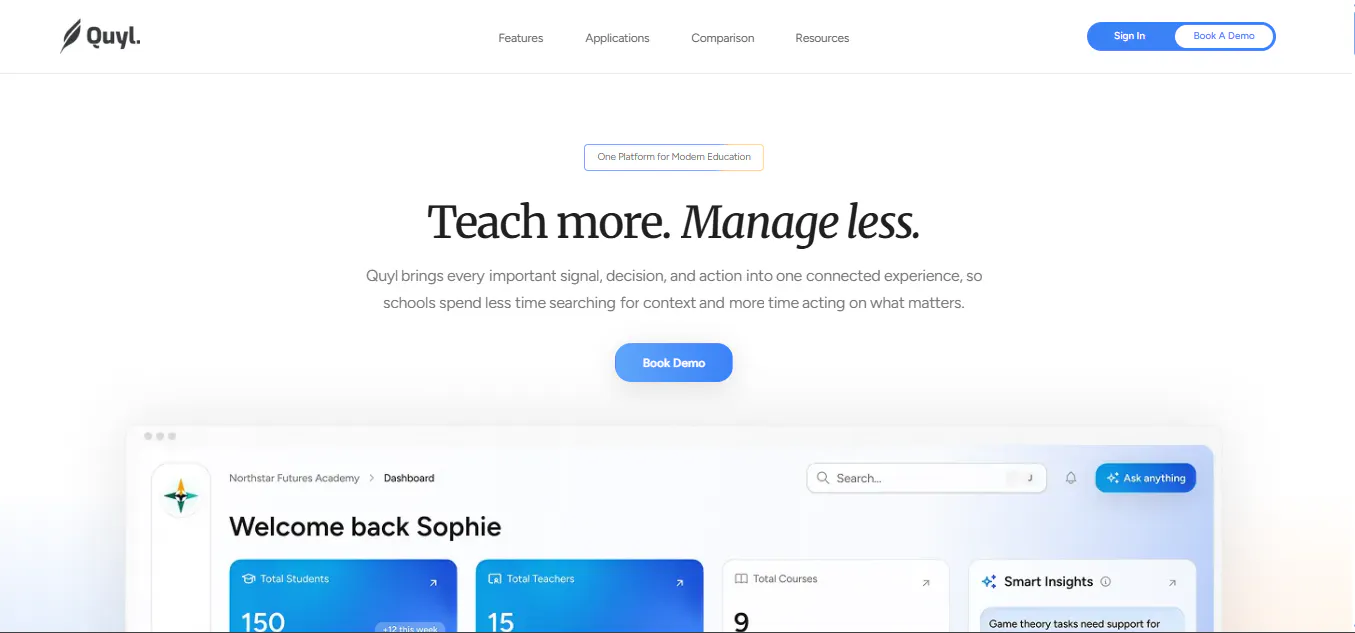
Quyl is a configurable learning management platform designed for educational institutions, coaching businesses, training centres and corporate learning teams. It brings course management, assessments, learner administration, attendance, payments and performance insights into one platform. It supports self-paced, live and blended learning environments.
Why We Picked Quyl
Quyl's coverage across academic learning and organisational training makes it relevant to multiple segments of Bengaluru's LMS market. We assessed its course and curriculum management, assignments, assessments, learner administration, attendance, fee management, Smart Insights and reporting against our evaluation criteria. Its customisation and API capabilities also support different institutional and business workflows, extending its use beyond conventional school LMS requirements.
Key Features
- Course and Curriculum Management: Organise courses, learning materials and curriculum activities.
- Assignments and Assessments: Create assignments and quizzes, evaluate submissions and manage grading.
- Learner Management: Manage students, employees, cohorts and staff roles.
- Attendance and Scheduling: Track attendance and organise learning sessions.
- Fee and Payment Management: Manage payments through Razorpay and manual bank or QR payment options.
- Smart Insights and Reporting: Monitor learner performance, assessment results and learning trends.
- Quyl Assistant: Access read-only assistance across relevant learning and organisational data.
- Customisation and APIs: Configure platform experiences and support organisation-specific workflows.
Pricing
Quyl does not currently publish standard subscription prices on its website. Organisations can contact the team to discuss their requirements, platform configuration and pricing through a product demo.
- Best for: Schools, colleges, coaching institutes, tutoring businesses, training centres, corporate training teams and EdTech providers.
- Free trial: Contact Quyl for a product demonstration.
6. KREDO Learning: LMS for Workforce Training and Development

KREDO is a workforce learning platform developed by Tesseract Learning, a Bengaluru-based learning technology and content solutions company. It supports corporate training through course authoring, virtual instructor-led training, assessments, gamification and learning analytics. Its industry coverage includes BFSI, healthcare, hospitality, IT, manufacturing, retail and automotive.
Why We Picked KREDO Learning
KREDO's Bengaluru presence and focus on workforce learning make it relevant to the city's corporate training market. We assessed its course authoring, AI-assisted content development, virtual training, assessments and reporting capabilities against the needs of organisations delivering structured employee learning across different industries.
Key Features
- AI Course Authoring: Create and translate learning content using AI-assisted tools.
- Content Management: Organise documents, videos, audio and SCORM learning materials.
- Virtual Training: Support virtual instructor-led training and meeting integrations.
- Assessments: Create tests, evaluations and skill-linked assessments.
- Gamification: Use leaderboards, badges, points and rewards.
- Learning Analytics: Monitor course activity, learner progress and learning paths.
- Multilingual Learning: Support learners through multiple language options.
Pros:
- Intuitive interface that makes the platform easy to use for administrators and learners.
- AI-powered course creation that simplifies content development and training delivery.
- Structured learning paths and microlearning modules that support knowledge retention.
- Gamification features that encourage learner participation and improve engagement.
- Responsive customer support that assists with implementation and platform usage.
Cons:
- Limited customisation options that restrict the ability to tailor certain learning experiences.
- Occasional performance issues and slow loading times, particularly when accessing SCORM courses.
- Reporting limitations that affect the flexibility of learning analytics.
- Limited offline access and downloadable content options that can restrict learning without an internet connection.
Pricing
KREDO does not publish fixed subscription prices on its official website. Organisations can request a customised quote based on their learner volume, required features and implementation needs.
- Best for: Enterprises, corporate training teams and organisations looking for structured employee learning and development.
- Free trial: Contact KREDO for a product demonstration.
Read more: 7 Best Learning Analytics Tools to Track Learner Progress
How Much Does an LMS Cost in Bengaluru?
The cost of an LMS in Bengaluru depends on the organisation's requirements, number of learners, features, integrations and level of customisation. Some platforms offer predefined subscription plans, while others provide customised pricing based on the organisation's learning needs and deployment scope.
Generally, LMS pricing is influenced by:
- Number of Learners: The total number of students, employees or other users accessing the platform.
- Required Features: Course management, assessments, certifications, attendance, analytics and other learning capabilities.
- Customisation: Custom branding, workflows, dashboards, roles and platform configurations.
- Integrations: Connections with existing HR systems, student information systems, payment gateways and other applications.
- Implementation and Support: Setup, onboarding, data migration, training and ongoing technical support.
Before selecting a platform, request a customised quotation based on your expected learner count and essential requirements. Check what is included in the pricing, whether additional features incur extra charges and how the cost may change as your organisation grows.
Rather than comparing subscription fees alone, evaluate the total cost against the features, flexibility, support and long-term learning requirements your organisation needs.
How to Choose the Right LMS Platform in Bengaluru?
To choose the right LMS in Bengaluru, start by identifying your organisation's learning requirements and evaluating how well each platform supports them. Consider these factors before making a decision:
- Identify Your Learning Requirements: Determine whether you need an LMS for schools, colleges, coaching institutes, online courses, employee onboarding or corporate training.
- Check Essential Features: Evaluate course management, assignments, assessments, certifications, learner management and progress tracking. Consider support for self-paced, instructor-led and blended learning if required.
- Evaluate Reporting and Analytics: Check whether the platform tracks learner participation, course completion, assessment performance and learning progress. Corporate teams may also require skill and compliance tracking.
- Review Integrations and Customisation: Look for compatibility with your existing systems, API access, role-based permissions, custom branding and configurable workflows.
- Consider Learner Experience: Test the platform on desktop and mobile devices. Check ease of use, mobile accessibility and offline learning support where necessary.
- Compare Overall Costs: Consider implementation, data migration, integrations, content development, support and renewal costs alongside subscription pricing. Request a quotation based on your learner count and requirements.
- Request a Demo: Ask providers to demonstrate everyday workflows, including learner enrolment, course assignments, assessments and reporting. Involve administrators, instructors and learners in the evaluation.
Conclusion
The six LMS providers in this comparison address different requirements across Bengaluru's education, training and corporate sectors. Their capabilities range from online course delivery and academic management to enterprise learning and workforce development.
To choose the right platform, compare its features, flexibility, reporting capabilities, integrations, support and overall cost against your organisation's needs. Request demos and evaluate the same practical workflows across your shortlisted platforms. This will help you select an LMS that supports your current learning requirements and future growth.
