
Key Takeaways
- An LMS focuses on teaching and learning, including courses, content, assignments, assessments, grading, and student progress, while an SMS manages school administration and operations.
- LMS and SMS platforms have different core features, with LMS tools supporting academic workflows and SMS tools handling records, attendance, admissions, fees, timetables, and communication.
- Schools should choose based on their specific academic and administrative requirements, considering factors such as usability, scalability, integrations, reporting, support, and cost.

An LMS and an SMS serve different purposes within a school. A School Learning Management System (LMS) focuses on teaching and learning, helping teachers create courses, deliver learning content, manage assignments and assessments, and track student progress. A School Management System (SMS) focuses on school administration, including student records, attendance, admissions, fees, timetables, and parent communication.
The main difference is simple: an LMS manages the learning experience, while an SMS manages the school’s administrative operations. While there can be some overlap between the two, they are designed to solve different problems.
In this blog, we’ll explain the key differences between an LMS and an SMS, compare their features and use cases, and help you understand which system your school needs.
What is the Difference Between An SMS And An LMS?
The main difference is their purpose. An LMS manages teaching and learning activities, while an SMS (School Management System) manages the administrative and operational side of a school.
- LMS: Manages courses, learning content, assignments, assessments, grading, student progress, and learning analytics.
- SMS: Manages student records, admissions, attendance, fees, timetables, staff information, and parent communication.
What is an LMS?
A Learning Management System (LMS) is a platform schools use to manage teaching and learning activities in one place. It helps teachers organize courses, share learning content, create assessments, grade students, and track academic progress.
Benefits of an LMS
- Centralized learning: Keeps courses, content, assignments, and assessments in one place.
- Better student tracking: Helps teachers monitor progress, performance, and engagement.
- Simpler assessment: Supports quizzes, assignments, grading, and feedback.
- Improved teaching efficiency: Reduces repetitive work through tools such as automated grading and reporting.
- Learning insights: Gives teachers and administrators data to understand student performance.
- Consistent course delivery: Helps schools organize and standardize learning content across classes.
Read more: What Is a Learning Management System (LMS)?
What is an SMS?
A School Management System (SMS) is a platform designed to manage a school’s administrative and operational activities. It centralizes information such as student records, attendance, admissions, fees, timetables, staff details, and parent communication.
Benefits of an SMS
- Centralized student information: Keeps important student records organized.
- Simpler administration: Reduces manual work across everyday school processes.
- Efficient attendance management: Helps schools record and monitor attendance.
- Streamlined fee management: Supports fee collection, payment tracking, and financial records.
- Better communication: Helps schools share information with parents, teachers, and students.
- Improved reporting: Gives administrators access to operational and student data for decision making.
Read more: What Is the Difference Between an SIS and an LMS?
LMS Vs SMS: Key Differences
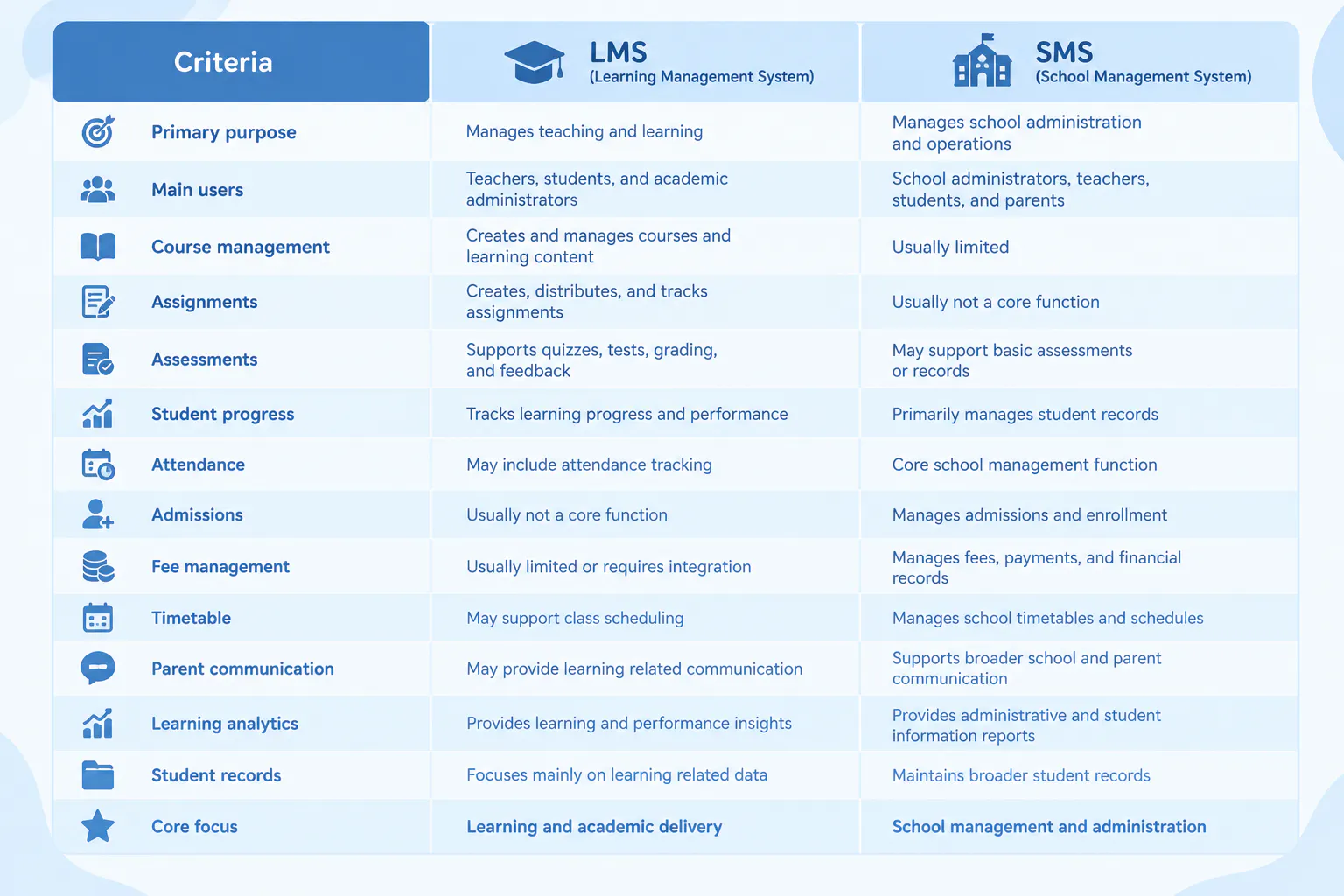
While both systems support school operations, they are built around different priorities. The table below compares an LMS and SMS across their core features, users, and functions to highlight where each system fits within a school.
Read more: LMS vs ERP: Which System Do Schools Need?
Which One Should Your School Choose?
The choice between an LMS and an SMS should be based on the specific requirements of your school. Neither system is automatically better than the other because they solve different problems.
- For academic management: An school LMS is the better choice when the priority is course management, learning content, assignments, assessments, grading, and student progress.
- For school administration: An SMS is more suitable when the priority is admissions, student records, attendance, fees, timetables, and parent communication.
- For schools with broader requirements: Look for a platform that covers the specific academic and administrative workflows your school needs rather than choosing based only on the number of features.
- For ease of implementation: Consider how easily teachers, administrators, students, and parents can adopt the system.
- For long term use: Evaluate scalability, integrations, reporting, customization, support, and overall cost before making a decision.
Read more: How to Choose the Right LMS for Your School
Conclusion
An LMS and an SMS address different areas of school management. An LMS supports the academic side of education by organizing courses, learning content, assessments, grading, and student progress, while an SMS supports administrative workflows such as admissions, attendance, fees, records, and parent communication.
For schools evaluating these systems, the key is to identify which workflows need stronger support and assess factors such as usability, scalability, integrations, reporting, support, and cost. In some cases, schools may need both systems or a platform that brings relevant academic and administrative functions together.

