
Key Takeaways
- Active learning is a teaching approach where students actively participate by discussing, solving problems, completing activities, and applying concepts rather than only listening to lectures.
- Active learning strategies such as role play, problem-based learning, flipped classrooms, peer teaching, debates, quizzes, and case studies can improve participation, critical thinking, collaboration, and understanding.
- Teachers can implement active learning by setting clear objectives, choosing suitable activities, encouraging participation, using technology, assessing understanding, and continuously improving their approach.

Active learning is a teaching approach where students participate directly in the learning process by discussing ideas, solving problems, answering questions, completing activities, and applying what they learn. Unlike passive learning, where students mainly listen to lectures or consume course content, active learning requires students to think and respond during the learning process.
Research shows a clear difference between the two approaches. A major meta-analysis of 225 STEM studies found that students in traditional lecture-based classes were 55% more likely to fail than students in active learning classes. Engageli's Active Learning Impact Study also reported 54% higher test scores in active learning sessions compared with passive, lecture-style learning.
In this blog, you will learn how active learning works, its benefits and challenges, the strategies teachers can use, assessment methods, how it aligns with NEP 2020, and how schools can implement it effectively.
What Is Active Learning?
Active learning is a teaching approach where students participate directly in learning activities instead of only listening to lectures or reading course materials. Students learn by asking questions, discussing ideas, solving problems, completing tasks, and applying concepts. Teachers guide the process, provide feedback, and assess how well students understand the subject.
Read more: 6 Government Policies Shaping EdTech in India
What Are the Key Components of Active Learning?
Active learning is built around three key components that help students move from understanding information to using it effectively.
Learning
Students gain new knowledge and understand concepts through lessons, discussions, reading, demonstrations, and other learning activities.
Reflection
Students think about what they have learned, evaluate their understanding, and consider how the information connects with what they already know.
Application
Students use their knowledge in practical tasks, problem solving, projects, discussions, or real world situations to demonstrate their understanding.
What Are the Benefits of Active Learning?
Active learning encourages students to participate, think, and apply concepts during the learning process. Active learning can improve both their understanding of subjects and their ability to use knowledge in practical situations.
- Improves Understanding: Students work with concepts through activities and problem-solving instead of only receiving information.
- Supports Better Retention: Applying and discussing information can help students remember concepts for longer.
- Develops Critical Thinking: Students analyze information, evaluate ideas, and work toward solutions.
- Encourages Participation: Interactive activities give students more opportunities to ask questions and contribute.
- Builds Problem-Solving Skills: Students practice applying knowledge to questions, tasks, and real situations.
- Strengthens Collaboration: Group activities and discussions help students communicate and work with others.
- Provides Regular Feedback: Teachers can identify misunderstandings during activities and provide support before they become larger learning gaps.
Read more: How Teachers Can Use AI to Identify Learning Gaps and Reduce Dropouts?
What Are the Active Learning Strategies?
Active learning strategies encourage students to participate, discuss ideas, solve problems, and apply what they learn. The following 10 strategies can be used across different subjects and learning environments.
1. Role Play
Students act out real or simulated situations to understand different perspectives and practice communication and decision-making.
2. Problem-Based Learning
Students work on a specific problem and apply their knowledge to develop solutions.
3. Three-Step Interviews
Students take turns as the interviewer, interviewee, and observer to practice questioning, listening, and communication skills.
4. Flipped Classroom
Flipped classroom allows students to review learning materials before class, while classroom time focuses on discussions, activities, and problem solving.
5. Peer Teaching
Students explain concepts to classmates, helping them strengthen their own understanding while supporting peer learning.
6. Debates and Discussions
Students discuss different viewpoints, present arguments, and respond to other perspectives, developing communication and critical thinking skills.
7. Pause Procedure
Teachers pause during a lesson and give students time to review notes, discuss key points, ask questions, or reflect on what they have learned.
8. Interactive Quizzes and Polls
Quizzes and polls encourage students to respond during lessons while helping teachers check understanding and identify areas that need attention.
9. Muddiest Point
Students identify the part of a lesson they found most difficult to understand. Teachers can use the responses to address specific learning gaps.
10. Case Studies
Students analyze realistic situations and apply their knowledge to evaluate problems, consider different options, and develop solutions.
Read more: 10 Modern Learning Methods Transforming K-12 Education
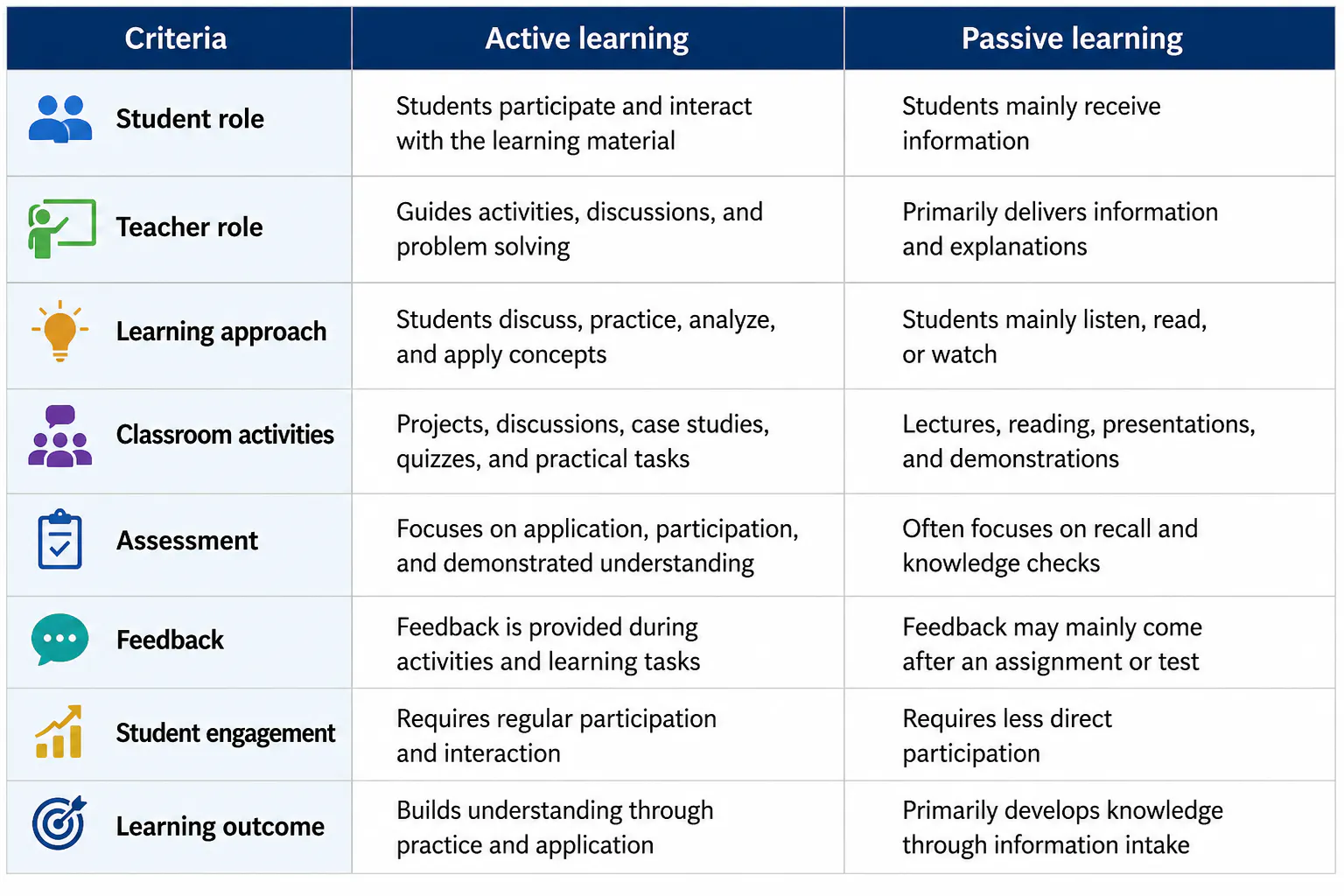
What Is the Difference Between Active Learning and Passive Learning?
Active and passive learning differ mainly in how students participate, process information, and demonstrate their understanding.
How Can Teachers Implement Active Learning in the Classroom?
Active learning works best when classroom activities connect directly with learning objectives and give students meaningful opportunities to participate. Teachers can introduce different strategies based on student needs, subject requirements, available resources, and classroom size.
Step 1: Understand Student Needs
Start by considering students' existing knowledge, learning levels, interests, and areas where they need support.
Step 2: Set Clear Learning Objectives
Define what students should understand or be able to do by the end of the activity. Every discussion, project, problem, or practical task should support a specific learning objective.
Step 3: Choose the Right Activity
Select an active learning strategy that fits the lesson. A case study can support problem solving, while debates can help students examine different viewpoints. Give students clear instructions, roles, timelines, and expected outcomes.
Step 4: Encourage Participation
Give students regular opportunities to ask questions, discuss ideas, work in groups, solve problems, and present their work. Teachers should guide the activity while allowing students to take an active role.
Step 5: Use Technology Where It Adds Value
Digital tools can make active learning easier to conduct in both physical and virtual classrooms. Interactive quizzes, School LMS, live polls, collaborative documents, digital whiteboards, discussion platforms, and online simulations can help students participate and apply concepts during lessons.
Step 6: Assess Student Understanding
Use quizzes, assignments, projects, observations, presentations, and practical tasks to evaluate learning. Assessment should show whether students can understand and apply the concepts covered in the activity.
Step 7: Review and Improve
Review student performance and feedback after each activity. Teachers can use this information to identify learning gaps, adjust future activities, and choose strategies that work better for different students and subjects.
What Are the Challenges of Active Learning?
Active learning can improve student participation and understanding, but teachers may face some practical challenges when using these methods regularly.
- Large Class Sizes: Group activities and discussions can be harder to manage when there are many students.
- Resource Requirements: Some activities need technology, materials, or additional classroom resources.
- Time Constraints: Activities such as discussions, projects, and problem solving can take more time than traditional lectures.
- Student Resistance: Students who are used to passive learning may initially be reluctant to participate.
- Subject Limitations: Some topics may require more direct instruction before students can apply active learning activities.
- Unequal Participation: Some students may contribute more than others during group activities.
Conclusion
Active learning shifts education from simply delivering information to actively involving students in the learning process. By using strategies such as discussions, problem-solving, peer teaching, case studies, role play, and interactive activities, teachers can create more engaging and practical learning experiences.
While active learning may require additional planning, classroom management, and resources, its focus on participation, application, collaboration, and feedback can help students develop deeper understanding and essential skills. With the right approach and appropriate digital tools, schools can make active learning a consistent part of everyday teaching.

